Towing a caravan in Great Britain: licences, weights and rules
What your licence lets you tow in Great Britain, how to read the car and caravan weight plates, a worked outfit check, and the speed and width limits for towing.
Sources checked - 8 October 2026
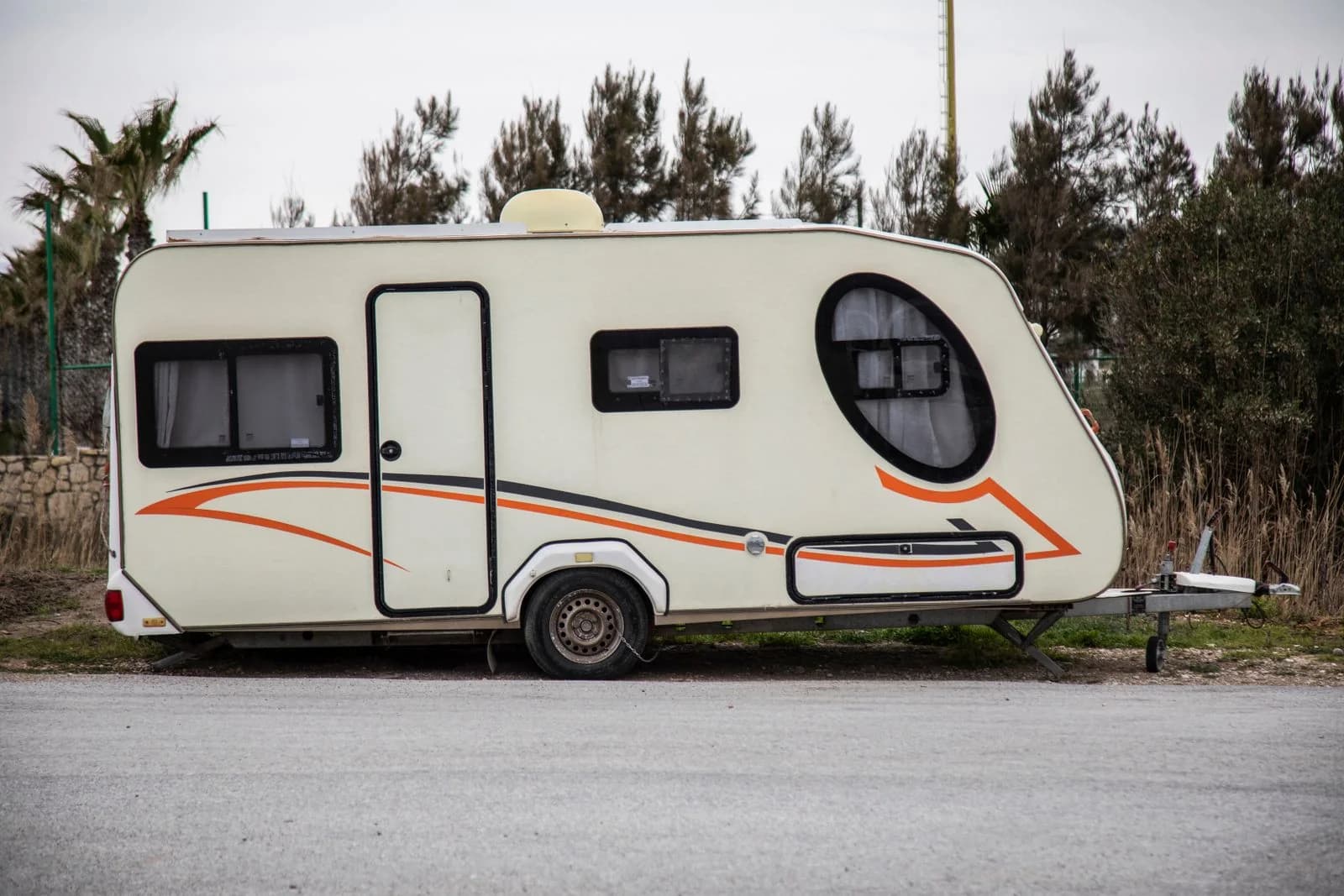
In this article
Before towing a caravan on the roads of England, Scotland or Wales, two separate checks have to pass. Is the driver licensed for this combination? And does the loaded car and caravan stay inside every weight limit set by the manufacturers? Passing one tells you nothing about the other. Once both are settled, a handful of British road rules, from lower speed limits to mirror requirements, complete the picture.
What your licence lets you tow
Licence entitlement is based on maximum authorised mass (MAM): the maximum a vehicle or trailer is allowed to weigh when fully loaded, printed in the handbook and normally on a plate or sticker on the vehicle (GOV.UK). It is a fixed rating, not what your outfit weighs today, so unloading luggage does not change it.
For a GB licence:
| When you passed your car test | What you can tow |
|---|---|
| From 1 January 1997 | A trailer up to 3,500 kg MAM (category BE) |
| Before 1 January 1997 | Usually a vehicle and trailer with a combined MAM up to 8,250 kg; check your licence record |
| Heavier combinations | Need category C1E, for combinations up to 12,000 kg MAM |
Source: GOV.UK, what you can tow.
Visitors drive on the categories of their own licence. EU licences use the common European categories; the Bulgarian Road Traffic Act sets them out clearly (Article 150a):
- Category B covers a trailer up to 750 kg MAM, or a heavier trailer as long as the car and trailer together do not exceed 3,500 kg MAM.
- Code 96 on a B licence, which needs extra training and a test, extends the combination to 4,250 kg MAM.
- Category BE covers a trailer up to 3,500 kg MAM behind a category B car.
For the details of driving in Great Britain on a foreign licence, use the official GOV.UK checker.
The weights that matter
| Figure | Where you find it | What it limits |
|---|---|---|
| Caravan MAM (often called MTPLM) | Caravan plate and handbook | The most the loaded caravan may weigh |
| Car MAM (gross vehicle weight) | Car's VIN plate | The most the loaded car may weigh |
| Axle limits | Car's VIN plate | Load on each axle |
| Gross train weight | Car's VIN plate | Fully loaded car plus fully loaded trailer, together |
| Towing limit | Car handbook or specification sheet | The heaviest trailer the car maker approves |
| Noseweight limit | Towbar and caravan documentation | Downward load on the tow ball |
Gross train weight must not be exceeded, and if your VIN plate does not list one, the car should not be used for towing. The VIN plate is normally under the bonnet or inside the driver's door (GOV.UK weight limits).
On top of the legal and technical limits, the Caravan and Motorhome Club gives two widely used stability guidelines: keep the caravan's actual laden weight to around 85 percent of the car's kerb weight (or the car's towing limit, if lower), especially if you are new to towing, and aim for a noseweight of about 5 to 7 percent of the caravan's actual laden weight, typically 50 to 90 kg (Caravan Club advice). These are recommendations, not law.
A worked outfit check
Take an illustrative outfit. The figures are examples to show the method, not a real car:
- Car: kerb weight 1,600 kg, MAM 2,150 kg, gross train weight 3,950 kg, towing limit 1,800 kg.
- Caravan: MAM 1,400 kg.
- Weighed on the way out, loaded for the trip: car 2,050 kg, caravan 1,350 kg.
| Check | Calculation | Result |
|---|---|---|
| GB licence after 1997 | Caravan MAM 1,400 kg against 3,500 kg | Covered |
| EU category B only | Combined MAM 2,150 + 1,400 = 3,550 kg against 3,500 kg | Not covered; needs code 96 or BE |
| Gross train weight | 2,050 + 1,350 = 3,400 kg against 3,950 kg | Within |
| Towing limit | 1,350 kg against 1,800 kg | Within |
| 85 percent guideline | 85% of 1,600 = 1,360 kg against 1,350 kg | Just within |
| Noseweight | 5 to 7% of 1,350 = about 68 to 95 kg | Set it within this range and the towbar's own limit |
Two points stand out. The licence check uses plated MAMs, so a driver with only an EU category B licence is short by 50 kg even though the outfit actually weighs 3,400 kg. And the weight checks use actual loaded weights, including passengers, water, gas bottles and bikes, which is why a public weighbridge visit before a long trip is worthwhile.
On the road in Great Britain
- Speed limits for a car towing a caravan are 50 mph (80 km/h) on single carriageways and 60 mph (96 km/h) on dual carriageways and motorways. In built-up areas the limit is 30 mph in England and Scotland and usually 20 mph in Wales (GOV.UK speed limits).
- Motorway lanes: you must not use the right-hand lane of a motorway with three or more lanes (DVSA).
- Size: a trailer may be no wider than 2.55 m, and behind a vehicle of up to 3,500 kg MAM no longer than 7 m (GOV.UK).
- Mirrors: the law requires an adequate view down both sides of the outfit, which in practice means towing mirrors for almost every caravan (Caravan Club).
Checks before every trip
DVSA's list is short and worth doing each time (safety checks): tyres with at least 1.6 mm of tread across the central three-quarters, all lights working, the coupling at the right height and correctly fitted, a breakaway cable or secondary coupling attached, and the load spread evenly and secured without exceeding any limit. Follow the towbar and coupling makers' instructions as well. GOV.UK pages were checked on 8 October 2026.
Sources & further reading
- Towing with a car: what you can tow - GOV.UK / DVLA
- Towing weight and width limits - GOV.UK
- Tow a trailer or caravan with a car: safety checks - Driver and Vehicle Standards Agency
- Speed limits - GOV.UK
- Driving in Great Britain on a non-GB licence - GOV.UK / DVLA
- Road Traffic Act, Article 150a (Bulgarian licence categories) - Republic of Bulgaria / Lex.bg
- Top questions about caravans - The Caravan and Motorhome Club
Tags
- caravan
- towing
- driving licence
- Great Britain
- trip planning