Free tenting in Denmark: forest camping and shelter nights
How Denmark's free tenting works in 275 state forests, the 1-2-3 rule, primitive campsites and shelters, with examples at Fussingø, Højbjerg and Ørnbjerg Mølle.
Sources checked - 8 October 2026
In this article
Denmark does not have a general right to wild camp anywhere, but it has something almost as good: the state has opened more than 275 of its forests to fri teltning, free tenting for a night without asking anyone first (Danish Nature Agency). Alongside it runs a network of primitive campsites, many with simple open shelters. All of these overnight options are free. The choice is between the freedom of a tent under the trees and the roof, water and toilet of a shelter site.
Four ways to sleep out
| Option | What it allows | Good for |
|---|---|---|
| Sleeping on the forest floor | A mat and sleeping bag, a blanket, a tarp or a hammock, but no tent | Minimalists |
| Free tenting (fri teltning) | One night in a small tent in a designated state forest | Walkers and cyclists carrying their own gear |
| Small primitive campsites | Up to two nights, up to eight tents, often with water and a simple toilet, some with shelters | Families and small groups |
| Large primitive campsites | Shelters for groups of 15 or more, such as scouts or school classes; booking gives priority | Groups |
Source: Danish Nature Agency, sleeping outside. A tarp used on the forest floor must not be rigged as a tent, and you must not damage trees or plants. The agency's detailed information on primitive campsites is in Danish, and campsites are listed and booked through udinaturen.dk and booking.naturstyrelsen.dk.
The 1-2-3 rule for free tenting
Free tenting comes with a short, memorable rule (fri teltning rules):
- 1 night in the same place.
- 2 tents at most.
- 3 people is the maximum capacity of each tent.
Tent capacity counts, not how many people sleep in it. Two walkers in one three-person tent are fine; the same two in a four-person tent are not. A group that needs three tents should book a primitive campsite instead.
Where you pitch matters too. The tent must stand under trees, out of sight of buildings and of roads used by cars, and must not disturb other forest users. A beach, open meadow or clearing inside a designated forest does not qualify. Motor vehicles are not allowed in state forests and nature areas, so plan to walk or cycle in from a car park or bus stop. Open fires are only allowed at designated fire sites; elsewhere cook on an enclosed stove such as a Trangia. At those fire sites you may gather dry branches and twigs from the forest floor, but never cut trees. Take all rubbish home (sleeping outside).
Free tenting areas are marked on the Nature Agency's map and on udinaturen.dk. Check the specific forest before you go: the scheme covers designated state forests, not every wood you pass.
Fussingø: a tent in an old beech forest
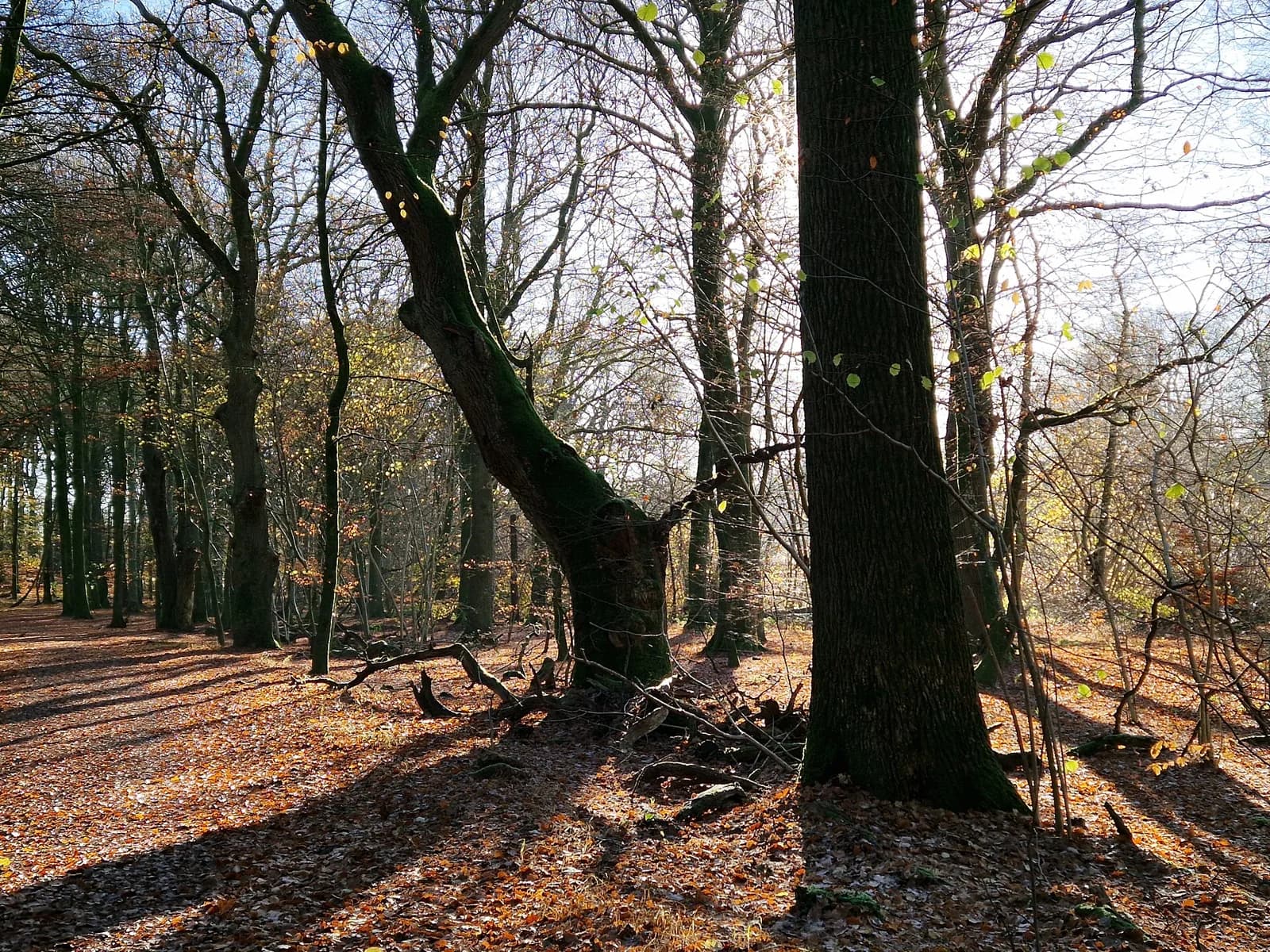
Naturnationalpark Fussingø, near Randers in central Jutland, shows Danish forest camping at its most atmospheric. Its beech woods, in places several hundred years old, have been left without timber harvesting since 1992. The lake is about 3 km long and up to nearly 30 m deep, the park holds around 70 burial mounds probably from the Bronze Age, and red deer and cattle graze it to help restore natural dynamics (Nature Agency guide to Fussingø).
For an overnight stay, the park has several designated free-tenting areas and two primitive campsites with shelters. Open fire is not allowed in the free-tenting areas; there are fire pits at the camping sites and the bathing beach. There are nine car parks, and buses stop at Ålum, Læsten and Øster Bjerregrav, around 2 km from the park boundary. Dogs must be kept on a lead throughout. Use the map link on the agency page to find the exact tenting areas rather than pitching anywhere in the park.
Højbjerg Skov: a simple free-tenting forest
Højbjerg Skov ved Korsør on Zealand has its own free-tenting listing. It repeats the 1-2-3 limits and needs no booking. There is no parking right beside the tenting area, and it is not listed as wheelchair-accessible (Udinaturen listing). No water point is listed, so carry what you need for the evening and morning.
Ørnbjerg Mølle: a shelter night by a watermill
If you would rather sleep under a roof, Ørnbjerg Mølle in Mols Bjerge National Park is a good example of a shelter site. The watermill near Stubbe Sø, between Ebeltoft and Feldballe, is documented as early as 1522; the present mill building dates from 1833, and its wheel still turns in the mill pond (Mols Bjerge National Park).
Two open shelters on the slope above the mill each sleep about five or six people. Shelter 1 can be booked through the Nature Agency's booking system; shelter 2 is first come, first served. The site has drinking water, composting toilets and a covered area with tables and benches, and a primitive camping area for tents is close by. A 1.6 km waymarked walk (yellow markers) starts here and links to the 20 km Ebeltoft stage. The address is Stubbevej 2B, 8410 Rønde.
A shelter has no walls on one side and no bedding. Bring a mat and a sleeping bag warm enough for the night, as you would for a tent.
Tent or shelter?
Choose free tenting if you are one or two people with a small tent, want flexibility and are happy with no facilities for one night. Choose a bookable shelter if your plan depends on a roof, water or a toilet, or if you are a family or a larger group. If the bookable shelter is taken, a first-come shelter gives you a chance, not a guarantee, so keep a tent or a backup plan. Nature Agency and national park pages were checked on 8 October 2026.
Sources & further reading
- Fri teltning - Danish Nature Agency
- Sleeping outside in nature - Danish Nature Agency
- Naturnationalpark Fussingø - Danish Nature Agency
- Højbjerg Skov ved Korsør - Udinaturen / Danish Nature Agency Storstrøm
- Ørnbjerg Mølle - Mols Bjerge National Park
Tags
- Denmark
- fri teltning
- free tenting
- shelters
- Fussingø
- Mols Bjerge