Milky Way at Great Sand Dunes: picking the night and the hour
When the Milky Way is up at Great Sand Dunes, how the Moon shifts the dark window night by night, and how to plan a safe night shoot on the dunes.
Sources checked - 8 October 2026
In this article
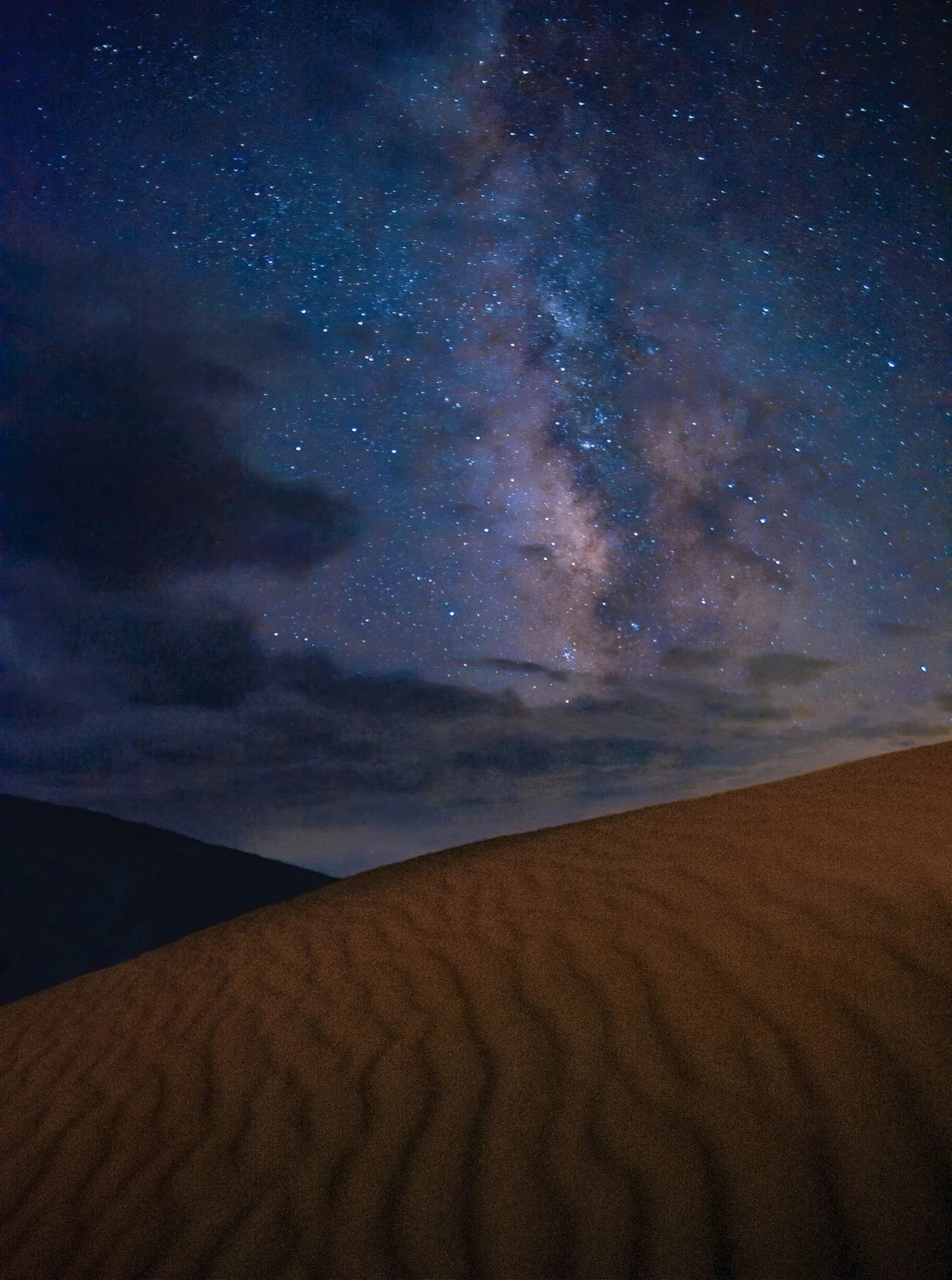
Great Sand Dunes National Park and Preserve in southern Colorado pairs the tallest dunes in North America with a sky dark enough to earn International Dark Sky Park status (park overview). Dry air, high elevation and little light pollution let the Milky Way stand out clearly above the sand (NPS night-sky guide). The park is open 24 hours a day all year, with no timed entry, so the question is not whether you can be there at night but which night and which hour.
When the Milky Way is up
The bright central band of the Milky Way is seasonal. At Great Sand Dunes it is up in the early-morning hours in spring and in the evening from midsummer to early autumn, which makes August and September the easiest months for an evening session (NPS night-sky guide).
At this latitude the core never climbs high. The galactic centre lies about 29 degrees south of the celestial equator, so from 37.7 degrees north it peaks at roughly 23 degrees above the southern horizon. In early September it is close to that highest point as full darkness arrives and then sinks towards the south-west, so the first dark hours of the evening are the ones to use. Pick a foreground with an open view to the south.
Three clocks that decide the start
Darkness is set by three things, and the latest of them wins:
- The Sun. The park recommends starting at least 90 minutes after sunset (NPS). The sky is only fully dark at the end of astronomical twilight, when the Sun is 18 degrees below the horizon; the end of civil twilight, the usual "dusk", is far too early (USNO definitions).
- The Moon. Moonlight washes out the Milky Way. Go on moonless nights, or from an hour after moonset or until an hour before moonrise (NPS).
- The weather, which only a forecast close to the date can answer.
The Moon is what changes fastest. It rises and sets later each day, by about 50 minutes on average and by around half an hour per evening in the example below, so in the days after new moon a growing crescent hangs in the western sky after sunset and sets a little later each evening, eating into the dark. In the days before new moon, the waning crescent does not rise until the small hours, leaving the whole evening dark.
A worked example: late summer 2027
New moon falls on 31 August 2027 (USNO moon phases). The table compares four evenings around it, using rounded park-area coordinates of 37.73 N, 105.51 W. All times are local daylight time, MDT (UTC−6).
| Evening | Sunset | Moon | Astronomical twilight ends | Dark from | Dark until |
|---|---|---|---|---|---|
| Sat 28 Aug | 19:37 | Rises 02:33 | 21:10 | 21:10 | about 01:33 |
| Wed 1 Sep | 19:31 | Sets 19:56 | 21:03 | 21:03 | dawn |
| Thu 2 Sep | 19:30 | Sets 20:24 | 21:01 | 21:24 | dawn |
| Sat 4 Sep | 19:27 | Sets 21:27 | 20:58 | 22:27 | dawn |
Sunset, moonrise and moonset come from the US Naval Observatory's calculations for 28 August, 1 September, 2 September and 4 September. Twilight times are from the 2027 annual table, which is in standard time, so one hour has been added.
"Dark from" is the latest of sunset plus 90 minutes, moonset plus 60 minutes and the end of astronomical twilight. On 28 August the 12 percent waning crescent does not rise until 02:33, so the evening is dark from 21:10 and stays dark until about an hour before moonrise. By 4 September the waxing crescent sets at 21:27 and pushes the start past 22:27, when the core is already lower in the south-west. For an evening shoot, the week before new moon is the sweet spot; a day or two after it still works.
For a different date or a different park, rerun the same three checks with your own coordinates.
On the night
Scout in daylight. Choose your dune, your foreground and your route back before dark. The Dunes Parking Area and the dunes are unlit; the park suggests remembering where you parked relative to the line of cottonwood trees beside the parking area so you can find your car again (NPS).
Use red light. A red headlamp keeps your night vision and does not spoil other people's photos.
Dress for the cold. Temperatures drop at night here even in summer, so bring warm layers for standing still on the sand.
Know the wildlife. Black bears and mountain lions are active at night, mainly in forested areas, and the dunes come alive with kangaroo rats, toads and owls (NPS).
Where to stay. Piñon Flats Campground is open April to October; outside that season there is no car camping in the park. The visitor centre is open daily from 9:00 to 16:30 except on three winter holidays (hours and seasons).
Camera expectations
Start with a sturdy tripod and a test exposure, then check two things on the screen: are the stars sharp, and is the dune foreground bright enough? Adjust from there to suit your lens. Do not be disappointed by the naked-eye view: to the eye the Milky Way is a faint whitish cloud, while a long exposure gathers enough light to show colour and structure the eye cannot see (NPS).
Before you set off, check the park's conditions and alerts page for road, weather and closure news. Park pages and the USNO calculations were checked on 8 October 2026.
Sources & further reading
- Great Sand Dunes National Park and Preserve - National Park Service
- Experience the Night - National Park Service
- Operating Hours and Seasons - National Park Service
- Current Conditions, Weather and Alerts - National Park Service
- Moon phases 2027 - US Naval Observatory
- Sun and Moon calculation - 28 August 2027 - US Naval Observatory
- Sun and Moon calculation - 1 September 2027 - US Naval Observatory
- Sun and Moon calculation - 2 September 2027 - US Naval Observatory
- Sun and Moon calculation - 4 September 2027 - US Naval Observatory
- 2027 astronomical twilight table - Great Sand Dunes example - US Naval Observatory
- Rise, Set, and Twilight Definitions - US Naval Observatory
Tags
- Great Sand Dunes
- Milky Way
- night photography
- dark sky park
- Colorado
- moon phase