Rephotographing a 1906 view of Copley Square, Boston
Use a public-domain 1906 postcard of Trinity Church to make a then-and-now photo: what changed on Copley Square, how to find the viewpoint and how to label it.
Sources checked - 8 October 2026
In this article
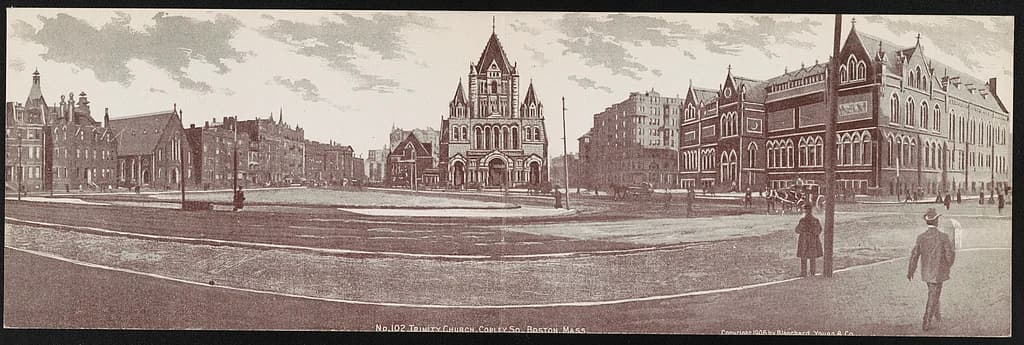
A 1906 panoramic postcard in the Library of Congress shows Trinity Church across Copley Square in Boston, with streets and buildings spreading out on either side (archive item). It makes an excellent first rephotography project: the church itself has barely changed in 120 years, while almost everything around it has. Standing in the same place and lining up a modern photo turns that contrast into something you can see at a glance.
Why this view works for then and now
The postcard is a photomechanical print, catalogued with Blanchard, Young & Co. as copyright claimant and no named photographer. It is about three times as wide as it is tall, typical of panoramic cards of the period (Commons file record).
The key fact for a rephotographer is that Trinity Church's west front, the side facing the square and the Boston Public Library, was already in its present form by 1906. H. H. Richardson's church was completed in 1877; stone pyramidal roofs were added to the small towers flanking the entrances in 1886, and the elaborate west porch followed in 1897. Apart from that west front, the exterior is largely unchanged since 1877 (Massachusetts Historical Commission inventory). The facade in the postcard is essentially the facade you will photograph.
The square is a different story:
| Then (1906) | Now |
|---|---|
| Huntington Avenue cut diagonally across the square | That stretch closed in 1968; the square became one park |
| The original Museum of Fine Arts stood on the square | Demolished 1910; the Copley Plaza hotel opened on the site in 1912 |
| No tower block beside the church | The John Hancock Tower, completed in 1976, stands next to it |
| A square divided by the avenue | One redesigned park, dedicated in 1989 and renovated again from 2023 |
The street and building history comes from the Copley Square overview. The most recent renovation added accessible paths, restored the fountain, planted 46 trees and, in the city's words, improved sightlines to the library and Trinity Church; Boston announced its completion in May 2026 (City of Boston). More trees mean better shade and a greener square, but also more branches between you and the church in summer.
Get the archive image and keep its record
Download the largest file offered on the Library of Congress item page and save the item URL, title, date and call number (ds.02412) next to it. The library reports no known restrictions on publication, and the Commons copy carries a public-domain mark because the card was published before 1931 (Commons file record). That status applies to this particular card; check each archive image separately.
Your new photograph is your own work, so the pair can be shared under whatever terms you choose for the modern half, with the archive image credited as "Blanchard, Young & Co., 1906, Library of Congress".
Keep an untouched copy of the download. If you straighten, crop or adjust contrast for the comparison, work on a duplicate.
Find the viewpoint
Rephotography is about matching the camera position, not just the subject. Perspective depends on where the camera stood; lens and zoom only change how much of that view fits in the frame. The usual method is to match how near and far objects line up, then fine-tune (rephotography techniques).
- Mark anchor points on the archive copy. Use permanent features you can identify today: the top of the central tower, the corners of the west porch, the line of the roof. Ignore people, carriages and trees.
- Walk until the anchors line up. In the park, move left, right, forwards and back until the tower sits over the porch the way it does on the card and the church's edges align with what is behind them. Moving your feet fixes parallax; zoom cannot.
- Match height and tilt. A camera at eye level gives a different relationship between the porch and the tower from one held low. Keep verticals straight rather than tilting up to fit the tower in.
- Choose how to handle the width. A single modern frame will not cover the whole panorama. Either shoot several overlapping frames from the same spot and stitch them, or make a tighter comparison centred on the church. Both are honest; stretching a single frame to the card's shape is not.
Start in the reopened park and work from the public paths and plaza. Treat the result as an approximate repeat view unless you can establish the exact 1906 camera position, which a panoramic card may not allow.
Light and season
The west front faces the library across the square, so it is lit by the sun in the afternoon and evening. Matching the light of the original, as far as you can read it from shadows, makes the comparison more convincing. Leafless months show the facade most clearly through the new trees; summer gives the fuller, greener contrast with 1906.
Present the pair clearly
Place the archive and modern images side by side or as an overlay, with the church at a similar scale in both. In the caption, give the archive's 1906 date and source, your capture date, your approximate viewpoint, the lens or phone mode, and whether you cropped or stitched. If something could not be matched, such as a viewpoint now blocked by planting, say which anchors you prioritised. Archive metadata and city information were checked on 8 October 2026.
Sources & further reading
- Trinity Church, Copley Sq., Boston, Mass. - item 2013647065 - Library of Congress
- Trinity Church postcard - file and public-domain status - Wikimedia Commons
- Trinity Church inventory form BOS.2623 - Massachusetts Historical Commission / Boston Preservation Alliance
- Copley Square - Wikipedia
- City of Boston celebrates completion of improvements to Copley Square Park - City of Boston
- Rephotography - Wikipedia
Tags
- rephotography
- Copley Square
- Trinity Church
- Boston
- archive photography
- then and now