Lake Waikaremoana Great Walk: transport, huts and Te Urewera
Planning the Lake Waikaremoana Great Walk in Te Urewera: the gravel road, water taxi and shuttle times, hut and campsite fees, direction and what huts lack.
Sources checked - 27 October 2026
In this article
The Lake Waikaremoana Great Walk is a one-way tramp of about 44-46 km along the western and northern shores of the lake, usually walked over three nights and four days between Onepoto in the south and Hopuruahine in the north (DOC). Three things shape the plan. Every hut and campsite night must be booked in advance for every walker, children included (adults NZ$35 a night in huts, NZ$19 at campsites). You need transport at both ends, from the lake's own water taxi or a road shuttle, and the water taxi usually runs only from October to April. And the road in, SH38, has about 90 km of gravel. The land is Te Urewera, which is not a national park: it is a legal entity in its own right, and Ngāi Tūhoe look after the track and huts.
Whose land this is
Te Urewera was a national park until the Te Urewera Act 2014, enacted on 27 July 2014 (Te Urewera). Section 11 of the Act makes Te Urewera a legal entity with "all the rights, powers, duties, and liabilities of a legal person", exercised on its behalf and in its name by the Te Urewera Board (s 11). Section 12 took the land out of Crown ownership and national park status and vested it in Te Urewera itself (s 12). Day-to-day care of the tracks and facilities is carried out by Te Uru Taumatua, Ngāi Tūhoe's operational entity. DOC still publishes the track information and runs the booking system (DOC).
For a walker this shows up in practical ways. The trip starts at Te Kura Whenua, the visitor centre that Tūhoe opened at Te Karetu on SH38 in 2016 (DOC visitor centre). DOC and Te Urewera both ask walkers to call in there for current conditions before setting out (DOC). Te Urewera lists it as open daily from 8am to 4.30pm, on +64 6 837 3900 (Te Urewera). Tūhoe wardens are stationed at the major huts in the peak season (DOC fees). Te Uru Taumatua began removing 44 backcountry huts across Te Urewera in 2022, and on this track Whanganui Hut has been decommissioned, with no toilets or water kept at the site. The other four Great Walk huts are unaffected (DOC hut removals). Visitors are asked to follow Te Kawa o Te Urewera, the management plan, which board chair Tāmati Kruger describes as "about the management of people for the benefit of the land" (Te Urewera).
The stages and where you sleep
There are four huts and five campsites, and you may camp only at the designated sites (DOC). DOC's stage figures, from Onepoto:
| Stage | Distance | Time | Overnight |
|---|---|---|---|
| Onepoto to Panekire Hut | 8.8 km | 4-6 hr | Hut, 36 bunks |
| Panekire Hut to Waiopaoa | 7.6 km | 3-4 hr | Hut, 28 bunks, and campsite |
| Waiopaoa to Korokoro Campsite | 3.6 km | 1 hr 30 min | Campsite |
| Korokoro to Maraunui Campsite | 6.8 km | 2 hr 30 min | Campsite |
| Maraunui to Marauiti Hut | 1.7 km | 30 min | Hut, 26 bunks |
| Marauiti Hut to Waiharuru | 6.2 km | 2 hr | Hut, 40 bunks, and campsite |
| Waiharuru to Hopuruahine Landing | 9.5 km | 4 hr 30 min | Track end |
Bunk numbers are from DOC's track page and the Waiharuru Hut page. DOC's suggested four days are Onepoto to Panekire, Panekire to Waiopaoa, Waiopaoa to Marauiti, and Marauiti to Hopuruahine. Day 1 is the hard one: the track climbs from the Onepoto shelter, past the site of an Armed Constabulary redoubt, onto Panekire Bluff, then follows the ridge over Puketapu Trig at 1,180 m. On day 2 it drops steeply off the range into beech and podocarp forest at the lake edge.
Two short extras are worth planning in. Korokoro Falls, a waterfall dropping off a sheer cliff, is about an hour return from Korokoro Campsite, and the turn-off is just before the Korokoro suspension bridge. From Marauiti Hut, a dusk walk to the edge of the Puketukutuku Peninsula is a chance to hear kiwi (DOC).
The length depends on who is counting. DOC's stages add up to 44.2 km, while DOC and Te Urewera both give 46 km in the headline figures. The "around 30 km apart" that DOC mentions on its booking page is the distance between the two ends, not the length of the track (DOC fees). Te Urewera's own table splits the last day at Whananui, the northern water-taxi stop: 6 km and 2.5 hours from Waiharuru, then another 5 km and 1 hour 40 minutes to Hopuruahine (Te Urewera).
Which way to walk
You can start at either end. DOC's advice is simply that Panekire can come at the start or the end, and that outside the peak dates you should aim to be on the range in the best weather, because the views from it are the highlight (DOC fees). Starting at Onepoto puts the big climb on the first day, with a full pack of food. Starting in the north leaves the ridge for the last day, when the pack is lighter, but the climb up to Panekire is then the steep side and the descent to Onepoto comes at the end of the walk. In both directions the ridge is the most exposed part.
The northern end also decides how much track you actually walk. The water taxi does not go to Hopuruahine. It stops at Whananui, about 5 km and 1.5 hours short; the operator says low water levels keep its boat out of Hopuruahine Landing (Waiwai Xpres). Te Urewera puts the choice plainly: if you want to have done all 46 km, book a road shuttle to or from Hopuruahine Landing Road, and if you would rather skip that last stretch, take the boat (Te Urewera).
Getting to the lake and to both ends
SH38 runs from Waiotapu to Wairoa, and passes Te Karetu, where the visitor centre and the Waikaremoana Holiday Park sit side by side. About 90 km of it, between Murupara and Tuai, is gravel, and DOC recommends a 4WD or SUV (DOC getting there). The holiday park is 57 km from Wairoa, about an hour's drive, and 163 km from Rotorua, about three hours with the gravel section. Wairoa, an hour away, has the nearest supermarkets. Mobile coverage is poor; Wi-Fi is available at the holiday park shop and the visitor centre (DOC holiday park).
Onepoto is about 20 minutes' drive from Te Karetu, and Hopuruahine about half an hour. DOC says the Hopuruahine road is not currently suitable for 2WD vehicles, which may affect access to the car park at that end, 2 km off the highway (DOC getting there). Parking for the walk is free near the lakeside towards the holiday park entrance (up to 10 days), at the Onepoto car park and boat ramp, and at Hopuruahine. The visitor centre allows day parking only. Summer is busy, and all parking is at your own risk.
Transport options, as listed on 27 October 2026:
| Service | Route and times | Listed fare |
|---|---|---|
| Waiwai Xpres water taxi, morning run | Te Karetu 8am, Onepoto 8.30am, Whananui 9am | NZ$75 a seat |
| Waiwai Xpres, return runs | Whananui 10am or afternoon (see below), via Onepoto to Te Karetu | NZ$75 a seat |
| Tira 38 scheduled shuttle | Onepoto to Hopuruahine, 9am on Tuesdays, Thursdays, Saturdays and Sundays, about 50 minutes | NZ$115 a person |
| Tira 38 scheduled shuttle | Te Karetu to or from Hopuruahine | NZ$75 a person |
| Tira 38 scheduled shuttle | Te Karetu to or from Onepoto | NZ$45 a person |
| Tira 38 private charter | Onepoto to or from Hopuruahine, at a time you choose | NZ$600 a group |
Times and fares are from the water taxi's southbound and northbound booking pages and from the Tira 38 booking site, including its Onepoto to Hopuruahine page and private charters. Their booking calendars charge the water taxi per seat (NZ$25 for a child aged 0-5) and the shuttle per passenger. The boat takes up to nine passengers and must be booked at least two days ahead. The scheduled shuttle runs only with at least four passengers and allows one backpack and one small bag per person, so a smaller group may need the private charter. Waiwai Xpres also sells a NZ$100 pack transfer. Te Urewera lists both operators as locally owned, with Waiwai Xpres as the only licensed water taxi (Te Urewera). Tira 38 also runs scheduled transfers from Napier and Rotorua airports and i-SITEs, about three and a half hours, for NZ$345 a person with a minimum of six passengers.
The water taxi schedule fits the common plan of parking at Onepoto. A walker starting there needs only a boat back from Whananui on the last day. The northbound page gives the afternoon boat as 3.30pm, but its booking calendar sells 2.30pm departures, so confirm the time when you book and plan for 2.30pm. Whananui is 6 km, about 2.5 hours, from Waiharuru, and about 4.5 hours from Marauiti by Te Urewera's times, so that boat is within reach from either hut with a morning start (Te Urewera). Walking north to south, the 8.30am boat from Onepoto takes you to the start.
Both operators keep a NZ$30 fee and refund the rest if you cancel seven or more working days ahead, refund half, less the same fee, from three to six working days, and nothing within two. If they cancel for weather, road closures or safety, you choose a refund or a new date (Waiwai Xpres terms, Tira 38 terms).
DOC says the water taxi usually runs from October to April and not in winter (DOC getting there). The operators' calendars on 27 October 2026 matched that: water-taxi runs were on sale up to 30 April 2027 and the Onepoto to Hopuruahine shuttle up to 25 April 2027, with nothing from May to September 2027. For a winter walk, plan on two cars or ask the operators before you book the huts.
Booking and fees
Bookings for the 2026/27 season are open. Huts and campsites must be booked all year, including for children and young people who stay free, and campsite bookings need both the group size and the number of tent sites. Walkers without a valid booking may be charged a penalty or turned away from a full site. Entry to Te Urewera and day walks on the track are free (DOC fees).
| Per person, per night, all year | Hut | Campsite |
|---|---|---|
| Adult, 18+ | NZ$35 | NZ$19 |
| Child, 5-17 (international visitors 0-17) | NZ$18 | NZ$9 |
| New Zealand child, 0-4 | Free | Free |
New Zealand and international adults pay the same rate. Backcountry Hut Passes and Hut Tickets are not accepted (DOC Waiharuru Hut). Book the huts and the transport together: DOC's booking steps tell you to plan the nights around the water-taxi drop-off and pick-up times, and to check transport availability before you pay for the huts (DOC fees).
What the huts do not provide
The huts have bunks with mattresses, non-flush toilets and tap water. They have no gas cooking, lighting or toilet paper, so you carry a stove and fuel, a torch or candles, and your own toilet paper. The tap water is untreated: boil, filter or treat it. Panekire's tank can run low in summer. DOC lists "heating" among the hut facilities, but its gear list says the bunkrooms are not heated and can be cold, so pack warm clothes to sleep in and the 3-4 season sleeping bag DOC recommends. The sleeping bag temperature guide explains how to read those labels. DOC also suggests earplugs for the shared bunkrooms (DOC).
There is no food for sale on the track and no emergency food in the huts, so carry spare food in case weather holds you up, in a rodent-proof bag if camping. Some supplies are sold at the holiday park store. There are no rubbish facilities anywhere on the track, so everything you carry in comes out with you. Dogs and other domestic animals are not allowed. Fires are permitted for cooking or warmth unless there is a fire ban, but DOC prefers a portable stove (DOC).
Weather and who the walk suits
DOC rates the walk an intermediate tramping track. Expect about 600 m of climb and descent over Panekire, 4-6 hours on the longer days, and a pack of up to 15 kg. DOC does not recommend it for children under 10 because of the exposed mountain terrain and frequent bad weather. The track lies between 600 and 1,200 m, and cold, snow, strong wind and heavy rain can occur at any time of year, summer included. Te Urewera is rainforest, so the track is often muddy (DOC).
Most of Te Urewera has little or no mobile coverage. Leave your trip details with someone you trust and consider a personal locator beacon (Te Urewera, Be Safe); DOC also asks you to fill in the hut books as you go (DOC). Te Urewera's alerts page listed no current alerts on 27 October 2026. Check it, and ask at Te Kura Whenua, before you leave, because closures here follow slips, flooding and fallen trees. Hunting is allowed in parts of Te Urewera by permit, but the permit conditions ban loading or firing a weapon within 500 m either side of the Great Walk (Te Urewera, Be Safe).
The lake itself
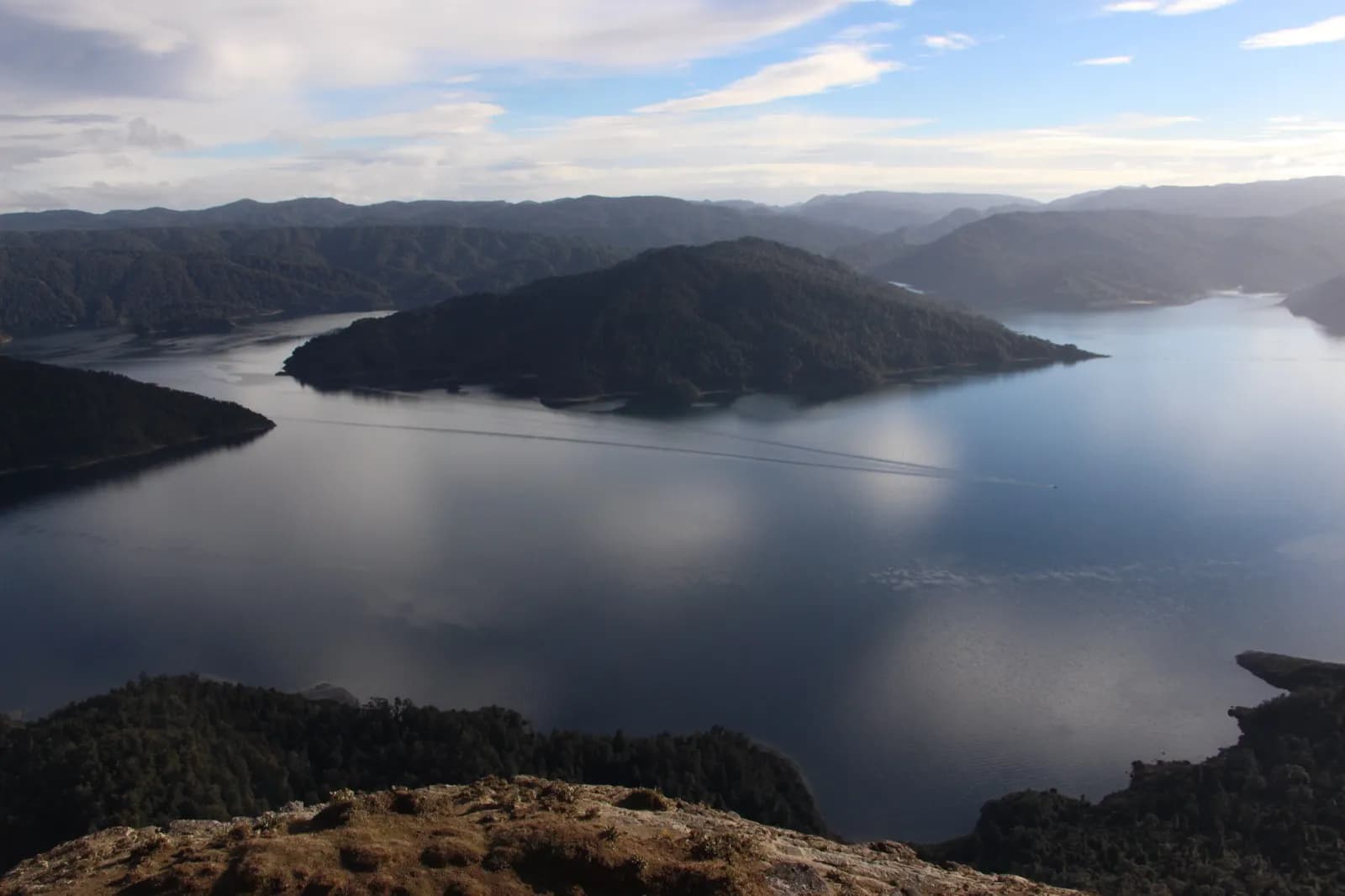
Lake Waikaremoana covers 54 km² and, at up to 256 m deep, is the deepest lake in the North Island. Its surface sits at about 600 m. A huge landslide about 250 m high blocked the valley around 2,200 years ago and formed the lake; the forest around it has never been logged (Wikipedia). The lake also feeds a hydroelectric scheme: engineers tunnelled through the landslide dam and sealed it on the lake side from the 1930s to about 1950 (Wikipedia). The lake is stocked with rainbow and brown trout, and anglers need a licence. It is not sold at the holiday park, so buy one from Fish & Game online beforehand. Jet skis, jet boats, houseboats and floatplanes are banned on the lake (DOC holiday park).
Fees, bookings, hut facilities, transport times, fares and operating dates were checked against DOC, Te Urewera and the operators' booking pages and calendars on 27 October 2026. This is a source check, not a site visit.
Sources & further reading
- Lake Waikaremoana Great Walk - Department of Conservation
- Lake Waikaremoana Great Walk: getting there - Department of Conservation
- Lake Waikaremoana Great Walk: fees and bookings - Department of Conservation
- Waiharuru Hut - Department of Conservation
- Te Urewera hut removals - Department of Conservation
- Waikaremoana Holiday Park - Department of Conservation
- Te Urewera Visitor Centre at Te Kura Whenua - Department of Conservation
- Enjoy Te Urewera - Te Urewera
- Be Safe - Te Urewera
- Te Marae: Te Urewera Act, legal personhood, Te Kawa o Te Urewera - Te Urewera
- Te Urewera Act 2014, section 11: Te Urewera declared to be legal entity - NZLII
- Te Urewera Act 2014, section 12: Vesting of Te Urewera establishment land - NZLII
- Departing Te Karetu for Whananui via Onepoto - Waiwai Xpres
- Departing Whananui for Te Karetu via Onepoto - Waiwai Xpres
- About Us and cancellation policy - Waiwai Xpres
- Tira 38 Shuttles - Tira 38 Shuttles
- Scheduled Transfer - Onepoto to Hopuruahine - Tira 38 Shuttles
- Private Charter - Tira 38 Shuttles
- About Us and cancellation policy - Tira 38 Shuttles
- Lake Waikaremoana - Wikipedia
Tags
- Lake Waikaremoana
- Lake Waikaremoana Great Walk
- Te Urewera
- Ngāi Tūhoe
- Panekire
- Great Walks
- New Zealand