Late-summer birdwatching on Bulgaria’s Black Sea wetlands
A useful August field guide to birdwatching around Bulgaria’s coastal wetlands: choose legal access, read habitat and heat, use optics, and avoid disturbing roosts.
Recently verified — 12 August 2026
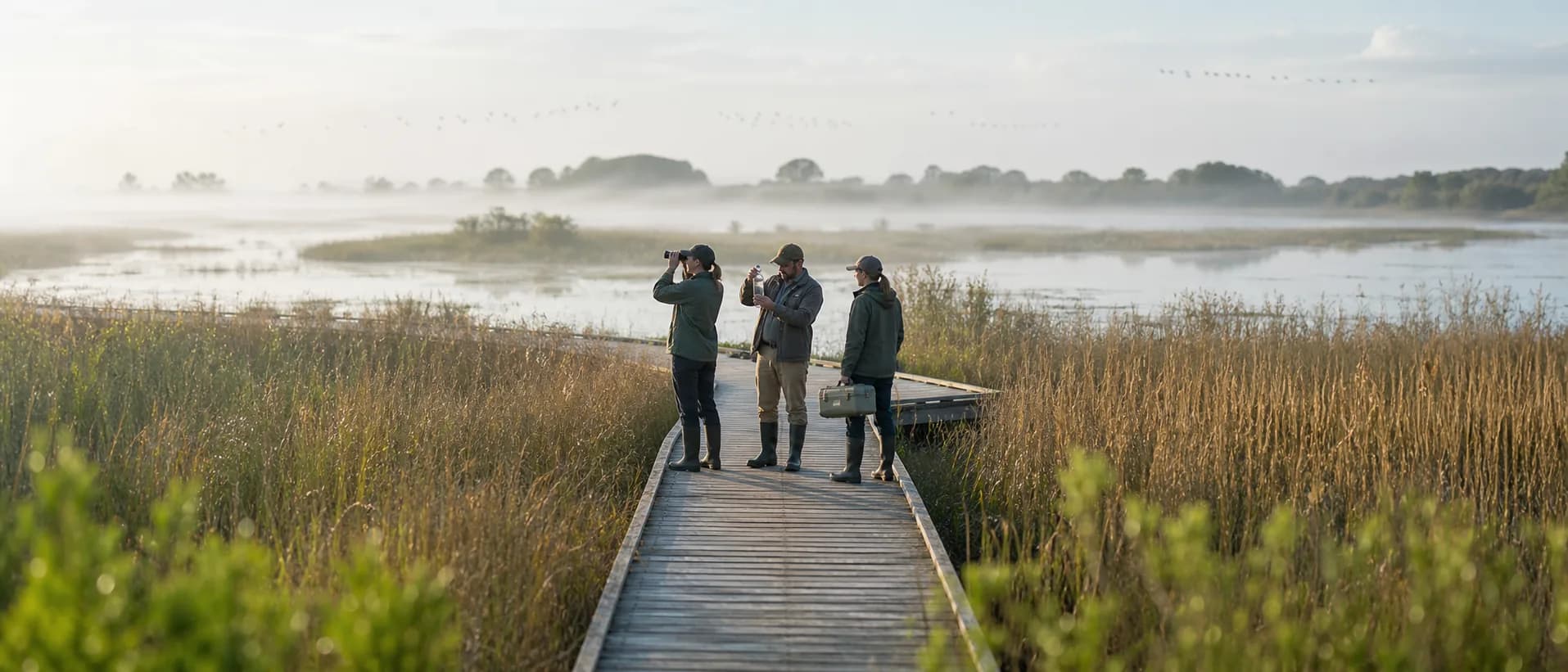
Late summer is a rewarding time to watch coastal wetlands, but it rewards patience more than a checklist. Around Bulgaria’s Black Sea coast, lagoons, lake margins, reed beds, saltmarshes and river mouths can support different birds within a short distance. In August, heat, wind, water levels, recent breeding activity and the first movements of migrants can all change what is visible from one morning to the next.
Use this guide to plan a respectful visit, not to expect a particular species. The protected status and access rules of a site come before its popularity. A wetland may be a protected area, a Natura 2000 zone, a Ramsar site, a managed reserve or a mixture of designations, each with its own restrictions and manager.
At a glance
Think in wetland habitats
Do not treat the coast as one continuous birdwatching venue. An open lagoon edge may favour a different set of birds than a reed-fringed channel, mudflat or freshwater lake. From a public route, scan slowly: first the water surface, then exposed mud or sand, reed stems, posts and the sky. Early light can make distant birds look like silhouettes; return to the same view as the angle changes instead of walking closer.
The Burgas wetland landscape is a useful example of this patchwork. Areas around Atanasovsko Lake, Lake Burgas/Vaya, Mandra and Poda have different habitats, land managers and visitor arrangements. Other coastal wetlands and river mouths also have their own rules. Do not assume that a path, platform, parking area or hide at one site exists or is open at another. Check the official manager, protected-area register and current on-site notices before travelling. This article does not confirm a current opening schedule.
Natura 2000 information can explain why a landscape matters, while the Ramsar Sites Information Service provides internationally recognised wetland context where a site is listed. Neither replaces the exact order, management plan or access instruction for the place you intend to visit.
Expect variation, not a guaranteed list
In late summer you might encounter herons, egrets, cormorants, terns, gulls, waders or passerines using the wetland, but visibility and species presence are never guaranteed. Some birds are still completing breeding activity; others are dispersing or beginning migration. A low waterline may expose feeding ground one week and disappear after wind or rain the next. Heat haze can make a bird look closer than it is and can defeat long-lens autofocus.
Record what you actually saw, with an honest confidence level. “Large pale heron at long range” is better field science than an overconfident species name. Note time, weather, water level if obvious, habitat and behaviour. A short list made from a single rushed pass says less than five careful observations from one fixed viewpoint.
Use optics without closing the distance
Binoculars are the most useful first tool. Keep both feet on the public route and use a scope or long lens from the same stable position. A beanbag or monopod can help without spreading tripod legs into vegetation. If you use a camera, pre-focus on the open water or a fixed reed stem, lower the shutter speed only as far as your hand and subject allow, and accept that a distant record shot may be more honest than a tightly cropped portrait.
Do not cross mud, reeds or shallow water to improve an angle. Do not walk around a flock to “push” it into flight, and do not stand between birds and water. If a group suddenly takes off, freezes, gives repeated alarm calls or swims away from you, stop moving and retreat to the last quiet position. A bird that remains visible is not necessarily undisturbed.
Playback calls, bait, drones and thrown food are especially harmful in a wetland. They can pull birds away from feeding, expose a roost to repeated visits or make a photograph appear to show natural behaviour. The same applies to hiding behind a vehicle and edging forward each time the bird relaxes. Distance is a field measurement: increase it until the animal’s behaviour returns to normal.
Make the early start comfortable
August mornings can be cool for an hour and hot soon after. Bring a hat, water, sun protection and footwear suited to wet boards or uneven ground. Check for ticks after walking through vegetation. A lightweight stool can reduce wandering, but only use it where it does not block a path or hide. Keep food sealed and take all packaging home; do not leave crumbs for gulls, foxes or other animals.
Use a quiet arrival and one clear route. If several people are visiting, spread out only when the path and manager’s guidance permit it. Keep dogs under the required control and away from the waterline and reed edge. Do not play music or make repeated calls to friends across the wetland. A small group that moves slowly can see more than a large group that constantly changes position.
Record and share with care
A helpful observation includes the date, start time, broad site or viewpoint, weather, habitat, access conditions and what remained uncertain. Photograph signs and boardwalk conditions only when doing so does not reveal a sensitive location or include identifiable people unnecessarily. If you find fishing line, sharp waste or a damaged barrier, keep your distance and report it to the manager rather than entering the habitat to fix it.
Use Garbamons’ mapped nature-place reports for dated access and habitat notes. Keep a nest, roost or especially vulnerable feeding place at a broad scale. The value of a public record is that it helps the next visitor prepare without turning a quiet wetland into a target.
Sources & further reading
- Natura 2000 in Bulgaria — Ministry of Environment and Water of Bulgaria
- Ramsar Sites Information Service — Ramsar Convention on Wetlands
- BirdLife Data Zone — BirdLife International
Access, prices and opening times change. Verify locally before you travel.
Tags
- Black Sea coast
- wetlands
- birdwatching
- August
- Bulgaria
Beyond this page
Links to reference material and organisations we don't control.
- ReferenceEcotourismWikipedia
- VideoNational Geographic on YouTubeYouTube
- ReferenceThe Bulgarian Black Sea CoastWikipedia
- ReferenceBeach cleaningWikipedia