Mount Fuji's Yoshida Trail: fee, gate rules and how to climb
Plan a Yoshida Trail climb of Mount Fuji: the route from the Fuji-Subaru Line fifth station, hut nights and sunrise, the ¥4,000 fee, gate hours and the season.
Sources checked - 8 October 2026
In this article
At 3,776 m, Mount Fuji is Japan's highest mountain, a near-perfect volcanic cone that last erupted in 1707. It has drawn pilgrims for centuries, inspired generations of artists and poets, and has been a UNESCO World Heritage cultural site since 2013. Around 300,000 people climb it each year, almost all in July and August, many walking through the night to see the sunrise from the top, known in Japanese as goraikō, the "arrival of light" (Wikipedia).
The Yoshida Trail on the Yamanashi side is the most popular of the four routes. It starts from the Fuji-Subaru Line fifth station at 2,305 m and has more mountain huts than any other trail, which makes it the natural choice for a first ascent (route comparison).
The climbing season is closed. The 2026 season ran from 1 July to 10 September, and climbing above the fifth station outside the season is prohibited (Fujiyoshida City). This guide is for planning the next one.
The route
| Direction | Distance | Approximate walking time |
|---|---|---|
| Ascent from the fifth station | 6.8 km | 6 hours 10 minutes |
| Descent to the fifth station | 7.0 km | 3 hours 35 minutes |
These official times leave out breaks, which add up quickly at altitude: allow ten hours of walking or more for the round trip, plus any time in a hut.
Fifth to sixth station. The trail begins as a gentle path through forest.
Sixth to seventh station. Above the forest the path zigzags up the open volcanic slope on sand and gravel.
Seventh station and above. The footing changes to steeper, rockier ground, and the huts cluster along the trail. Near the original eighth station, the Subashiri Trail joins, and from there to the top the shared path can be very crowded. The final section is narrow and rocky, with a risk of falling stones.
The summit. The crater rim is the goal; most climbers time their arrival for sunrise, which comes at about 4:20 in early July and about 4:50 in late August (Fujiyoshida City).
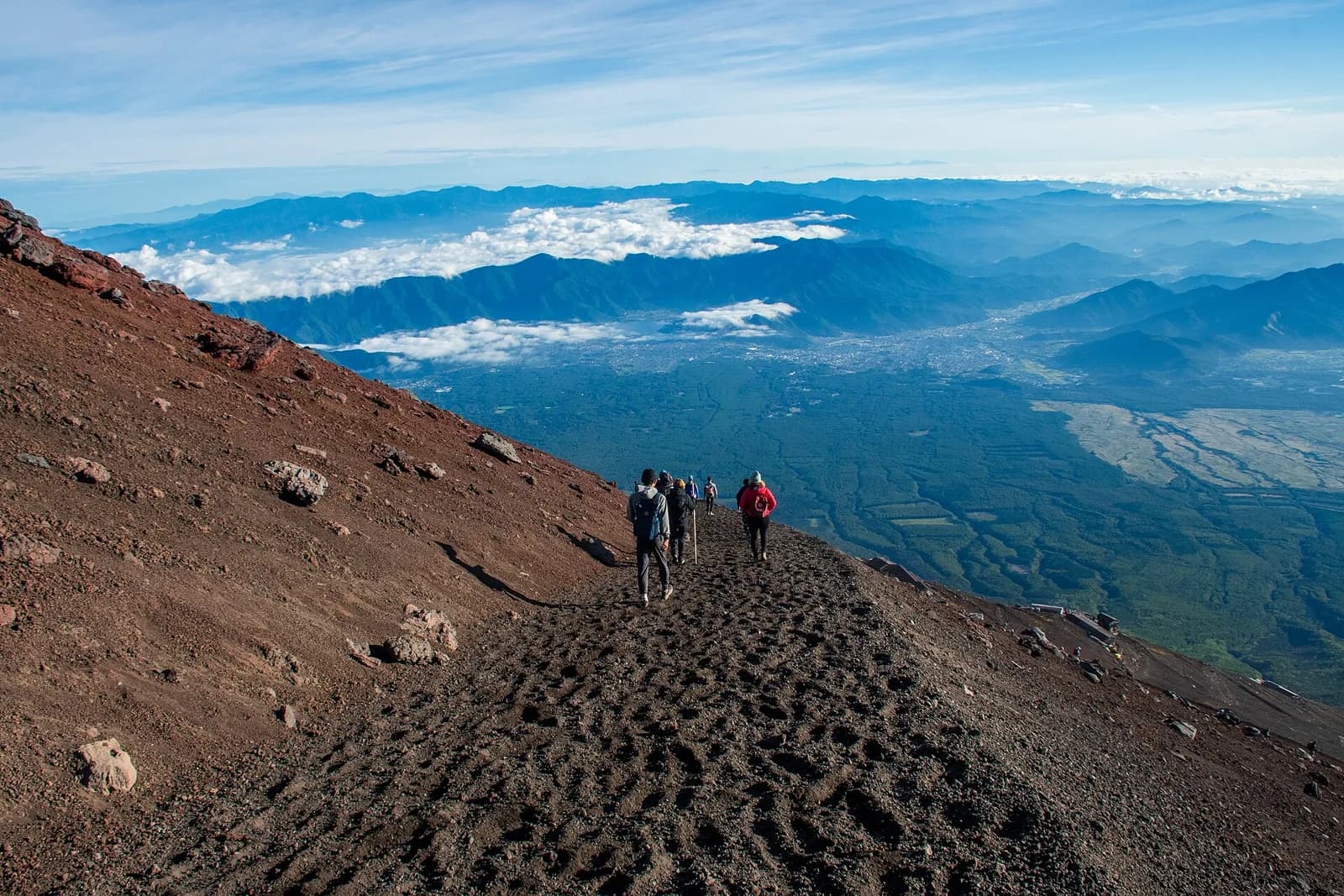
The descent. Yoshida uses a separate route down, a former bulldozer track of loose, dusty gravel with steep sections at the top. At the junction with the Subashiri descent, follow the signs for Yoshida and the Fuji-Subaru Line fifth station; the other branch takes you to a different trailhead far from your bus. There are far fewer huts and toilets on the way down, so stock up with water and use a toilet before you start (route comparison).
Hut night or day climb?
Many climbers split the ascent. They walk up in the afternoon, sleep for a few hours in a mountain hut around the seventh or eighth station, and set off again in the small hours to reach the summit for sunrise. A hut bed and meals cost roughly ¥15,000 to ¥20,000 per person; book well ahead for summer weekends (Fujiyoshida City). The night at altitude also helps your body adjust.
A day climb is allowed if you pass the gate between 3:00 and 14:00 and come down the same day. Leaving the fifth station in the evening without a hut booking and climbing straight through the night, known as "bullet climbing", is what the gate rule below is designed to stop.
Rules in 2026
Yamanashi Prefecture set these rules for the Yoshida Trail in 2026 (2026 restrictions; FAQ):
- Fee: ¥4,000 per person per climb.
- Reservation: you pick the date you will pass the fifth-station gate and pay online in advance; same-day registration is also possible while places remain. Online payment takes major credit cards, and the on-site counter accepts other methods such as PayPay. Bookings for 2026 opened on 27 April (Travel Watch).
- Daily limit: 4,000 climbers, not counting hut guests. In 2026 the limit was not reached on any day.
- Gate hours: the gate at the Yoshida Trail trailhead on the fifth station is closed from 14:00 to 3:00 the next morning, except to climbers with a hut reservation.
- Gear check: you need warm clothing, two-piece rain gear and proper climbing shoes to pass.
- Cancellation: free until the day after payment; date changes until the day before the climb.
Toilets on the mountain ask for a fee of ¥200 to ¥300 in coins, so carry change. Expect rules for the next season to be published in spring; check the official site before booking huts or transport. The three Shizuoka trails (Fujinomiya, Gotemba and Subashiri) use a separate registration system.
Getting to the fifth station
Make sure you head for the Fuji-Subaru Line fifth station; other fifth stations serve other trails. In season there are local buses from Fujikawaguchiko and Mt. Fuji Station, a shuttle from Fujisan Parking at the foot of the mountain, and express buses from Shinjuku in Tokyo. During the climbing season private cars are banned from the Fuji-Subaru Line for set periods, and drivers park at Fujisan Parking and take the shuttle up (route comparison).
Time your bus so you can reach the gate before 14:00 if you are not staying in a hut, and check the last bus down before committing to a day climb.
What to pack
The required winter clothing is not a formality: the summit is cold before dawn even in midsummer. Carry the required warm layers and two-piece rain gear, gloves, a headlamp with spare batteries, enough water and snacks for the long descent, and coins for toilets. Walk slowly; a headache with nausea is a sign to rest or turn back.
| Item | Detail |
|---|---|
| Season | 1 July to 10 September in 2026; closed the rest of the year |
| Start | Fuji-Subaru Line fifth station, 2,305 m |
| Fee | ¥4,000 per person (2026) |
| Gate | Closed 14:00 to 3:00 without a hut booking |
| Times | Up about 6 h 10 min, down about 3 h 35 min, without breaks |
| Hut | About ¥15,000 to ¥20,000 per person (2026) |
Season rules and fees were checked on 8 October 2026.
Sources & further reading
- Comparison of routes: Yoshida Trail - Official Mount Fuji Climbing Website
- Yoshida Trail 2026 restrictions - Official Mount Fuji Climbing Website
- Frequently asked questions - Official Mount Fuji Climbing Website
- Climbing Mt. Fuji FAQ - Fujiyoshida City
- Mount Fuji - Wikipedia
- Yoshida Trail reservation system opens for 2026 - Travel Watch
Tags
- Mount Fuji
- Yoshida Trail
- Japan
- climbing season
- mountain huts