In this article
Samokov sits at about 950 metres in a basin between Rila, Vitosha and Sredna Gora, 55 km from Sofia, and most visitors only pass through on the way to Borovets. That is a pity. For centuries this was one of the Balkans' iron towns, and in the nineteenth century it produced the Samokov school of icon painters, the Zograf family among them. Its small museums tell both stories well, and 15 km away a restored late-Roman fortress, Tsari Mali Grad, looks down on the valley from a hill above Belchin.
Iron and icons: why Samokov matters
The town's name comes from the samokov, a water-powered mechanical hammer, and its wealth came from iron. Under Ottoman rule Samokov was an administrative centre for iron mining, and its forges worked on a large scale: in 1565-1566 the town had to deliver 20,000 horseshoes and 30,000 nails to Belgrade.
That money and craft tradition fed a remarkable art scene. Hristo Dimitrov founded a family workshop whose sons, Dimitar and Zahari Zograf, became leading painters of the Bulgarian Revival, while Samokov's woodcarvers ranked alongside those of Debar and Bansko. The sights below follow these two threads: metal and painting.
What to see in Samokov
History Museum
The History Museum's home, completed in 1940, is what the Regional History Museum in Sofia describes as the first building in Bulgaria designed as a museum. It has two permanent exhibitions; allow an hour or more for both.
Samokov - Spirit and Metal starts with working models of a vidnya, the local iron-smelting furnace, and the water-driven hammers that gave the town its name. Seeing the mechanism first makes the rest of the room, with its tools, archaeological finds and nineteenth-century crafts such as goldsmithing, coppersmithing and pottery, much easier to read. Look out for objects from a glass factory founded around 1850 with craftsmen from Karlsbad, Nikola Karastoyanov's printing press of 1828, the first in Bulgaria, and Lyuboslovie, Konstantin Fotinov's magazine of 1844 and the first Bulgarian magazine.
Samokov Art School is the icon room. It shows works by Hristo Dimitrov and his sons Dimitar and Zahari Zograf alongside Nikola Obrazopisov and Vasil Popradoykov, plus portraits and self-portraits by Ivan Ikonopisets and Stanislav Dospevski. The painters' brushes, pigments and sketches are displayed too, which helps explain how a family workshop operated. Photography is not allowed in the halls.
Bayrakli Mosque
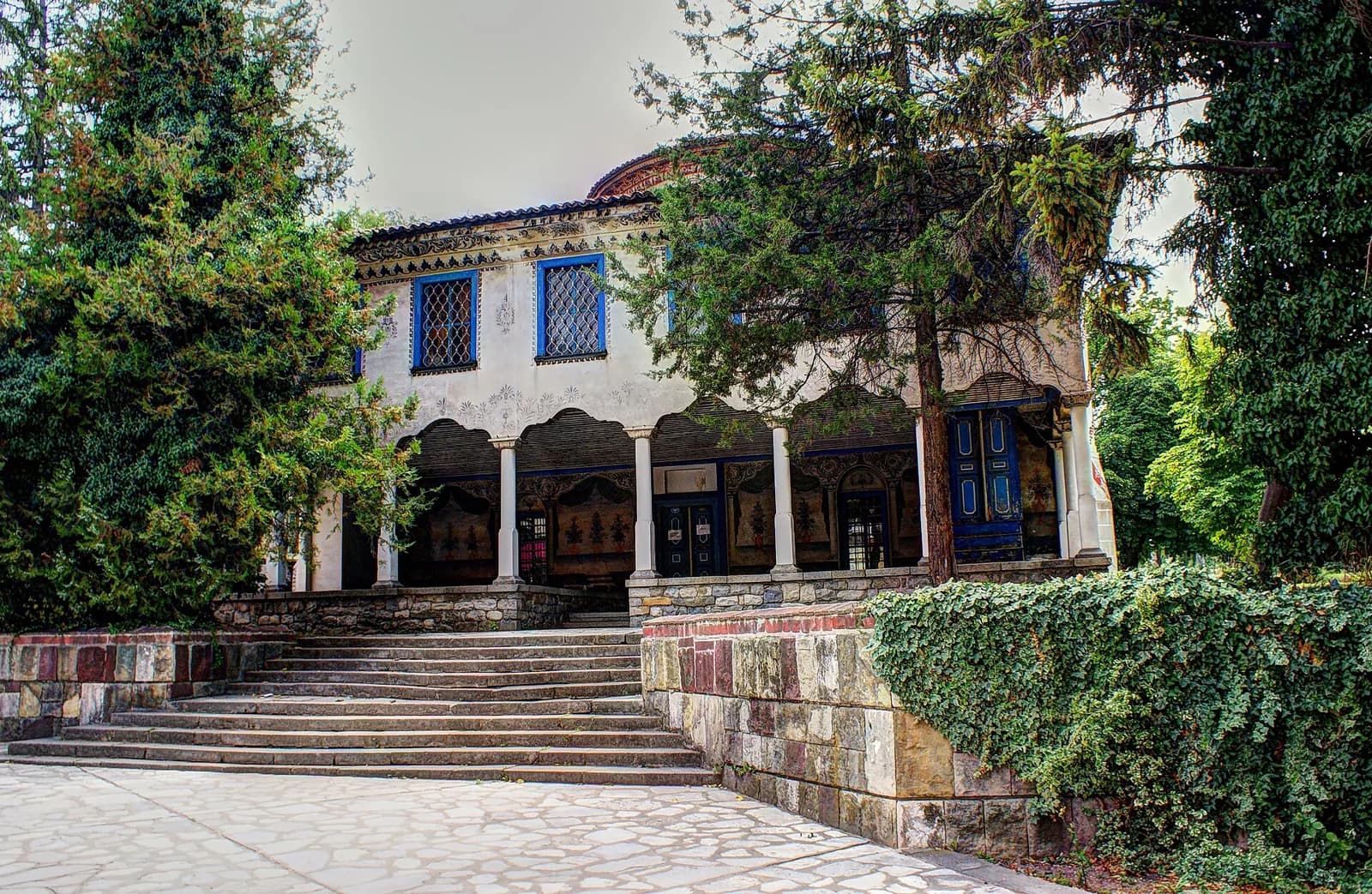
The only mosque in Samokov preserved from the Ottoman period, Bayrakli Mosque was largely rebuilt in the mid-nineteenth century and painted around 1845 by three local icon painters, Ivan Ikonopisets, Kosta Valyov and Hristo Yovevich. Their ornament follows the decorative style of the Samokov school, here applied to a mosque rather than a church, which makes the building a natural companion to the icon room in the History Museum.
The building is now a museum and houses a photographic exhibition of old Samokov and Borovets, with archival photographs and postcards from the late nineteenth to the mid-twentieth century. It is not staffed all day: on working days, ask at the History Museum and staff will open it for you.
Prof. Vasil Zahariev Gallery
On the second floor at 3 Zahari Zograf Square, the town gallery picks up where the icon painters left off. Its permanent exhibition brings together 21 twentieth-century artists connected with Samokov. Recurring subjects tie them together: the streets and houses of old Samokov, Rila landscapes, often in watercolour, and portraits of the local artistic circle. The differences come from training abroad. Vasil Zahariev met graphic techniques and Expressionism in Leipzig, Vladimir Katsarov studied decorative painting in Paris and stage design in Berlin, and Slavi Genev settled in Samokov after years in Paris. The museum also holds Zahariev's drawings, prints, tools and personal belongings; if a particular piece is the reason for your visit, ask whether it is on show.
Esov House and the Graphic Base
Esov House at 11 Zahari Zograf Street is a late-Revival house that has served since 1973 as a printmaking studio of the Union of Bulgarian Artists, founded with the artist Zafir Yonchev. It is a working base rather than a gallery. There is a lithography workshop with a German press and stones of 50x70 and 35x50 cm, and an etching press for intaglio, drypoint, linocut and woodcut; artists bring their own paper, crayons and ink. Printmakers can arrange a session with the master printer, Radoslav Genev, by email ([email protected]) or by written message on Viber or WhatsApp to +359 883 228 333. Casual visitors should arrange a time first.
A short walk around town
Two more sights fit into a short walk. The Big Drinking Fountain on the town square dates from around 1660 and is richly carved in Ottoman style; local lore says that whoever drinks from it will stay in Samokov. The Convent, a nunnery with eighteenth and nineteenth-century buildings, has a church consecrated in 1839 with icons by Zahari and Dimitar Zograf. Dospevska House is currently closed to visitors.
Tsari Mali Grad above Belchin
Why the fortress stood here
Tsari Mali Grad crowns St Spas Hill above the village of Belchin, 15 km from Samokov. The Ministry of Tourism dates the first fortress to the reign of Emperor Valens, 364-378. From the hill a garrison could watch the western end of the valley, the mineral springs, the magnetite ore deposits and a hard but direct route towards Macedonia. Excavations recovered 1,078 finds and identified five phases of occupation, and archaeologists have linked the site with protecting the iron deposits around Samokov (Bulgarian National Radio).
The hill was also sacred. The operator's account describes a Thracian sanctuary, a fourth-century church, a sixth-century basilica and a fifteenth-century Church of the Ascension built over the older remains. Local people traditionally gathered at the church by the gate on Ascension Day.
What you see today
Be clear about what is old and what is new. The walls, towers and gate are a substantial modern reconstruction built on the excavated foundations, and the complex has operated as a museum since 2011. The rebuilt walls give a strong sense of the fortress's outline and scale, and the view over the valley explains its position, but most of the masonry you see is recent.
The museum displays fill in the life behind the walls: finds from ritual pits, pottery, tools for spinning and weaving, jewellery, a bronze coin of Galla Placidia, and arrowheads and sling stones from the fortress's defence. Some displays combine original finds with reconstructions, and the labels say which is which. The ticket also covers the ethnographic museum, about 300 metres below the fortress.
Getting up the hill
There are three ways up (operator). A path of 860 m with a 15% gradient starts near the funicular; a shorter but much steeper path of 410 m at 33% starts above the ethnographic museum; and a 2 km asphalt road, steep in places, reaches the top for cars. Parking is free and pets are not allowed in the complex.
The funicular runs Wednesday to Sunday with a technical break from 13:00 to 14:00 and has its own ticket. It stops in heavy snow, strong wind, heavy rain, thunderstorms and when the temperature is below -7°C or above 33°C, so do not count on it for the descent in doubtful weather.
Suggested plans
Half a day in Samokov. Start at the History Museum when it opens at 08:30, ask there for Bayrakli Mosque, then visit the gallery and finish at the fountain and the convent. All three museum sites close for lunch from 12:00 to 13:00, so either finish before noon or split the visit around it. A combined ticket covers two or more sites on the same day.
One day: Samokov and Tsari Mali Grad. Samokov museums in the morning, lunch in town, then drive to Belchin for the fortress in the afternoon. From April to October the complex stays open until 17:30 on weekdays and 18:30 at weekends, which leaves plenty of time.
With the mountains. Samokov is the gateway to Borovets, and the museums make a good bad-weather alternative to a day on Rila. See the guides to Musala from Borovets and the Seven Rila Lakes for hiking days.
Pick your day carefully. The Samokov museums close on Sundays and Mondays, while Tsari Mali Grad closes on Mondays and Tuesdays. Wednesday to Saturday is the only window when everything is open. On the first Tuesday of the month entry to the Samokov museums is free, but the fortress is closed that day.
Getting there and practical details
Samokov has no railway; buses connect it with Sofia, Borovets, Malyovitsa, Dupnitsa, Kyustendil and Plovdiv. By car it is about 55 km from Sofia. Belchin is 15 km from Samokov and about 50 km from Sofia, and the fortress is easiest to reach by car or taxi.
Hours and prices below were checked on 8 October 2026.
| Site | Opening hours | Adult ticket | Good to know |
|---|---|---|---|
| History Museum | Tue-Sat 08:30-12:00 and 13:00-17:30 | €3.07 | Free on the first Tuesday of the month; no photography |
| Bayrakli Mosque | Tue-Sat 08:30-12:00 and 13:00-17:00 | €3.07 | Ask at the History Museum to visit |
| Vasil Zahariev Gallery | Tue-Sat 08:30-12:00 and 13:00-17:30 | €3.07 | Second floor, 3 Zahari Zograf Square |
| Esov House Graphic Base | Tue-Sat 09:00-12:00 and 13:00-18:00 | By arrangement | Contact by written message first |
| Tsari Mali Grad | Wed-Fri 09:00-17:30, Sat-Sun 09:00-18:30 until 31 Oct; Wed-Fri 09:00-16:30, Sat-Sun 09:00-17:30 from 1 Nov | €5.11 | Last entry 30 min before closing; includes the ethnographic museum |
| Tsari Mali Grad funicular | Wed-Sun, break 13:00-14:00 | €2.56 | Weather-dependent; not valid for entry |
In Samokov, a combined ticket for two or more museum sites on the same day costs €4.09, and a ticket bought after 16:00 is valid the next day. Reduced tickets for pupils and pensioners are €2.05 for one site; at Tsari Mali Grad students and pensioners pay €3.58. A guided tour of the Samokov museums costs €10.23 in a foreign language, and groups of up to 25 should book a day or two ahead on +359 722 66712. Small museums occasionally change their hours, so call ahead if you are making a special trip.
Sources & further reading
- Samokov - Wikipedia
- Белчин - Wikipedia
- Historical Museum Samokov - Regional History Museum Sofia
- Museum exhibitions - Historical Museum Samokov
- Opening hours of the museum sites - Historical Museum Samokov
- Tickets and services - Historical Museum Samokov
- Masters of the 20th century - Historical Museum Samokov
- Bayrakli Mosque - Samokov Tourist Information Centre
- Esov House - Samokov Tourist Information Centre
- The Nunnery - Samokov Tourist Information Centre
- The Big Drinking Fountain - Samokov Tourist Information Centre
- Transport facilities - Samokov Tourist Information Centre
- Graphic Base - Samokov - Union of Bulgarian Artists
- Tsari Mali Grad - Bulgarian Ministry of Tourism
- St Spas hill - Tsari Mali Grad museum complex
- Exhibitions - Tsari Mali Grad museum complex
- Contacts and opening hours - Tsari Mali Grad museum complex
- Tickets and funicular - Tsari Mali Grad museum complex
- Tsari Mali Grad restoration project - Glavbolgarstroy
- Tsari Mali Grad guarded the iron deposits near Samokov - Bulgarian National Radio
Tags
- Samokov
- Tsari Mali Grad
- Belchin
- Samokov Art School
- Bayrakli Mosque
- museums
- Bulgaria