In this article
Rila Monastery is the one Bulgarian monastery worth building a whole day around. It grew from the hermitage of Saint John of Rila in the 10th century, stands at about 1,147 m in a forested valley of the Rila Mountains, and has been a UNESCO World Heritage Site since 1983 (Wikipedia). The courtyard and church are free; five small museums inside the walls charge separate tickets, and the best of them are well worth the money.
A short history that explains what you see
Saint John of Rila came to the valley as a hermit in the first half of the 10th century, and the community that formed around him became the monastery. In 1334-1335 the regional ruler Hrelyo added a defensive tower, monks' cells and a church, and through the Ottoman centuries Rila remained a centre of Bulgarian religious and literary life (monastery history).
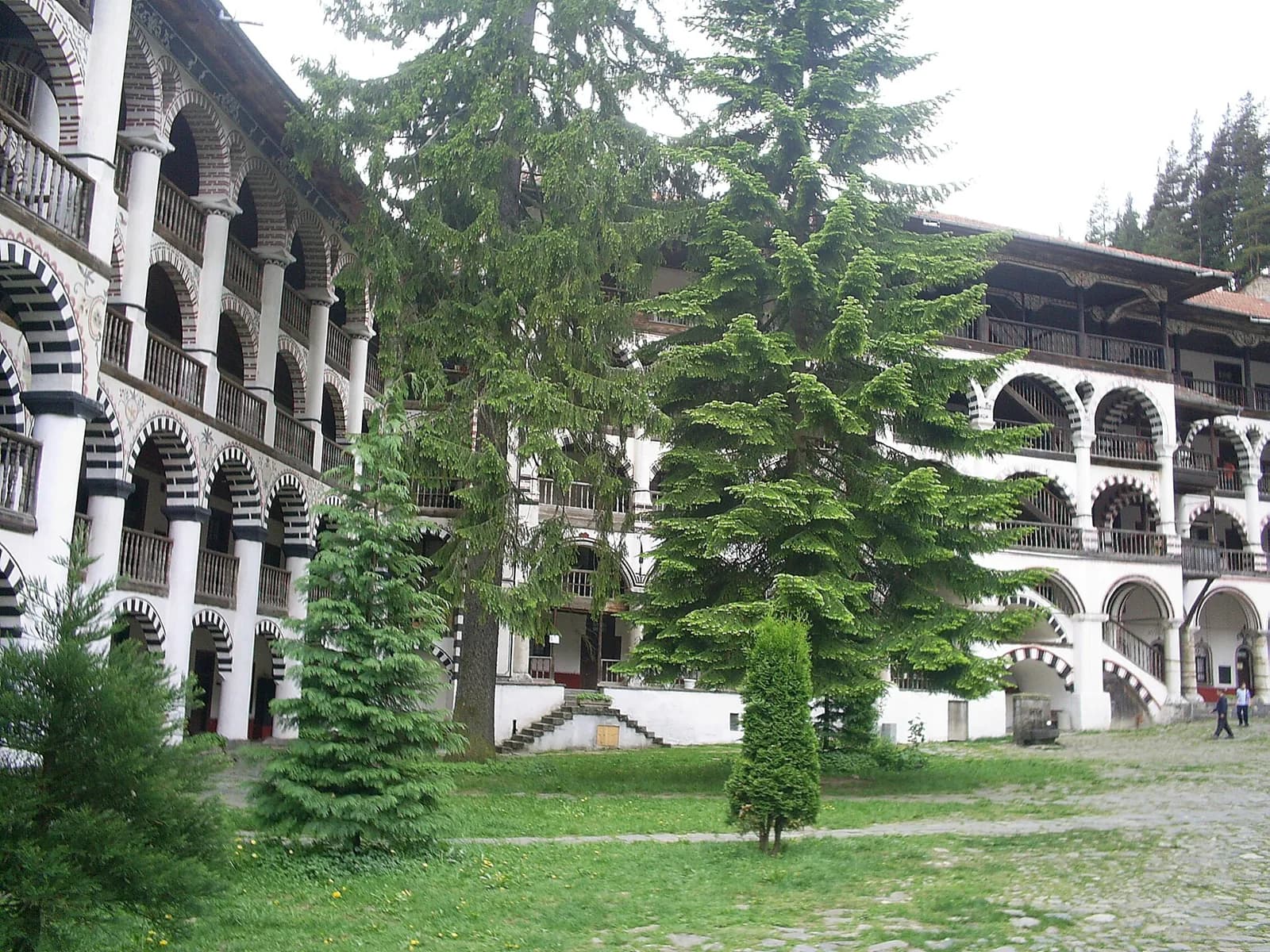
Most of what you walk through today is younger. A fire on 12 January 1833 destroyed every building except the tower and the church of the time. Reconstruction began the next year under the master builder Alexi Rilets, and the new main church was finished in 1837 (Bulgarian Wikipedia). The result is a 19th-century National Revival complex wrapped around a 14th-century tower, which is exactly the contrast that makes the visit interesting.
What to see
The courtyard
Tall residential wings with arcaded galleries close in an irregular courtyard, with the church in the middle and Hrelyo's Tower beside it. The upper floors are monks' quarters and are not open to visitors (visitor requirements). Walk the full circuit of the courtyard before going indoors to take in the scale of the wings against the wooded slopes above.
Church of the Nativity of the Virgin
The main church is a five-domed building in the Mount Athos tradition, built between 1835 and 1837 by master Pavel Ivanovich from Krimin. Its carved iconostasis dates from 1840, and the wall paintings were completed in 1846 by a team that included the brothers Zahari Zograf and Dimitar Zograf of the Samokov school (Bulgarian Wikipedia; Wikipedia). The painted outer gallery is the part you can study at leisure, since photography is not allowed inside. The church is a working place of worship and holds the relics of Saint John of Rila, so expect pilgrims and services alongside sightseers.
Hrelyo's Tower
The oldest building in the complex, built in 1335, is a five-storey stone tower 23.6 m high. Its top floor holds a chapel of the Transfiguration with 14th-century frescoes, the main reason to climb it (Hrelyo's Tower).
Church History Museum and Raphael's Cross
If you buy only one ticket, buy this one. The museum traces the monastery from its founding to the 19th century through manuscripts, early printed books and prints (Church History Museum). Its centrepiece is Raphael's Cross, a wooden cross carved by the monk Raphael with 104 religious scenes and about 650 miniature figures; the work took at least 12 years and was finished in 1802 (Wikipedia).
The other four exhibitions
- Icon Gallery: 80 icons from the 18th and 19th centuries plus 28 portraits of abbots from 1860 to 2005 (Icon Gallery).
- Economy of the Monastery: the old mill, bread oven, logging and beekeeping tools, and the magernitsa, the great kitchen where food was cooked for monks and pilgrims on feast days (monastery economy). Its conical chimney rises 22 m (Bulgarian Wikipedia).
- Ethnographic museum and guest rooms: 18th and 19th-century textiles, costumes and jewellery given by craft guilds and pilgrims, and five guest rooms furnished by the towns of Koprivshtitsa, Teteven, Chirpan, Kyustendil and Gabrovo for their own pilgrims. The Koprivshtitsa, Chirpan and Teteven rooms have the richest carved and painted decoration (ethnographic museum).
Which tickets to buy
Bought one by one, the five adult tickets add up to €17.50; the combined ticket covers all of them for €12 (museum prices). With two hours or less, the Church History Museum and Hrelyo's Tower (€8 together) give you the two highlights. With a full afternoon, the combined ticket is the better buy. Tickets are sold only at the monastery, at the exhibition entrances; museum tickets bought online are not valid (museum information in Bulgarian).
The monastery also offers guided tours of about 50 minutes, priced at €15 in English or French and €8 in Bulgarian (museum information in Bulgarian).
Visiting the church respectfully
The rules apply to the whole complex, not only the church (visitor requirements):
- Cover up: no shorts, short skirts or vests. Carry a light layer if you are coming straight from a hike.
- No smoking anywhere in the complex, no pets and no photography or video inside the church and the museum.
- Inside the church, men remove their hats. Tourist backpacks, prams and other bulky bags are not allowed, so leave them in the car or with someone outside.
- Keep silent, keep your phone away, do not touch icons or the saint's relics, and place candles in the stands provided: the low stands are for the dead, the high ones for the living.
Services run every day: evening service from 17:00, morning service from 06:30 on weekdays and from 08:00 on Sundays and major feasts. In winter they move from the main church to the Nativity of Christ chapel by the monastery bookshop (service times). Sightseeing inside the church is easiest outside those times.
Suggested plans
Two to three hours: walk the courtyard, see the church and its painted gallery, climb Hrelyo's Tower and spend most of your ticket time in the Church History Museum.
A full day: add the kitchen and the ethnographic guest rooms, then walk to the Old Hermitage, the cave where Saint John lived, about 5 km east of the monastery. A church built in 1746 over the place of his original tomb stands beside it (Bulgarian Wikipedia).
Summer evenings: from June to September the Church History Museum stays open until 19:30, while the other exhibitions close at 16:30. A late arrival still gets you the main museum, but not the rest.
If you have a second day in the mountains, the Seven Rila Lakes are the classic high-mountain pairing.
Getting there
The monastery lies about 117 km south of Sofia (Wikipedia). By car, the usual route follows the Struma motorway south and then the road up the Rila valley via the town of Rila. The monastery itself says there is currently no regular public transport to it: you need your own car, an organised tour, or a bus to Blagoevgrad followed by a taxi (how to get there).
Hours and prices
Checked on 8 October 2026 against the monastery's museum pages.
| Exhibition | Adult ticket | Under 18 | Hours |
|---|---|---|---|
| Church History Museum | €5 | €2 | 08:30-16:30; to 19:30 from 1 June to 30 September |
| Hrelyo's Tower | €3 | €2 | 08:30-16:30 |
| Economy of the Monastery | €3 | €2 | 08:30-16:30 |
| Ethnographic museum and guest rooms | €4 | €2 | 08:30-16:30 |
| Icon Gallery | €2.50 | €2 (under 7 free) | 08:30-16:30 |
| Combined ticket, all exhibitions | €12 | - | - |
The courtyard and church are free. For the opening of individual exhibitions on a given day, the monastery's museum phone is 0896 872 016 (museum information in Bulgarian).
Sources & further reading
- Rila Monastery museums - Rila Monastery
- За музеите - работно време, цени и екскурзоводски услуги - Рилски манастир
- Church History Museum - Rila Monastery
- The Icon Gallery - Rila Monastery
- Hrelov Tower - Rila Monastery
- Museum Economy of the Monastery - Rila Monastery
- Ethnographic museum and guest rooms - Rila Monastery
- Requirements to the Visitors - Rila Monastery
- Divine service - Rila Monastery
- About the monastery - Rila Monastery
- How to get there - Rila Monastery
- Rila Monastery - Wikipedia
- Рилски манастир - Уикипедия
Tags
- Rila Monastery
- Bulgarian monasteries
- UNESCO World Heritage
- Rila Mountains
- museum tickets
- day trips from Sofia