Sofia Museums Guide: Which to Visit and How to Combine Them
Sofia's best museums and Boyana Church compared, from Thracian gold and medieval frescoes to socialist sculpture, with day plans, hours and prices.
Sources checked - 8 October 2026
In this article
Sofia holds most of Bulgaria's national collections, and two days here cover a remarkable span: Thracian and Roman treasures, thirteenth-century frescoes on the UNESCO World Heritage List, a park of relocated communist-era monuments and the National Gallery's Bulgarian paintings. Most of the museums sit in or near the historic centre; the National Museum of History and Boyana Church are a bus ride away at the foot of Vitosha.
Which Sofia museums to choose
If you only have time for two or three, pick by interest rather than by name:
- Ancient gold and archaeology: the National Archaeological Museum, then the prehistory and Thracian halls of the National Museum of History.
- Medieval Bulgaria and religious art: Boyana Church, paired with the National Museum of History, also in Boyana.
- Bulgarian painting: Kvadrat 500, the National Gallery's main building.
- The communist period: the Museum of Art from the Socialist Period and its sculpture park.
- Sofia itself: the Sofia History Museum in the old Central Mineral Baths.
- With children: the Natural History Museum, Earth and Man, and the Polytechnic Museum.
- Military history and hardware: the National Museum of Military History.
- Contemporary art: Sofia Arsenal.
Museums in the city centre
National Archaeological Museum
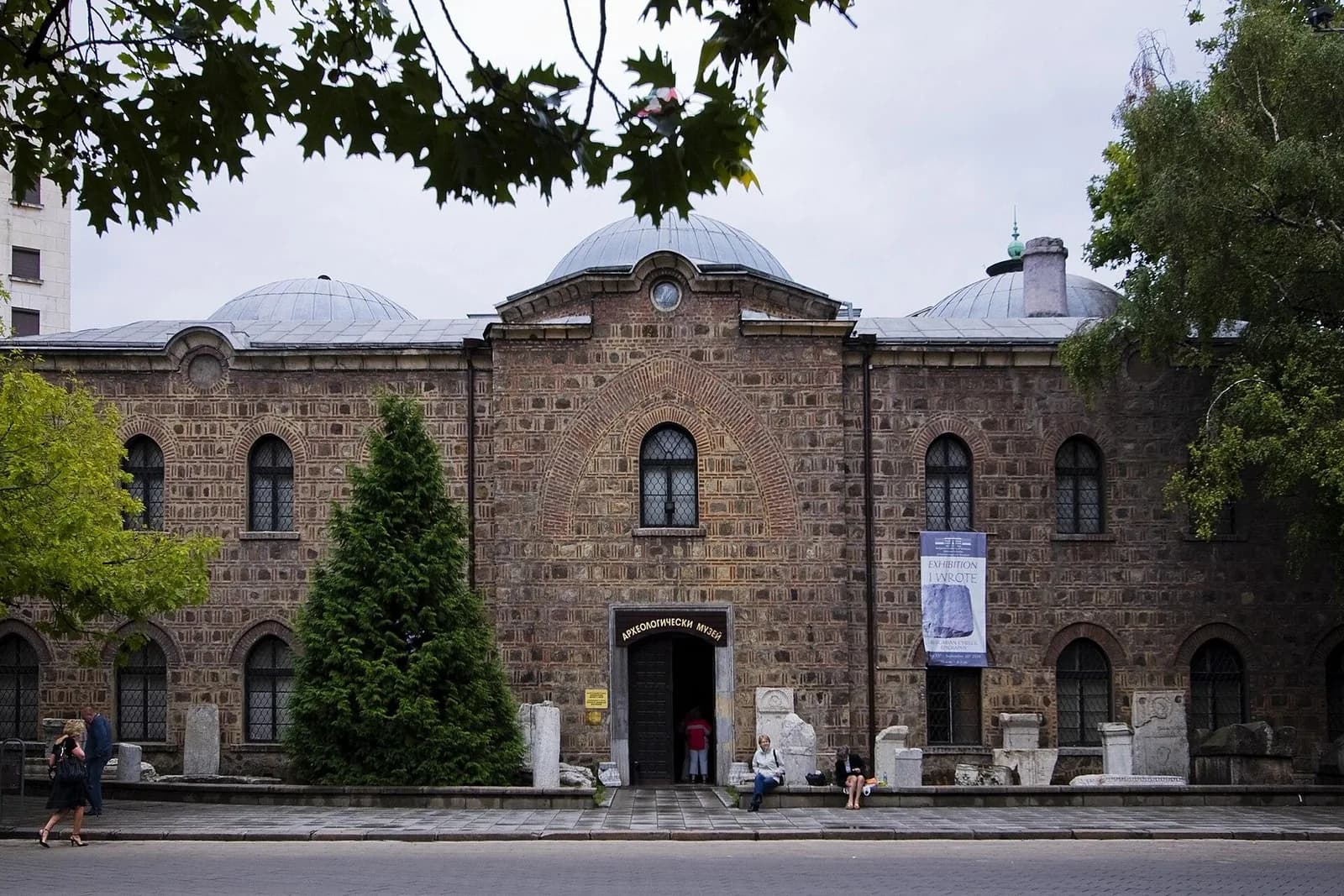
The museum occupies the Büyük Mosque, begun in 1451 for Mahmud Pasha, grand vizier of Mehmed II, and finished in 1494. After the Liberation the building was handed to the new museum, which was formally established here in 1892. A bombing raid on 30 March 1944 destroyed its coin collection, and the building reopened in 1948.
The permanent display is organised in four halls. The Prehistory Hall on the ground floor of the north wing holds one of the largest prehistoric collections in the Balkans. The Vault, upstairs in the eastern building, holds the treasures: grave goods and precious objects from the Late Bronze Age to Late Antiquity. The two-storey Central Hall traces Southeastern Europe from the Late Bronze Age to the late Middle Ages, and a replica of the Madara Horseman above the central staircase leads into the Middle Ages Hall. Allow 90 minutes to two hours. Until 17 January 2027 the temporary exhibition The Forgotten Deities adds another room. A mobile guide in English costs €3, a live English tour €20.
Sofia History Museum
The Central Mineral Baths were designed after Austrian architect Emil von Förster won an 1889 competition; the large bath opened in 1913 and the building reopened as the city's history museum in 2015. Eight themed halls cover 2,300 square metres, with the focus on how a small Ottoman town turned into a European capital after 1879.
The rooms work best in pairs. "A Street in Sofia", "Homes and Clothing of Sofia Residents" and "Cultural Life and Entertainment" build a picture of everyday city life, while "The Dynastic Connection with Western Europe", "The Palace Cabinet" and "State and Municipal Institutions" follow the young monarchy and its administration. "Heritage of Antiquity" and "Strength of the Spirit" cover the older and religious layers. An audio guide in English is €3, and the restored building, a protected cultural monument, is worth a look in its own right.
National Museum of Natural History
Founded more than 130 years ago, this is the oldest museum in Bulgaria, with nearly one and a half million specimens of animals, plants and minerals. Four floors divide neatly by subject (floor plans): minerals on the first, birds, reptiles, fish and fossils on the second, mammals in Halls 10 to 13 on the third, and insects and plants at the top.
The star is in Hall 9: a Parapuzosia ammonite 144 cm across from the Shumen Plateau, about 84 million years old and the largest invertebrate fossil ever found in Bulgaria. The same hall has the country's only known skull of the giant deer Megaloceros. Habitat dioramas with a polar bear, a tiger and a jaguar among macaws give the animal halls their liveliest moments. One to two hours is enough for most visitors.
Kvadrat 500
The National Gallery's main building, on Alexander Nevsky Square, shows around 1,700 works in 28 halls on four levels, drawn from a collection of more than 42,000. Do not try to see it all. For the nineteenth century, look for Zahari Zograf's self-portrait and his portrait of his wife Hristiyania, then Jan Mrkvička's Rachenitsa, a step from church painting towards scenes of everyday life. For the twentieth century, the collection highlights include Ivan Milev's Gadulka Player, Vladimir Dimitrov-Maystora's Reaper and Zlatyu Boyadzhiev's Autumn. Works rotate, so ask at the desk if one painting is the reason for your visit.
Until 21 October 2026 the gallery is showing 21 prints by Francisco Goya, from early etchings to war scenes and fantastic allegories. A separate immersive Zahari Zograf exhibition runs until 30 January 2027 with its own ticket. On Thursdays every National Gallery branch charges €2.
South of the centre: Cherni Vrah Boulevard
Earth and Man
This mineral museum exists because of one gift. In 1985 Iliya Delev, a Bulgarian emigrant in Brazil, donated 53 giant crystals from the Rio Doce valley in Minas Gerais, and the state gave the former Sofia Arsenal building to house them; the museum opened in 1986. Only about 200 such Brazilian giant crystals are known, and the largest collections are in Paris and Sofia. The museum also displays what it calls the largest preserved amethyst geode in Europe, found near Studen Kladenets in Bulgaria.
Beyond the giants, seven permanent exhibitions cover minerals of the world and of Bulgaria, mineral resources, and precious and ornamental stones. An English tour costs €17.90 and needs booking two days ahead.
Sofia Arsenal - Museum of Contemporary Art
Next door at No. 2, a 1916 arsenal building once used for producing and storing artillery ammunition has been a contemporary art museum since 2011. Visits revolve around its changing exhibitions. Until 18 October 2026 it shows MACONDO, Maya Antova-Mayoto's installation marking the centenary of the artist Ivanka Sokerova. At €4 it pairs naturally with Earth and Man.
Further out
National Museum of Military History
Founded in 1916, the military museum holds more than a million items, with about 28,000 on display and 4 hectares of open-air exhibits. The three sections suit different visitors. The outdoor park is for tanks and other large military equipment. The chronological exhibition follows Bulgaria's wars period by period. The collection halls group weapons, uniforms, orders and decorations by type, which is better if you want to compare objects across eras.
The standard ticket of €5.11 covers the outdoor park and the chronological exhibition; the collection halls cost €3.07 extra. Outdoor-only entry is €2.05. Parking is free and the site is wheelchair accessible.
National Polytechnic Museum
Bulgaria's only museum of science and technology has more than 1,000 exhibits covering clocks, telephones and radios, photography and cinema, sound recording, computing and space instruments. Car fans head for the 1928 Ford Model A and the Balkan motorcycles; others for the cylinder phonographs and gramophones. The computing corner is the most Bulgarian part: the ELKA 6521, which the museum presents as one of the world's earliest electronic calculators and the first with a square-root function, and the IMKO microcomputer of 1979, a Bulgarian counterpart of the Apple II Plus. Note that it closes on Sundays but opens on Mondays.
Museum of Art from the Socialist Period
Opened in 2011, this branch of the National Gallery gathered more than 70 monumental sculptures from Bulgaria's communist years, 1944 to 1989, into a 7,500 square metre park. Seen together, away from the squares and buildings they were made for, the monuments read as a record of how the regime wanted to present itself. The five-pointed star that once topped the Party House in central Sofia sits at ground level here. Indoors, a 550 square metre hall hosts temporary exhibitions and a video room screens archival films. Start outdoors in good weather; the hall and films give context afterwards.
National Anthropological Museum
This museum of human remains, disease, trauma and facial reconstruction closed for renovation on 27 May 2026, and no reopening date has been announced. Its collection is unusual enough to be worth a visit once it reopens.
Boyana: the National Museum of History and Boyana Church
National Museum of History
The national history museum, founded in 1973, moved in 1998 into House No. 1 of the former Boyana government residence, a 3,300 square metre building; its permanent exhibition opened in 2000. The collections run to about 650,000 objects.
Four halls carry the main story. Hall 1 covers prehistory, with grave goods from Varna and Durankulak and finds from Dabene in the Karlovo valley, where about 21,000 gold pieces came from ritual stone structures. Hall 2 follows the Thracian lands under Rome, with silver ritual vessels and votive plaques of the Thracian Horseman. Hall 3 covers the medieval Bulgarian state, opening with copies from the Malaya Pereshchepina treasure and moving on to carved church doors, ceramics and everyday tools. Hall 4 explains the Ottoman period and the Revival through rose-oil production, crafts and town clock towers as well as schools and the independence struggle. Plan on two to three hours.
The museum is at 16 Vitoshko Lale Street and is served by buses 63, 111 and 304 and trolleybus 2.
Boyana Church
On the UNESCO World Heritage List since 1979, Boyana Church is a small building with three phases: a tenth to eleventh-century cross-domed church, a two-storey thirteenth-century addition on the west side, and a nineteenth-century extension. Its fame rests on the frescoes painted in 1259. In the narthex, the donors Sebastokrator Kaloyan and his wife Desislava appear beside Tsar Constantine Asen Tikh and Tsaritsa Irina, whose individual, lifelike faces are a large part of the paintings' importance, together with 18 scenes from the life of Saint Nicholas. In the nave, Christ Pantocrator fills the dome above angels and Evangelists, with the enthroned Virgin in the apse.
Visits are short and controlled. No more than nine people may be inside at once and each visit to the medieval parts lasts ten minutes. Photography and filming are forbidden. Individuals and small groups of up to five need no reservation; organised groups must book by email. Decide in advance what you want to look at: the donor portraits first, then the dome.
Suggested plans
Half a day in the centre. Start at the National Archaeological Museum when it opens, then walk to the Sofia History Museum or the Natural History Museum. Add Kvadrat 500 if you have energy left.
One full day. Do the Archaeological Museum in the morning, eat in the centre, then take a bus to Boyana for the National Museum of History and Boyana Church in the afternoon. In winter, aim to reach the church by mid-afternoon: it closes at 17:30.
Two days. Day one as above. Day two: Kvadrat 500 or the Sofia History Museum in the morning, then Earth and Man and Sofia Arsenal on Cherni Vrah Boulevard, or the socialist sculpture park.
With children. Natural History Museum in the morning, Earth and Man after lunch, or the Polytechnic Museum if they prefer machines to minerals. The military museum's outdoor park also works well.
On a Monday. The National Gallery branches, the Sofia History Museum and the military museum are closed. The National Museum of History, Boyana Church, the Natural History Museum, Earth and Man and the Polytechnic Museum all open, and the Archaeological Museum opens on Mondays from May to October.
Hours, tickets and getting around
The National Archaeological Museum, Sofia History Museum, Natural History Museum and Kvadrat 500 are all within walking distance of each other in the historic centre. Earth and Man and Sofia Arsenal are neighbours on Cherni Vrah Boulevard. The outlying museums are a short taxi or public transport ride away, and Boyana is reached by city bus. All prices are in euros.
Hours and adult prices below were checked on 8 October 2026.
| Museum | Opening hours | Adult ticket | Good to know |
|---|---|---|---|
| National Archaeological Museum | May-Oct daily 10:00-18:00; Nov-Apr Tue-Sun 10:00-17:00 | €6 | Last entry 30 min before closing; free on the last Sunday of the month |
| Sofia History Museum | Tue-Sun 10:00-18:00 | €5 | Last entry 17:30; free on the first Thursday of the month; family €10 |
| Natural History Museum | Daily 10:00-18:00 | €6.50 | Last entry 17:30; family €16; ramp and mobile platform |
| Kvadrat 500 | Tue-Sun 10:00-18:00 | €10 | Ticket office until 17:30; €2 on Thursdays |
| Earth and Man | Daily 10:00-18:00 | €5 | Family €7.60; free on the last Monday of the month |
| Sofia Arsenal | Tue-Sun 10:00-18:00 | €4 | €2 on Thursdays |
| Museum of Art from the Socialist Period | Tue-Sun 10:00-18:00 | €8 | €2 on Thursdays |
| Military History Museum | Wed-Sun 10:00-18:00 | €5.11 | Tickets until 17:00; collection halls €3.07 extra; free on the last Wednesday of the month |
| Polytechnic Museum | Mon-Sat; summer 09:30-18:00, winter 09:00-17:00 | €7 | Cash desk closes 30 min earlier; closed Sundays |
| National Museum of History | Daily; Oct-Mar 09:30-18:00, Apr-Sep 09:30-19:00 | €9 | Ticket desk closes 45 min before closing |
| Boyana Church | Daily; Nov-Mar 09:00-17:30, Apr-Oct 09:30-18:00 | €10 | Ten-minute visits, nine people at a time; students €3 |
| National Anthropological Museum | Closed for renovation | - | No reopening date announced |
Most museums close on major holidays such as 1 January, Orthodox Easter and Christmas, and temporary exhibitions change through the year, so check the museum's own page before a special trip.
Sources & further reading
- Entrance tickets and working time - National Archaeological Institute with Museum, BAS
- Permanent exhibitions - National Archaeological Institute with Museum, BAS
- The museum building - National Archaeological Institute with Museum, BAS
- Home page and current exhibitions - National Archaeological Institute with Museum, BAS
- Sofia History Museum main building (Bulgarian) - Regional History Museum Sofia
- Main building: Central Mineral Baths - Regional History Museum Sofia
- Ticket prices - Regional History Museum Sofia
- Visit us: hours, admission and facilities - National Museum of Natural History, BAS
- National Museum of Natural History home page - National Museum of Natural History, BAS
- Floor plans - National Museum of Natural History, BAS
- Hall 9: Palaeontology - National Museum of Natural History, BAS
- Kvadrat 500 visitor information - National Gallery
- Bulgarian Art, 19th Century - National Gallery
- Bulgarian Art, 20th Century - National Gallery
- Francisco Goya: Dreams of a Keen Mind - National Gallery
- Working hours and prices - Earth and Man National Museum
- Giant crystals exhibition - Earth and Man National Museum
- Permanent exhibitions and visitor services - Earth and Man National Museum
- Sofia Arsenal - Museum of Contemporary Art - National Gallery
- Museum of Art from the Socialist Period - National Gallery
- Visit: hours, fares and guided tours - National Museum of Military History
- About the museum - National Museum of Military History
- Exhibitions - National Museum of Military History
- Opening hours - National Polytechnic Museum
- Prices and visitor rules - National Polytechnic Museum
- Permanent exhibition - National Polytechnic Museum
- Closure notice - National Anthropological Museum, IEMPAM-BAS
- Permanent exhibition - National Anthropological Museum, IEMPAM-BAS
- Prices and working time - National Museum of History
- Visit the museum - National Museum of History
- The museum - National Museum of History
- Hall 1: Bulgarian prehistory - National Museum of History
- Hall 2 - National Museum of History
- Bulgaria VII-XIV century - National Museum of History
- Hall 4: Bulgarian Revival - National Museum of History
- Boyana Church - National Museum of History
- Visitors information - Boyana Church
Tags
- Sofia
- museums
- Boyana Church
- National Archaeological Museum
- National Museum of History
- National Gallery
- Bulgaria