Tongariro Northern Circuit: huts, bookings and stages
How to book and walk the Tongariro Northern Circuit: hut and campsite fees, why it is an arc until a planned mid-December reopening, stages, transport and hazards.
Sources checked - 27 October 2026
In this article
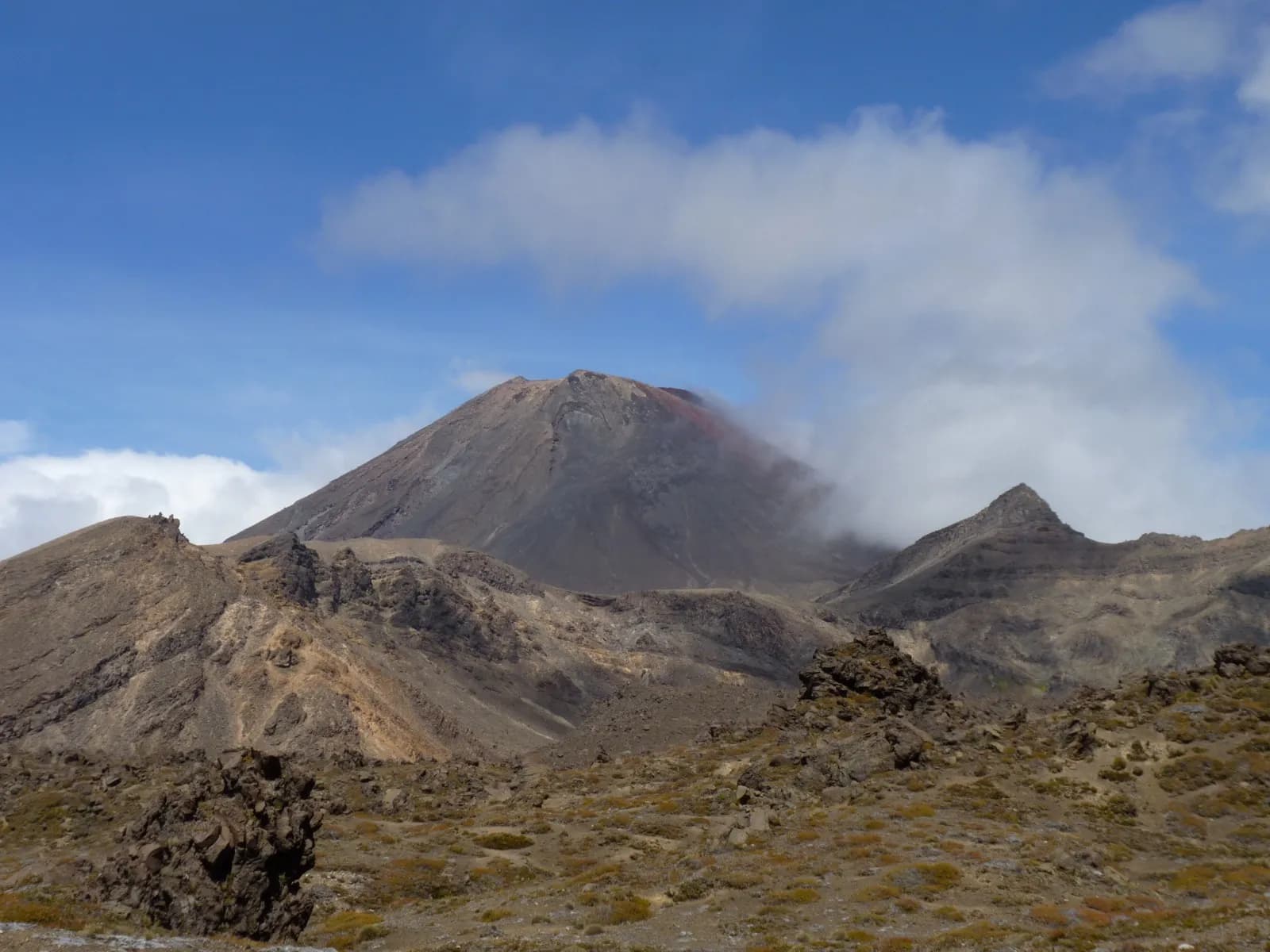
The Tongariro Northern Circuit is a multi-day tramp around Mount Ngauruhoe in Tongariro National Park, run by the Department of Conservation (DOC) as one of New Zealand's Great Walks. The short answer to "how do I book and walk it": book every night in a hut or campsite on the DOC booking system before you go, because bookings are required year-round and no spaces are kept for walk-ins; walk it between 23 October 2026 and 30 April 2027 unless you have alpine skills; and plan around this season's changes. DOC is planning to reopen both the missing track section and the middle hut on 18 December 2026. Until then the walk is not a loop and has no hut in the middle, so the second day is about 20 km over the hardest terrain on the route (DOC; Mangatepopo Hut).
Why the route changes in mid-December
Two separate problems shape the 2026/27 season.
The Mangatepopo Track is closed. This 9.4 km section, also called the Ditch Track, normally links Whakapapa Village with Mangatepopo Hut and closes the loop. Fires that started on 8 November 2025 burned an estimated 2,935 hectares of the park and heavily affected parts of this track (DOC, 16 November 2025). DOC's alert on the track page, last reviewed on 2 October 2026, says the track's structures were damaged by fire and are not safe to use, and that DOC is planning to have it open by 18 December 2026 (DOC). Until then the walk runs one way between the Mangatepopo Road end and Whakapapa Village, which DOC's principal ranger called "less of a circuit, more of an arc" (DOC, 18 May 2026). Fire-damaged land is also under a 10-year restorative rāhui (a customary restriction) placed by Ngāti Hikairo ki Tongariro. It covers the burned areas, not the open tracks and huts, and walkers are asked to keep out of them (DOC, 9 December 2025).
Oturere Hut is being rebuilt. The hut is being replaced by a new 28-bed building with a separate shelter for campers, designed with Ngāti Hikairo ki Tongariro (DOC, 18 May 2026). Weather stopped materials being flown in, and in September DOC moved the opening of the hut and its campsite to 18 December 2026. Walkers with bookings between 22 October and 17 December were to be contacted with a refund or a new date (DOC, 4 September 2026; DOC). DOC's alert states plainly that there is no accommodation between Mangatepopo Hut and Waihohonu Hut, and that the section should only be done by people fit enough to walk 20 km in a day over difficult terrain (DOC).
The body text of DOC's track page has not caught up. On 27 October 2026 it still said the Mangatepopo Track would not be available for the 2026/27 season and that the circuit was not operating as a Great Walk while Oturere Hut is replaced. The alerts at the top of the same page and the September release are newer, and they give 18 December as the plan for both (DOC; DOC, 4 September 2026). Plans are not reopenings: check the alerts on the DOC track page before you book around 18 December, and again in the days before you leave.
Stages and distances
DOC gives these times and distances for each section (DOC):
| Section | Distance | Time | Status on 27 October 2026 |
|---|---|---|---|
| Whakapapa Village to Mangatepopo Hut (Mangatepopo Track) | 9.4 km | 3-5 h | Closed; DOC plans to reopen it by 18 December |
| Mangatepopo car park to Mangatepopo Hut | 1.7 km | 25 min | Open |
| Mangatepopo Hut to Emerald Lakes, over Red Crater | 8 km | 3 h 30 min | Open |
| Emerald Lakes to Oturere Hut | 4 km | 1 h 30 min | Open; hut closed, due to reopen 18 December |
| Oturere Hut to Waihohonu Hut | 8.1 km | 3 h | Open |
| Waihohonu Hut to Whakapapa Village | 15.4 km | 5 h | Open |
The headline numbers are easy to misread. The full loop from Whakapapa Village is 44.9 km, the sum of the hut-to-hut sections. DOC's shortened figure of 35.5 km is that loop minus the closed Mangatepopo Track, so it is measured from Mangatepopo Hut and does not include the 1.7 km walk in from the car park. From the car park to Whakapapa Village the arc is 37.2 km.
Choosing an itinerary
DOC says most walkers take three or four days and that the track can be walked in either direction. Very fit walkers can do it in two days with one night, but each day is at least 8 hours (DOC). With the planned dates, the realistic options are:
- Before 18 December: the arc in three days, two nights. Walk 25 minutes in to Mangatepopo Hut on the first afternoon. The second day climbs over Red Crater, passes the Emerald Lakes, drops into the Oturere Valley and continues to Waihohonu Hut: 20.1 km and about 8 hours of walking on DOC's section times. The third day is 15.4 km to Whakapapa Village past the Tama Lakes junction and Taranaki Falls.
- Before 18 December: two days, one night. Car park to Waihohonu Hut in one day is about 21.8 km and 8.5 hours, followed by the 5-hour day to Whakapapa. Only for people who are comfortable with a long alpine day.
- From 18 December, if both reopenings happen: the full loop in four days, three nights. Start and finish at Whakapapa Village and stay at Mangatepopo, Oturere and Waihohonu. This breaks the Red Crater crossing into a 12 km day and needs no shuttle, because you return to your car.
The Red Crater section between Mangatepopo Hut and the Emerald Lakes is shared with the Tongariro Alpine Crossing, so expect day walkers there. Mangatepopo Hut is the only hut close to the Crossing and gets extra day traffic in summer (Mangatepopo Hut). You do not need a separate Crossing booking if you hold a Northern Circuit hut or campsite booking (Tongariro Alpine Crossing booking system).
Which way round matters on one section. The 400 m descent from the lowest Emerald Lake into the Oturere Valley is steep, with small sharp rocks over hard lava, and DOC says it is most slippery in dry conditions (DOC). Walking from Mangatepopo, as described above, means descending it. Walking the other way means climbing it with a full pack and then going down the loose slopes of Red Crater towards Mangatepopo.
Booking and fees
Book online through DOC's Great Walks booking system or through the Tongariro National Park Visitor Centre in Whakapapa Village. Visitor centre and phone bookings carry a $10 service fee. If no space shows online, the hut is full. Same-day bookings are possible online until 8 pm if beds remain (Mangatepopo Hut; Waihohonu Hut).
Prices are per person per night in New Zealand dollars (DOC fees and bookings):
| Hut, 23 Oct-30 Apr | Campsite, 23 Oct-30 Apr | Hut, 1 May-22 Oct | Campsite, 1 May-22 Oct | |
|---|---|---|---|---|
| Adult, New Zealand rate (18+) | $44 | $19 | $25 | $10 |
| Adult, international rate (18+) | $66 | $28 | $25 | $10 |
| Child, New Zealand rate (5-17) | $22 | $9 | $12.50 | $5 |
| Child, international rate (0-17) | $33 | $14 | $12.50 | $5 |
| Infant, New Zealand (0-4) | Free | Free | Free | Free |
The lower rate is for New Zealand citizens and people ordinarily resident in New Zealand. You may be asked to prove it on the track, for example with a passport, a New Zealand driver's licence or a bill showing your address. If you cannot, you pay the difference plus a $50 administration fee per person. Using a hut or campsite without a valid booking costs the normal fee plus a full adult fee, and you can be turned away if it is full. The exception is a hut used as emergency shelter in bad weather, and even then you only get a bunk that nobody has booked (DOC terms and conditions).
The same terms set the cancellation charges for Great Walks. Cancelling 15 or more days before your first night costs 10%, between 14 and 4 days before 50%, from 3 days before 75%, and on the day before or the day of arrival 100%; cancelling on the day you book or the day after is free if the trip is more than two days away. A booking cannot be moved to a different hut or campsite, only to other dates in the same season, and no waitlist is kept. If DOC itself closes a hut or track, for example for fire, volcanic activity or an orange or red weather warning, you can ask within seven days for a refund of the unused nights or a new date (DOC terms and conditions). Bad weather that does not close the track does not entitle you to a free change.
The huts and campsites
There are three huts, each with a campsite nearby. Camping is not allowed within 500 m of the track (DOC). In the Great Walk season the huts have mattresses, heating, non-flush toilets, solar lighting, basic gas cooking and a DOC ranger. Tap water is not treated, so boil it. There is no food, cookware or showers, and the bunkrooms themselves are not heated; DOC's gear list includes a three- to four-season sleeping bag (see how sleeping bag temperature ratings work).
- Mangatepopo Hut: 20 bunks at 1,190 m in the Mangatepopo Valley, a 1974 hut with sunset views to Taranaki on clear evenings (Mangatepopo Hut).
- Oturere Hut: closed, with the new 28-bed hut due to open on 18 December 2026 (DOC, 18 May 2026; DOC, 4 September 2026). It sits at the edge of the jagged lava flows that fill the Oturere Valley.
- Waihohonu Hut: 28 bunks at 1,150 m, heated by a wood burner with firewood flown in once a year. Mobile coverage is reasonably good along the track, with some gaps, but generally absent or very limited here (Waihohonu Hut; DOC).
Carry all your food plus a spare day's worth in case weather holds you in a hut. Nothing is sold on the track.
What you walk through
The route is a sequence of volcanic landforms rather than a single viewpoint. From Mangatepopo the track climbs over old lava flows from Ngauruhoe, the youngest and blackest of them erupted in 1949 and 1954. A five-minute detour leads to the cold Soda Springs. Above the Mangatepopo Saddle the track crosses South Crater, which is a drainage basin rather than a true crater, then climbs to Red Crater, the highest point of the walk at 1,886 m (DOC; Wikipedia). The dark band on the far wall of Red Crater is a dike, an old magma feeder exposed by erosion. Below it the Emerald Lakes fill old explosion pits and take their colour from minerals washed down from Red Crater's thermal area (DOC).
East of the mountains the landscape turns to open gravel fields, where eruptions, altitude and climate keep plants sparse, then to beech forest before Waihohonu. Side trips from that end of the walk are short and worth planning into the day (DOC):
- Historic Waihohonu Hut, built in 1903/04, the first hut in the park: 20 minutes return from the modern hut.
- Ohinepango Springs, where cold water pours out from under an old lava flow: about 1 hour return from Waihohonu Hut.
- Tama Lakes, two water-filled explosion craters off the Tama Saddle: the lower lake (1,200 m) is about 10 minutes from the junction, the upper lake (1,314 m) a further steep climb, about 1 hour 30 minutes return.
- Taranaki Falls, on the last hour into Whakapapa Village if you take the lower branch of the loop.
DOC asks walkers not to climb the summits of Ngauruhoe and Tongariro. Ngāti Tūwharetoa, who gifted these sacred peaks to the nation, regard climbing them as disrespectful and unacceptable (DOC).
Getting to the start
Until the loop reopens you need transport between the two ends. Parking at the Mangatepopo car park is limited to 4 hours during the Great Walk season, so DOC advises parking in Whakapapa Village and taking a shuttle to the start, or using a shuttle from a nearby town. Overnight parking in Whakapapa Village needs a free permit from the Tongariro National Park Visitor Centre. Bus and train services stop at National Park Village (Waimarino), 15 km from Whakapapa Village (DOC getting there). DOC's "find a shuttle provider" link goes to the regional tourism site's list of Tongariro Alpine Crossing shuttles. On 27 October 2026 it listed nine services, most based in National Park Village and others in Ohakune, Raetihi and Ōwhango, with fares listed from about $45 to $110. Those fares are for Crossing day trips; only one listing, Tongariro Crossing Shuttles, mentions the Northern Circuit and Whakapapa Village (Visit Ruapehu). Ask any operator for a one-way drop at Mangatepopo on your start day and what it charges, and arrange your Whakapapa parking permit first. The visitor centre is on State Highway 48 in Whakapapa Village, phone +64 7 892 3729 (Tongariro Alpine Crossing booking system).
Weather, volcanoes and who should go
Most of the track is open, exposed and uneven, and DOC does not recommend it for children under 10. Weather can turn from warm and sunny to cold, wet and windy quickly, and wind chill on the tops can be severe, so check the NIWA forecast for the park before each day. The loose rock on Red Crater's slopes is the main slip hazard (DOC).
The track crosses an active volcanic area where eruptions are unlikely but can happen at any time, with little or no warning (DOC). On 27 October 2026 GeoNet had Tongariro and Ngauruhoe at Volcanic Alert Level 0 (no unrest) and Ruapehu at Level 1 (minor unrest), and DOC's risk management was at its normal Stage A for all three (GeoNet; DOC volcanic risk). Red Crater, which the track crosses, is one of Tongariro's three active vents, and DOC says a rise in the alert level at Tongariro or Ngauruhoe will close the track or sections of it; that is the kind of DOC closure that lets you claim a refund or new date under the terms above (DOC volcanic risk; DOC terms and conditions). Check both pages again before you set out. If an eruption does start, DOC's advice is to move away from the eruption site and out of valleys, sideways to higher ground, because lahars (volcanic mudflows) follow valleys, and to shelter behind a bank or ridge with your pack over your head if rocks or an ash cloud are coming towards you (DOC volcanic risk).
Dogs are not allowed, and flying a drone needs a permit (DOC).
Outside the Great Walk season
From 1 May to 22 October the track is graded advanced to expert. Snow and hard ice can hide the markers, avalanches are most likely from July to October, and the Red Crater section is particularly complex. The huts have no gas cookers or rangers, running water may be off, and DOC expects an ice axe, crampons, an avalanche transceiver, probe and shovel, a locator beacon and the skills to use them. Mangatepopo and Waihohonu huts still need to be booked, at the lower winter rate (DOC; Mangatepopo Hut; Waihohonu Hut). For most visitors the practical window is late October to April.
Sources were checked on 27 October 2026. This guide is based on DOC, GeoNet and Visit Ruapehu information, not a walk of the track.
Sources & further reading
- Tongariro Northern Circuit - Department of Conservation
- Tongariro Northern Circuit: fees and bookings - Department of Conservation
- Tongariro Northern Circuit: getting there - Department of Conservation
- Loop linked again as work continues on Tongariro Northern Circuit (4 September 2026) - Department of Conservation
- New hut, updated route for Tongariro Northern Circuit walkers (18 May 2026) - Department of Conservation
- Tongariro Alpine Crossing reopens (16 November 2025) - Department of Conservation
- Tongariro fire: tracks reopen (9 December 2025) - Department of Conservation
- Mangatepopo Hut - Department of Conservation
- Waihohonu Hut - Department of Conservation
- Oturere Hut - Department of Conservation
- Huts, campsites, Great Walks, cabins and lodges terms and conditions - Department of Conservation
- Tongariro Alpine Crossing booking system - Department of Conservation
- Volcanic risk in Tongariro National Park - Department of Conservation
- Volcanic alert levels - GeoNet (GNS Science)
- Tongariro Alpine Crossing shuttles - Visit Ruapehu
- Tongariro Northern Circuit - Wikipedia
Tags
- Tongariro Northern Circuit
- Great Walks
- Tongariro National Park
- Ngauruhoe
- Red Crater
- Emerald Lakes
- DOC huts
- New Zealand