In this article
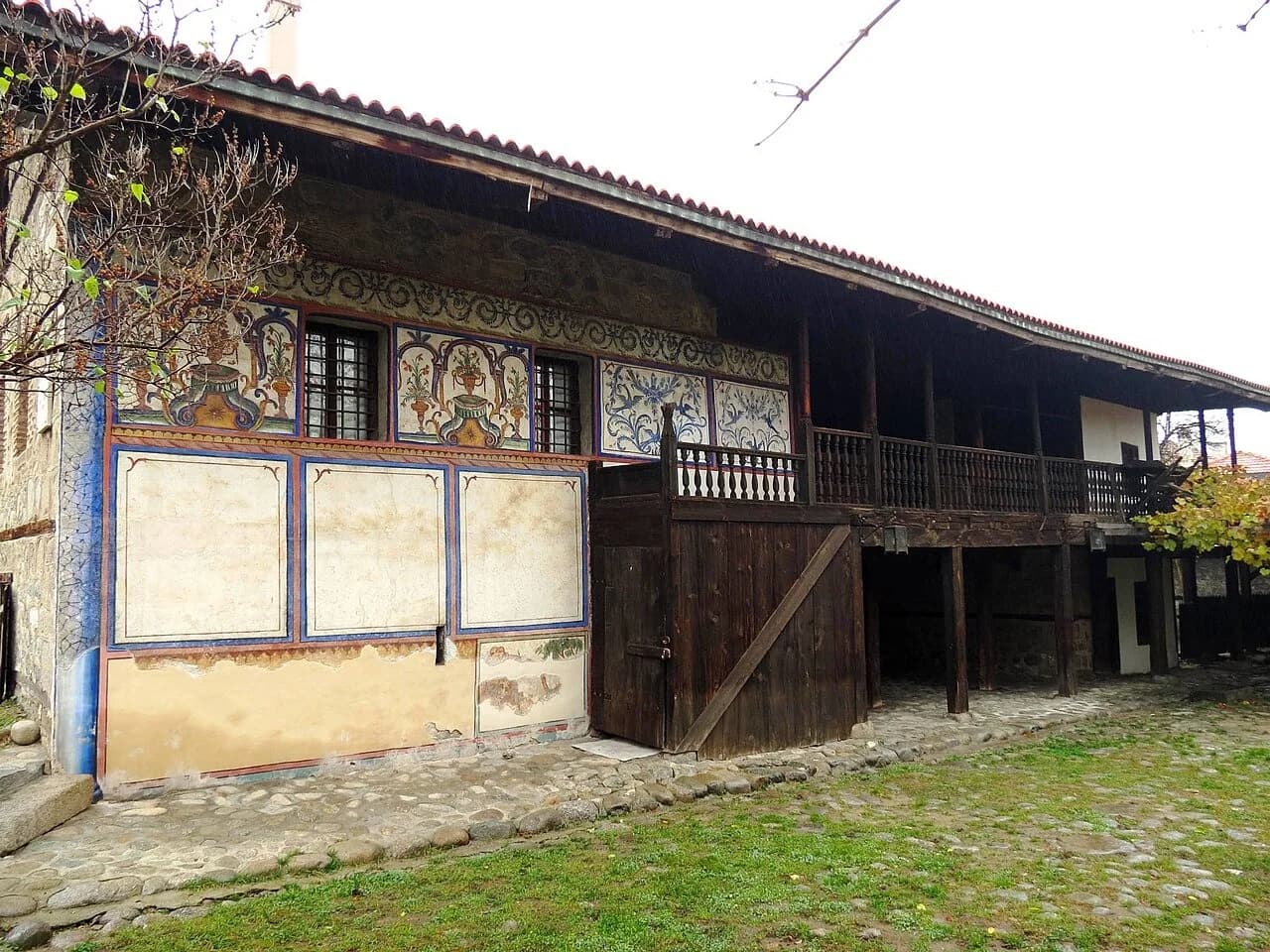
Most people know Bansko as a ski resort, but its old town is one of the most rewarding Revival-era quarters in Bulgaria: stone houses built like small fortresses, rooms painted with imaginary European cities, and the birthplaces of men who shaped Bulgarian schooling and religious art. Give the lanes around Vazrazhdane Square a full day, then use the Razlog valley as a base for Razlog's masquerade museum, the bear sanctuary above Belitsa and the Roman town of Nicopolis ad Nestum in the Mesta valley.
Why Bansko's old town is worth a day
In the 18th and 19th centuries Bansko lived from trade and crafts. Its caravans took wooden, leather and iron goods south to the Aegean hinterland around Serres and Drama and returned with cotton, fish, tobacco, olives and hides (Bansko Municipality). That wealth built the thick-walled stone houses that still line the old streets, with hiding places on the ground floor and carved, painted living rooms above.
Trade also brought ideas. The town produced Paisius of Hilendar, born here in 1722 and author of the Slavo-Bulgarian History; the teacher and scholar Neofit Rilski (1793-1881); and Toma Vishanov, known as Molera, who founded the Bansko school of painting. Bansko was liberated from Ottoman rule on 5 October 1912. Almost every museum in town picks up one of these threads, which is why the houses work best as a set rather than as isolated stops.
What to see in Bansko
Bansko Museums runs six sites in town, all within a few minutes' walk of each other, plus the House of Arts on Vaptsarov Square and a small exhibition in nearby Dobrinishte (Bansko Museums).
Velyanova House: defence below, colour above
If you see only one house, make it this one. It is a two-storey 18th-century stone building with a cellar and a hiding place on the ground floor, small grilled windows and guest, family and living rooms upstairs. The painter Velian Ognev, a master of the Debar school, decorated those rooms with murals and carved wooden ceilings: views of European cities meant to stir curiosity about distant places, celestial bodies, and closely observed domestic scenes (Velyanova House). The contrast between the closed, defensive lower floor and the bright rooms above tells you a lot about how a prosperous Bansko family lived. The house became a museum in 1977. Book the €5 guided tour if you want the paintings explained room by room.
Neofit Rilski House: a family home and a schoolroom
The Beni family house stands in a walled courtyard beside Holy Trinity Church and has been a museum since 1981. Its plan follows the fortified Bansko type: a two-part hiding place and a kneading room below, and upstairs the family rooms and a small cell school, the church-run classroom where children learned to read before secular schools existed. A wide wooden gallery leads across to the former outbuildings, now a documentary hall with Neofit's Bulgarian Grammar of 1835, parts of his Greek-Bulgarian dictionary and books from his own library (Neofit Rilski House).
The grammar belongs to a turning point in Bulgarian education. The school that opened in Gabrovo on 14 January 1835 used the mutual method, in which one teacher ran a class of 100 to 200 pupils with the help of older pupils acting as monitors, who led reading from tables hung on the walls. Neofit was its teacher, wrote the grammar and translated the reading tables (National Museum of Education). Seeing the tiny cell school first and the printed grammar afterwards makes that change easy to grasp.
Nikola Vaptsarov House: the poet's childhood and later life
Opened in 1952, this was the first museum in the Pirin region. Downstairs are the reconstructed rooms of the poet's childhood home, including his mother's study and the guest room, and a handwritten notebook she gave him. Upstairs, documents and photographs follow his life after he entered the Marine Engineering School in Varna, alongside Motor Songs, the only collection of his poetry published in his lifetime, and a World Peace Council award (Vaptsarov House). It is the only museum in town open every day, so it is the obvious choice for a Sunday or Monday.
Radonova House, the Icon Exhibition and the Paisius Centre
Radonova House is the broad local-history museum. On the ground floor of this early-19th-century house are ceramics, coins, glass and jewellery found in the area, ranging from the Thracian period to the Middle Ages; the ethnographic rooms show tools, household objects, everyday and festive costumes, jewellery and textiles (Radonova House). With children, pick one coin, one pot and one costume and compare them rather than reading every label.
The Permanent Icon Exhibition, open since 1986 in a historic building that belonged to Hilendar Monastery, is the place to understand the Bansko school of painting. It concentrates on original icons by Toma Vishanov and his descendants Dimitar and Simeon, alongside other local painters (Icon Exhibition). Visit it just before the church to recognise the same tradition in its setting.
The St Paisius of Hilendar Centre is a new building on the site of Paisius's birthplace. Its centrepiece is a replica of the cell at Hilendar where he wrote his History, with a reconstructed chapel of St Ivan Rilski and displays on his associates, Abbot Lavrentiy and the donor Hadzhi Valcho (Paisius Centre). It is an interpretation centre rather than a historic interior, so it suits readers who want the story of the History more than an old house.
Holy Trinity Church
Built in 1835 by local masters at the initiative of the merchant Lazar German, the church, its bell tower and the surrounding walls are protected as an architectural monument and are free to visit all year (Ministry of Tourism). It sits next to the Neofit Rilski House, so the two make a natural pair.
Pirin on the doorstep
Bansko lies at the foot of Pirin National Park, on the World Heritage List since 1983 and enlarged in 2010, when the ski zones above Bansko and Dobrinishte were moved into the buffer zone (UNESCO). For half-day walks from the gondola or Vihren hut, see Pirin day hikes from Bansko.
Razlog: two museums and a New Year festival
Razlog is about 20 minutes north of Bansko on the Sofia buses. Its Historical Museum occupies two houses with different subjects.
Parapunova House, on 15 September 1903 Square near the centre, is a fine example of the Razlog-Chepino building style. Built in the late 19th century, it was destroyed during the Krastovden fighting of 1903 and rebuilt in 1904-1905. It holds the main collection of more than 5,000 objects: archaeology, weapons, early printed books, Razlog costume and local crafts (Parapunova House).
Patokova House has housed the Museum of the Razlog Chaush since 2023. Chaush is the local word for a kukeri mummer, and the displays cover the kukeri and survakari of Starchevata as well as customs for Babinden, Easter and St George's Day (Patokova House). Starchevata itself takes over the town on 1 January: each neighbourhood parades its chaushi in long-haired leather costumes hung with bells, followed by dancers in Razlog dress (BTA). Outside New Year, Patokova House is where you see those costumes up close.
Bear Sanctuary Belitsa
Keeping "dancing bears" was banned in Bulgaria in 1998, and in 2000 FOUR PAWS and the Fondation Brigitte Bardot opened this sanctuary above Belitsa to house them. The last Bulgarian dancing bears arrived in 2007; today it also cares for bears rescued from poor conditions in Albania, Croatia, North Macedonia, Serbia, Ukraine and Argentina (Bear Sanctuary Belitsa).
Guided tours in Bulgarian and English leave every half hour and last 30-40 minutes, and guides tell the history of individual bears, explain hibernation and may point out a den. The bears share 12 hectares and choose where to spend their time, so sightings are never guaranteed; that freedom is the purpose of the place. Allow about an hour and a half on site. The paths are steep, with more than 100 steps, so the visit is not suitable for people with limited mobility or for pushchairs; wear proper shoes.
The sanctuary is at Andrianov Chark, 12.4 km above the town of Belitsa, which is about 20 km from Bansko. The last 2.4 km of road are under construction; plan to arrive by car or taxi.
Gotse Delchev and Nicopolis ad Nestum
The Bansko buses continue south to Gotse Delchev in about an hour, into the Mesta valley, the ancient Nestos.
The Municipal Historical Museum, opened in 1979, has archaeology, history, ethnography and art collections (museum). Its ethnography rooms are the highlight: more than 20 women's costumes; the shamia, a yellow or red flowered headscarf usually bought at the Thessaloniki fair; and livestock bells. The chan bells were made in sets tuned across an octave and a half, cast from copper, zinc and tin in a 6:1:1 ratio with silver added for a clearer tone, while the big tyumbelek bells hung on the largest billy goats and doubled as percussion in wind bands (ethnography department).
Nicopolis ad Nestum, at Garmen about 7 km east of town (Wikipedia), is one of three cities Emperor Trajan founded after his victory over the Dacians in 106; the name means "city of victory on the Mesta" (Garmen Municipality). Excavations in 1980-1984 exposed walls 2.4-2.6 m thick and up to 5 m high, with four round towers on the south side and a gate guarded by two near-square towers. Just inside the south wall are baths with a changing room and cold and hot pools, and in the south-east corner a peristyle house built around a courtyard with a marble colonnade (historical overview). See the museum first and the ruins second; the objects make the low walls easier to read.
Suggested plans
One day in Bansko (Tuesday to Saturday). Start at Velyanova House at 09:00, walk to the Icon Exhibition, then Holy Trinity and the Neofit Rilski House next door (closed on Tuesdays). After lunch, choose Radonova House or the Paisius Centre and finish at the Vaptsarov House, open until 17:30 on weekdays. Most museums close for lunch from 12:00 or 13:00, so plan the break around that. Three museums on one combined ticket cost €6; six cost €13 and the ticket is valid for three days.
Sunday or Monday. Velyanova, Radonova, the Icon Exhibition and the Paisius Centre are closed, but the Vaptsarov House opens daily and the Neofit Rilski House closes only on Tuesdays. Pair them with Holy Trinity in the morning, then go up into Pirin.
Two days. Add Razlog in the morning and Belitsa in the afternoon (the sanctuary opens at noon outside July and August), or spend the second day on Gotse Delchev and Nicopolis ad Nestum. The Gotse Delchev museum is closed on Mondays and free on Thursdays.
Season. The bear sanctuary closes from December until spring, so autumn is a good time to combine all three areas. Come on 1 January for Starchevata.
Getting there and around
- By bus. Sofia Central Bus Station's 2026 timetable has several daily buses to Bansko, taking about three hours for €14, via Blagoevgrad and Razlog; most continue to Gotse Delchev (Central Bus Station). The same buses link Razlog, Bansko and Gotse Delchev.
- By train. Bansko and Razlog are on the narrow-gauge Septemvri-Dobrinishte line. From Sofia it takes six and a half hours or more with a change at Septemvri (BDZ), so take it for the scenery rather than speed; see Bulgaria by train and bus for hikers.
- By car. A car makes the bear sanctuary and Nicopolis ad Nestum far easier to combine in one day.
- Information. The tourist information centre is in the 1929 Old Cinema building at 4 Vazrazhdane Square, open Monday to Friday 09:00-12:00 and 13:00-18:00, Saturday 10:00-13:00 and 14:00-18:00 and Sunday 10:00-14:00 (Visit Bansko).
Hours and prices
Checked on 8 October 2026 with each operator. Hours shift with the seasons, so phone ahead if one site is the main reason for your trip.
| Site | Hours | Adult ticket |
|---|---|---|
| Velyanova House | Tue-Sat 09:00-12:00, 13:00-17:00 | €3; guided tour €5 |
| Neofit Rilski House | 09:00-13:00, 14:00-17:00; closed Tue | €3 |
| Nikola Vaptsarov House | Mon-Fri 09:00-13:00, 14:00-17:30; weekends and holidays until 17:00 | €3 |
| Radonova House | Tue-Sat 09:00-12:00, 13:00-17:30 | €3 |
| Icon Exhibition and Paisius Centre | Tue-Sat 09:00-12:00, 13:00-17:00 | €3 each |
| Bansko combined tickets | Any three museums / six museums over three days | €6 / €13 |
| Holy Trinity Church | All year | Free |
| Razlog Historical Museum | Contact +359 87 892 0530 (museum) | Ask on site |
| Bear Sanctuary Belitsa | Apr-Jun and Sep-Nov 12:00-18:00; Jul-Aug 10:00-12:00, 13:00-18:00; closed Dec to spring; last tour 17:30 | €8 cash; ages 7-18 €2.50 |
| Gotse Delchev museum | Tue-Sun 08:30-12:00, 13:00-17:30 (visitor page) | €2.05; free on Thursdays |
| Nicopolis ad Nestum | Open year-round; phone 0894 349 039 | Ask on site |
Reduced tickets at the Bansko museums are €2 for pupils and pensioners, and a family ticket costs €5.
Sources & further reading
- History of Bansko - Bansko Municipality
- Bansko Museums: sites and combined tickets - Bansko Museums
- Museum Velianova House - Bansko Museums
- House-Museum Neofit Rilski - Bansko Museums
- House-Museum Nikola Vaptsarov - Bansko Museums
- Historical and Ethnographic Complex Radonova House - Bansko Museums
- Permanent Icon Exhibition - Bansko Museums
- Spiritual and Historical Center St. Paisius of Hilendar - Bansko Museums
- Holy Trinity Temple, Bansko - Ministry of Tourism of Bulgaria
- School reconstructions: mutual teaching - National Museum of Education, Gabrovo
- Tourist Information Centre Bansko - Bansko Municipality / Visit Bansko
- Pirin National Park - UNESCO World Heritage Centre
- Parapunova's House - Historical Museum Razlog
- Patokova's House: Museum of the Razlog Chaush - Historical Museum Razlog
- Historical Museum Razlog contacts - Historical Museum Razlog
- Preparations for the Starchevata festival in Razlog - BTA Bulgarian News Agency
- BEAR SANCTUARY Belitsa - BEAR SANCTUARY Belitsa / FOUR PAWS
- Municipal Historical Museum Gotse Delchev - Municipal Historical Museum Gotse Delchev
- Ethnography department - Municipal Historical Museum Gotse Delchev
- Visitor information - Municipal Historical Museum Gotse Delchev
- Nicopolis ad Nestum landmark record - Garmen Municipality
- Nicopolis ad Nestum historical overview - Garmen Municipality
- Nicopolis ad Nestum - Wikipedia
- Bus Sofia - Bansko timetable - Sofia Central Bus Station
- Sofia - Bansko train journeys - BDZ Passenger Services
Tags
- Bansko
- Razlog
- Pirin
- house museums
- Bear Sanctuary Belitsa
- Gotse Delchev
- Nicopolis ad Nestum
- Bulgarian Revival