Melnik, Rupite and the Struma valley: southwest Bulgaria guide
Melnik's sand pyramids and wine houses, Rozhen Monastery, Heraclea Sintica, Samuil's Fortress, Sandanski's mosaics and Blagoevgrad, with plans and prices.
Sources checked - 8 October 2026
In this article
The far southwest of Bulgaria, where the Struma river runs between Pirin and Belasitsa towards Greece, packs a remarkable amount into short distances. Melnik, the smallest town in Bulgaria, sits among sandstone pinnacles and old wine merchants' houses; nearby are a medieval monastery rebuilt in the 18th century, an ancient city identified by a single inscription, the hills where Tsar Samuil's army was destroyed in 1014, and fifth-century mosaics preserved where they were laid. Plan two or three days, travelling south from Sofia via Blagoevgrad.
How the region fits together
Coming from Sofia, the road and railway follow the Struma south past Blagoevgrad, then Sandanski. Melnik lies 22 km south-east of Sandanski at about 400 m, on the south-western slopes of Pirin, with Rozhen another 7 km beyond it (Sandanski Municipality). Further south, Petrich is the base for Rupite, Heraclea Sintica, Samuil's Fortress and the Belasitsa mountain. Stay in Melnik if wine and the pyramids are the point of the trip; Sandanski or Petrich suit a museum-and-archaeology itinerary.
Melnik
The town and its houses
Melnik is a protected town-museum and cultural-historical reserve. In the 13th century it was the seat of Despot Alexius Slav, who founded the Spileotissa monastery around 1200, and the hill of St Nicholas above town holds the remains of a 9th-10th century fortress. In and around town are the Kordopulova and Bolyarska houses and a string of churches, among them St Barbara, St Anthony, the Holy Mother of God, St Nicholas the Wonderworker and Sts Peter and Paul (Sandanski Municipality). The town's wealth came from wine made from the local Shiroka Melnishka grape, once shipped far across Europe. The Historical Museum on the main street covers the town from antiquity to the early 20th century (Ministry of Tourism).
Kordopulova House: a wine merchant's palace
Built in 1754 on three levels, Kordopulova House is billed by its owners as the largest Revival-era house in Bulgaria and the Balkans. The Kordopulos family traded wine across Europe, mostly to Venice and Paris, and the house was designed to impress their partners. The main guest room covers about 90 square metres and has two rows of twelve windows: the upper row mixes Venetian and Oriental styles, the lower is typically Bulgarian. Its ceiling shows a sun surrounded by twelve geometric figures, read as the apostles and the months. The smaller kyoshka was for intimate gatherings and musicians, the bedroom has stained glass with Bulgarian, Greek, Turkish and Oriental motifs, and a hidden room played a part in the family's business dealings (Kordopulova House).
Below lie the cellar and tunnels where the wine was stored. Basic admission at €5 already includes a tasting of Shiroka Melnishka in the cellar; the 3-, 4- and 5-wine packages (€14, €16 and €18) add commentary and cheese and cured meats. The wine is unfiltered and made by the house, and a guided talk is offered to groups of more than 20 (prices and packages). It opens daily from May to September, Wednesday to Sunday in March-April and October-November, and Thursday to Sunday in winter (opening days).
The Melnik Pyramids
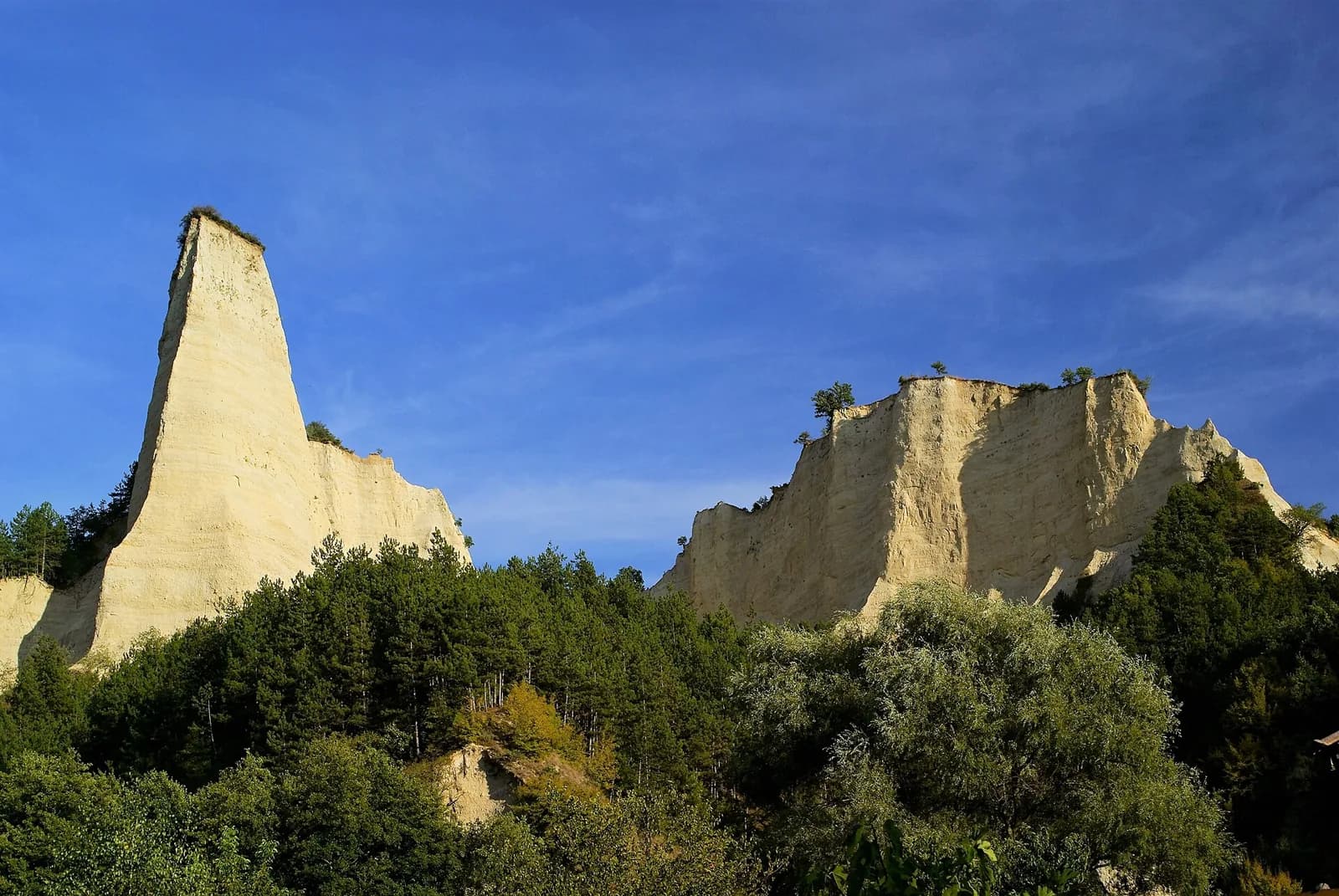
The "pyramids" are sandstone pinnacles, ridges and capped columns spread over about 50 square kilometres, carved by erosion of the clay-rich ground and protected as a natural landmark since 1960. They fall into three groups. Near Kurlanovo stand four obelisk-like pinnacles more than 100 m tall; around Melnik they rise directly behind the town; and south of Rozhen there are thousands of rock "mushrooms", large and small. Other forms resemble haystacks, minarets and miniature alpine ridges (Ministry of Tourism). The landscape has been shaped over roughly four million years and is still changing; access is free all year, and the tourist information centres in Melnik and Sandanski can point you to the paths for each group (destination record).
In summer, walk among them early or late in the day. The Kurlanovo obelisks are the tallest forms; the Rozhen group is the one to combine with the monastery.
Rozhen Monastery
Athonite sources date the monastery to 890. It burned in the 17th century and was rebuilt in the early 18th; its church was finished in 1732. Residential ranges enclose an irregular hexagonal courtyard with the church in the middle, and the refectory, ossuary and some farm buildings survive from before the fire. Inside, look for the well-preserved wall paintings, stained glass and carved woodwork, and for the venerated icon of the Virgin kept in the chapel of Sts Cosmas and Damian (Ministry of Tourism). Entry is free, all year, in daylight. This is a working monastery, so dress modestly and keep voices low. Do not confuse it with the Rozhen observatory, which is in the Rhodopes.
Sandanski: mosaics where they were laid
The Archaeological Museum at 55 Makedonia Street is built over an early Christian basilica, identified as the basilica of Bishop John, whose fifth-century mosaic floors remain in place on the ground floor. Upstairs the collection runs from prehistory to the Middle Ages, with marble grave monuments carrying portrait reliefs typical of the Middle Struma; outside are a 4th-century church complex and a stretch of ancient street (museum; municipality). Elsewhere in town, the separate Bishop's Basilica at 1 Mara Buneva Street adds mosaics, marble altar screens with biblical scenes and a baptistery. Seeing both shows the difference between a single church and a full episcopal complex. Sandanski is an easy stop on the way to or from Melnik.
Petrich, Rupite and Belasitsa
Heraclea Sintica
On Kozhuh hill at Rupite lies a city founded in the 4th century BC in the land of the Thracian Sinti and named after Heracles. The ruins alone did not reveal the city's name. In 2002 a marble slab with a Latin text settled the question: a letter of Emperor Galerius and Caesar Maximinus Daia from 307-308 AD, restoring civic rights to the people of Heraclea. Systematic excavation began in 2007 and has revealed a prosperous town laid out on a regular Hippodamian grid (Petrich History Museum). Nothing is rebuilt: what you see is conserved as it was found, so the visit rewards anyone who enjoys reading streets and foundations. It is open daily from 08:00 to 20:00 between April and October, which makes an early start or a cooler evening visit easy (opening hours).
Rupite: the volcano and Vanga's church
The Rupite locality, on the right bank of the Struma about 8 km from Petrich, is the crater of an extinct volcano, with Kozhuh hill and hot mineral springs (Ministry of Tourism). It is best known as the place where the seer Vanga (1911-1996) received visitors. The church of St Petka of Bulgaria, which she funded, opened on 14 October 1994; its murals and icons by the painter Svetlin Rusev depart freely from Orthodox canon, and the church draws thousands of visitors a year (Vanga's church). Combine it with Heraclea Sintica nearby.
Vanga House in Petrich
Vanga's family home in Petrich, built by her husband Dimitar in 1947, opened as a museum on 5 May 2008. On the ground floor are the prayer room, kitchen and the room where she received visitors until 1980; upstairs are the living room, white salon, bedroom and glazed terrace, all furnished with her belongings and gifts. In her last fifteen years she received people at Rupite but came home to Petrich every evening (Vanga House). Visit it if you are curious about the person; skip it if you came for archaeology.
Samuil's Fortress
Sixteen kilometres west of Petrich, at Strumeshnitsa on the road to the Zlatarevo border crossing, a park-museum marks the battle of 1014. Between 997 and 1014 Tsar Samuil fortified the passes of the region; at nearby Klyuch the army of Emperor Basil II defeated the Bulgarians, and Basil blinded thousands of captured Bulgarian soldiers, earning the name "Bulgar-slayer". The park opened on 23 October 1982. Its archaeological core is modest: 40 conserved small dugout dwellings, a larger "great dugout" and the remains of a watchtower, set among woodland paths and modern memorials (Samuil's Fortress). Come for the setting and the story rather than for castle walls.
Belasitsa: two short walks and a long one
The Belasitsa Nature Park, on the border ridge above Petrich, has two easy themed trails. Life of the Chestnut is a 5.3 km loop from Kolarovo through chestnut forest, about 2 hours 30 minutes. Friends runs from Belasitsa hut to the Leshnitsa waterfall and back, 3.6 km and about 1 hour 40 minutes, with blue waymarks and boards introducing ten tree species (thematic routes). Belasitsa hut itself is about 1 hour 30 minutes on foot from Petrich stadium, and the full climb from Kolarovo to Radomir summit takes about seven hours (park routes).
Blagoevgrad and Rila on the way back
Blagoevgrad's old quarter, Varosha, grew up in the 17th century and was restored in the 1980s; its Revival houses now hold galleries, workshops and arts centres, and the house of the revolutionary Georgi Izmirliev stands here too (Blagoevgrad Municipality). At its heart is the Church of the Presentation of the Virgin, built in 1840-1844 on the model of the Rila Monastery church, with murals by the Bansko painters Mihail Golev, Dimitar Sirleshtov and Kosta Marunchev and icons from the Bansko and Samokov schools. Entry is free (Ministry of Tourism). An hour here breaks the drive back to Sofia nicely.
The Regional History Museum, founded in 1952 and also in Varosha, holds white-painted Neolithic pottery and clay figurines, a large collection of 13th-century sgraffito ware from Melnik, the first printed edition of the Slavo-Bulgarian History (1844) and 24 letters of Gotse Delchev (municipality). Its exhibition is closed for energy-efficiency renovation, with no reopening date announced (museum).
Hikers can go higher. The red-waymarked E4 traverse from Makedonia hut to the Predela pass runs along the Parangalitsa reserve over Malak Mechi Vrah (2,474 m), German (2,484 m) and Ezernik (2,485 m), then drops through forest; it is 26.1 km long, 14.2 km of it inside Rila National Park, and ends far from its start, so arrange transport at both ends (Rila National Park).
Suggested plans
One day around Melnik. Morning in town and at Kordopulova House (the €5 entry includes the tasting), then drive or walk to Rozhen Monastery and spend the late afternoon among the Rozhen pyramids. With a car, add the Kurlanovo pinnacles.
Two days. Day one as above. On day two start at Heraclea Sintica when it opens at 08:00, see the St Petka church at Rupite, then go west to Samuil's Fortress and finish at Vanga House in Petrich (open until 17:00). With three Petrich sites the €10 combined ticket, valid for three days, beats single tickets (€5 + €3 + €3 = €11); for Heraclea and Samuil's Fortress alone, buy separate tickets for €8 (prices). Swap Samuil's Fortress for a Belasitsa walk if you would rather be in the forest.
Three days or a slower return. Stop at the Sandanski museum on the way south and at Varosha in Blagoevgrad on the way back.
Season. Spring and autumn are the most comfortable for walking. The Petrich sites publish hours for April to October only, so phone ahead in winter.
Getting there
- By bus. From Sofia Central Bus Station, 2026 timetables list frequent buses to Blagoevgrad (about two hours, €7), several daily to Sandanski (three to three and a half hours, €10) and four daily to Petrich (about three to four hours, €11-12). A direct bus to Melnik leaves at 14:00 on weekdays and arrives at 18:00, for €12 (Melnik; Sandanski; Petrich; Blagoevgrad).
- By train. The Sofia-Kulata line serves Blagoevgrad in two to three hours, with seven trains on a Saturday in October, and Sandanski in about three and a half hours, with three trains (Blagoevgrad; Sandanski). The nearest station to Melnik is Damyanitsa, 12 km away.
- By car. A car is by far the easiest way to link Melnik, Rozhen, Rupite and Samuil's Fortress in two days.
Hours and prices
Checked on 8 October 2026. Hours change with the seasons, so ring ahead if one site is the reason for your trip.
| Site | Hours | Adult ticket |
|---|---|---|
| Kordopulova House, Melnik | Daily May-Sep; Wed-Sun Mar-Apr and Oct-Nov; Thu-Sun Dec-Feb | €5 with one tasting; 3-5 wine packages €14-18 |
| Rozhen Monastery | Daylight hours, all year | Free |
| Melnik Pyramids | Open landscape, all year | Free |
| Archaeological Museum Sandanski | Phone +359 892 253 176 | €3 |
| Heraclea Sintica, Rupite | Apr-Oct daily 08:00-20:00 | €5 |
| Samuil's Fortress | Apr-Oct daily 08:00-19:00 | €3 |
| Vanga House, Petrich | Daily 09:00-17:00; guided talks 10:00-16:00 | €3 |
| Petrich History Museum, City Park | Daily 09:00-18:00 | Combined ticket for all Petrich sites €10, valid three days |
| Regional History Museum Blagoevgrad | Closed for renovation | - |
| Church of the Presentation, Blagoevgrad | All year | Free |
Petrich museum sites charge €2-3 for pupils, students and pensioners over 64, and children under seven enter free.
Sources & further reading
- Town of Melnik - Sandanski Municipality
- Historical Museum, Melnik - Ministry of Tourism of Bulgaria
- Kordopulova House: the house - Kordopulova House
- Kordopulova House: prices and packages - Kordopulova House
- Kordopulova House: seasonal opening days - Kordopulova House
- Melnik Pyramids: landscape description - Ministry of Tourism of Bulgaria
- Melnik Pyramids: destination record - Ministry of Tourism of Bulgaria
- Rozhen Monastery - Ministry of Tourism of Bulgaria
- Archaeological Museum Sandanski - Archaeological Museum Sandanski
- Cultural institutes - Sandanski Municipality
- Ancient city of Heraclea Sintica - Petrich History Museum
- Plan your visit: prices from 1 January 2026 - Petrich History Museum
- Map and opening hours - Petrich History Museum
- Vanga House - Petrich History Museum
- National Park-Museum Samuil's Fortress - Petrich History Museum
- Rupite locality - Ministry of Tourism of Bulgaria
- Vanga's church at Rupite - Ministry of Tourism of Bulgaria
- Thematic routes - Belasitsa Nature Park Directorate
- Routes in Belasitsa Nature Park - Belasitsa Nature Park Directorate
- Visitor information and temporary closure - Regional History Museum Blagoevgrad
- Regional History Museum - Blagoevgrad Municipality
- Varosha quarter - Blagoevgrad Municipality
- Presentation of the Blessed Virgin Church - Ministry of Tourism of Bulgaria
- Hiking routes through Parangalitsa Reserve - Rila National Park Directorate
- Bus Sofia - Melnik timetable - Sofia Central Bus Station
- Bus Sofia - Sandanski timetable - Sofia Central Bus Station
- Bus Sofia - Petrich timetable - Sofia Central Bus Station
- Bus Sofia - Blagoevgrad timetable - Sofia Central Bus Station
- Sofia - Sandanski trains - BDZ Passenger Services
- Sofia - Blagoevgrad trains - BDZ Passenger Services
Tags
- Melnik
- Melnik Pyramids
- Rozhen Monastery
- Heraclea Sintica
- Rupite
- Petrich
- Sandanski
- Blagoevgrad
- Belasitsa