Belogradchik and Vidin guide: rocks, caves and Baba Vida
What to see around Belogradchik and Vidin: the fortress among the red rocks, Magura and Venetsa caves, Baba Vida and Kula, with day plans, hours and prices.
Sources checked - 8 October 2026
In this article
The Belogradchik Rocks are a 30-kilometre band of red sandstone towers in the foothills of the western Balkan range, and the town's fortress is built straight into them. Within half an hour's drive are two show caves, including Magura with its prehistoric paintings, and to the north the Danube city of Vidin keeps the medieval castle of Baba Vida. Together they fill two rewarding days in Bulgaria's north-west.
What to see
Belogradchik Rocks and the fortress
The rock massif stretches for about 30 km and is 6-7 km wide, with some pillars rising more than 100 m. The red colour comes from iron oxides in the sandstone, and the formations took shape over some 200 million years (Ministry of Tourism). They fall into five groups. The first, right around the town, holds the figures with names: the Horseman, the Madonna, the Dervish, Adam and Eve, the Monks, the Bear, the Schoolgirl and the Mushrooms. A second group west of town takes in Zbegove, Erkupria and Borich, where the rocks were also used for defence; others lie around Latin Kale and the Lepenishka cave, between Borovo and Falkovets, and near Gyurgich and Belotintsi. Most visitors see the first group from the fortress and the roads around town, which is enough to understand the scale.
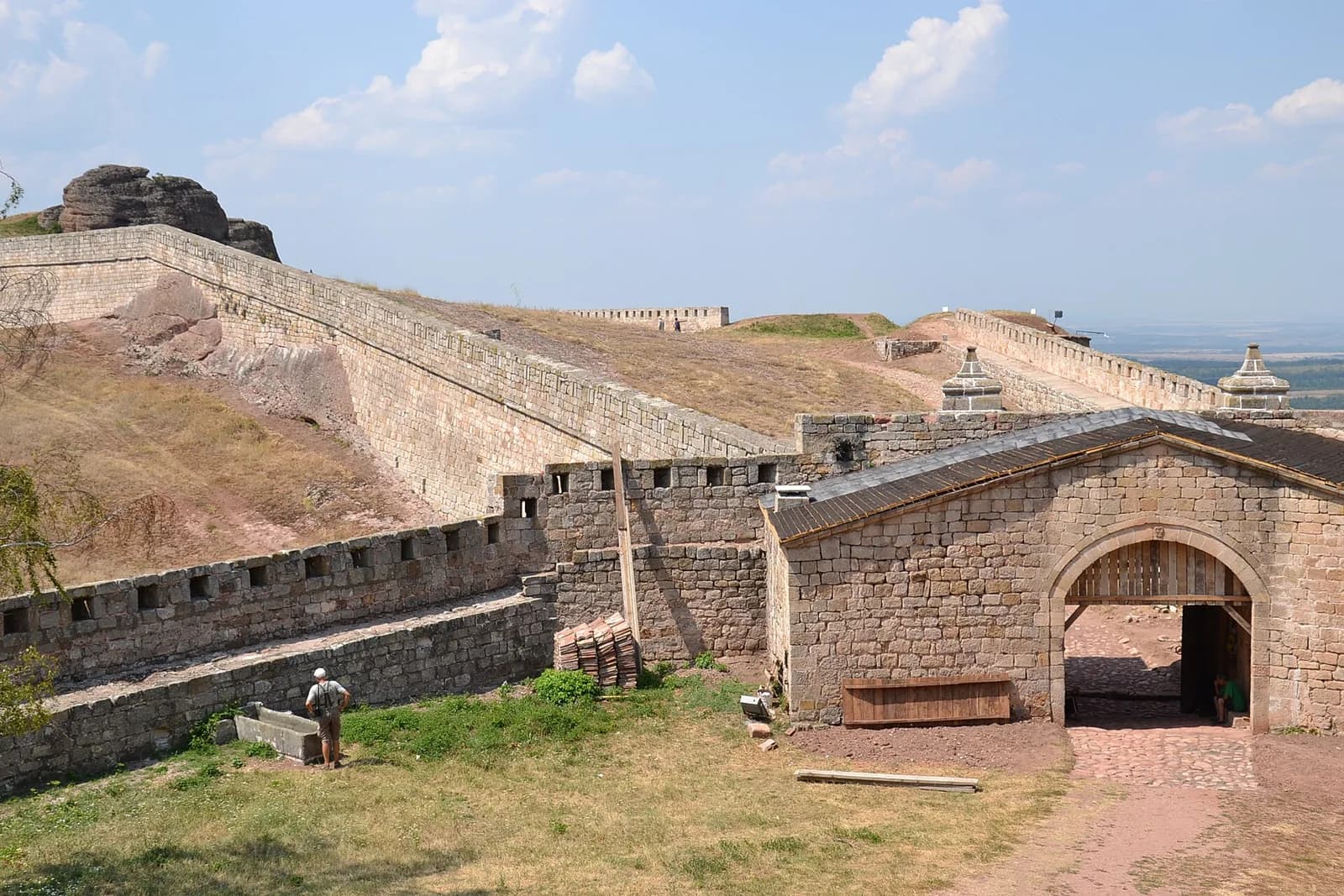
The fortress, known locally as Kaleto, sits about 1.5 km from the centre and is the place to start. Its logic is simple: the builders only had to close the gaps between the rocks. The Romans put up the highest part, the citadel, in the 1st-3rd centuries. Tsar Ivan Sratsimir enlarged and strengthened it in 1356-1396, and after the Ottoman conquest it became a garrison fort, still in military use during the Serbo-Bulgarian War of 1885 (Ministry of Tourism). Today you pass through three separate courtyards covering 10,210 square metres, past gun embrasures and three bastions. The walls are more than 2 m thick at the base and up to 12 m high, and much of what stands reflects an early 19th-century Ottoman expansion in which French and Italian engineers took part (fortress history).
The climb ends at the First Slab, the highest point, with the rocks laid out below and the Balkan range behind them. A monument marks the place linked to the 1850 uprising, whose leaders were taken out through one of the fortress tunnels and executed (Ministry of Tourism). Allow an hour or two. The paths include rock-cut steps and uneven stone, so wear shoes with good grip.
The three town museums
Belogradchik's historical museum runs three small indoor collections, each with a €3 ticket, which make a good hour if the weather turns (fees).
- History Museum, Panova House. The house itself, built in 1810 with a stone ground floor, a projecting upper storey and two verandas, is a fine example of pre-Revival architecture. Inside are farming tools, metalwork, pottery, copperware, 18th-century women's jewellery and icons, plus relics of the 1850 uprising centred on Belogradchik, including a rebel's staff and the sabre of Petko the Blacksmith. Later rooms cover the 1877-1878 war, when the fortress was besieged and shelled, and the Serbo-Bulgarian War of 1885 (museum page).
- Art Gallery. Housed in a former bank and opened in June 1983, it holds more than 180 paintings and graphic works, many acquired through international plein-air painting gatherings held in the area until 1989. One room shows the permanent collection, with works by Vladimir Dimitrov-Maystora, Stoyan Venev and Ivan Hristov among others; two rooms host changing exhibitions (gallery page).
- Natural History Museum. Opened in 1975 and the only collection of its kind in north-west Bulgaria, it shows 520 objects from a fund of about 3,000: rocks, insects, amphibians, reptiles, birds, mammals, eggs and pressed plants, arranged by habitat rather than by species list (museum page).
All three close for lunch, from 12:00 to 13:00 in summer and 12:00 to 12:30 in winter (hours).
Magura Cave
Magura lies in the limestone hill of Rabisha, 17 km from Belogradchik. It is about 2.5 km long, with a main gallery and three side branches, and holds a steady 12°C all year. Its formations began growing some 15 million years ago and include the Giant Column, more than 20 m tall on a 4 m base (Ministry of Tourism). Part of the cave is used to mature sparkling wine, because its conditions resemble those of Champagne cellars.
The cave is best known for its paintings, made in bat guano and showing human figures, hunting scenes, animals, stars and tools from several periods between the Palaeolithic and the start of the Bronze Age. The ministry describes a late Neolithic solar calendar here as the earliest yet found in Europe (Ministry of Tourism). The painted gallery itself is closed: a Ministry of Culture inspector has suspended visitor access until proper conservation conditions are in place (Ministry of Culture reply). The guided route covers the halls and formations, so go for the geology and the scale, and see the Magura paintings presented in the prehistory section of the Konaka museum in Vidin. Paths are damp and slippery, and guides speak Bulgarian; an audio guide costs €5.11 (fees).
Venetsa Cave
Venetsa is the small, easy alternative: a 200-metre lit path through five halls of stalactites, stalagmites and formations that look like ice crystals, about 40-50 minutes in all. It lies 1 km south-west of the village of Gara Oreshets, roughly 13 km from the rocks. Visits run on the hour from 09:00 to 16:00 in groups of up to 15, the temperature inside is 10°C, and adult tickets cost €5. The cave reopened on 5 May 2026 and is listed as open daily all year (Venetsa Cave). It suits families and anyone short of time; if you can only do one cave, Magura is bigger, Venetsa is more compact and closer to the railway.
Vidin: Baba Vida and the old town
Vidin sits 55 km north of Belogradchik on the Danube (Belogradchik). Its landmark, Baba Vida, stands on the foundations of Roman Bononia. Bulgarian building began in the second half of the 10th century, and the castle took its main shape in the Second Bulgarian Kingdom, from the late 12th to the 14th century, when Tsar Ivan Sratsimir lived here. Nine towers rise from an irregular four-sided inner wall, an outer wall wraps around it, and a moat once filled from the Danube was crossed by a movable bridge. Excavations in 1956-1962 found Roman, Byzantine, Bulgarian and Ottoman layers and the foundations of a 13th-14th century chapel. From the late 17th to the early 19th century the Ottomans adapted it for firearms and used the stone halls as stores, guardrooms and a prison (Regional History Museum Vidin). An audio guide in seven languages costs €5.20 (prices).
The same museum runs two more sites worth an hour each:
- Konaka. An 18th-century Ottoman police building whose tower doubled as a fire lookout, a museum since 1956. It tells the region's story from prehistory to 1878, including the Magura paintings, Roman stone sculpture from Ratiaria, Bononia and Castra Martis with the marble "Resting Herakles", and documents of the 1850 Vidin uprising (Konaka).
- Krastata Kazarma. Cross-shaped Ottoman barracks built in 1801, now an ethnographic display of farming, weaving, metalwork, costume and Danube fishing in the Vidin area around 1900, with a section on two local infantry regiments in the First World War (Krastata Kazarma).
In the courtyard of the Vidin Metropolis stands the mausoleum of Antim I, a square stone building of 1934 by architect Ilya Popov, with a windowed dome of white Vratsa stone, a mosaic portrait over the entrance, a seated sculpture inside and the sarcophagus in the crypt (Ministry of Tourism). Antim I was the first head of the Bulgarian Exarchate from 1872, chaired the Constituent Assembly of 1879 and served as Metropolitan of Vidin until his death in 1888 (biography). The exterior is always on view; ask at the Metropolis about seeing the interior.
Kula: Castra Martis and the ethnographic house
Kula lies 30 km west of Vidin, 13 km short of the Serbian border at Vrashka Chuka (Kula). Castra Martis was a late Roman fort of the 2nd-4th centuries linked to Diocletian's frontier works, guarding the road from Ratiaria (modern Archar) to Singidunum (Belgrade). It combined a small square fort with barracks enclosures, and its south-eastern round tower is the tallest surviving piece. Avars and Slavs destroyed it in the 6th century, though it was partly used again under Ivan Sratsimir. Finds include coins, fibulae, lamps, a Jupiter altar, a statue of Venus and sections of aqueduct (Ministry of Tourism).
Nearby, the ethnographic house holds about 700 objects of town and village life collected from 2010 onwards, including local costumes and a hand mill from the late 17th century, in the former home of Kula mayor Kancho Yonchov. Both sites are open year-round for a fee, but neither publishes hours, so treat Kula as a detour on your Vidin day rather than a destination of its own.
How to plan your visit
If you have half a day, do the fortress and look over the town rocks from the First Slab. Add Venetsa if you have another hour and a car.
For one day, start with the fortress in the morning, drive to Magura for a midday tour, and finish at one of the town museums or Venetsa. The combined fortress and Magura ticket, €12.27, saves €2.56 on two separate adult tickets.
For two days, spend the first on Belogradchik as above and sleep in town. On the second, drive to Vidin for Baba Vida, the Konaka museum and the Antim I mausoleum, with a detour west to Kula for Castra Martis.
The fortress keeps long summer hours, open until 20:00 from May to mid-September, which makes late afternoon and early evening a good time for the rocks. In winter both the fortress and Magura close at 17:00 with last entry at 16:00, so start early. Spring and autumn are the most comfortable for walking between the rocks.
Practical information
Getting there
Belogradchik is 55 km from Vidin. The nearest railway station, Gara Oreshets on the Mezdra-Vidin line, is 12 km away, and the main I-1 road from Sofia to Vidin passes a few kilometres to the north-east (Belogradchik). The caves and Kula are spread out, so a car makes the trip much easier; without one, arrange a taxi from town or from the station. The fortress has its own paid car park.
Opening hours and tickets
Adult prices are shown; reduced tickets exist for students and pensioners, and children under seven enter Belogradchik sites free. Checked on 8 October 2026.
| Site | Hours | Adult ticket |
|---|---|---|
| Belogradchik Fortress | Daily; October 09:00-18:00, May to mid-September 09:00-20:00, November-March 09:00-17:00; last entry 1 hour before closing | €7.67; parking €2.56 |
| Magura Cave | Daily; April-October 09:00-19:00, November-March 09:00-17:00; last entry 1 hour before closing | €7.16; with fortress €12.27 |
| History Museum, Art Gallery, Natural History Museum | Daily; April-October 09:00-12:00 and 13:00-18:00, November-March 08:30-12:00 and 12:30-17:00 | €3 each |
| Venetsa Cave | Daily 09:00-17:00, tours on the hour, last at 16:00 | €5 |
| Baba Vida, Vidin | Summer: weekdays 09:00-18:00, weekends 09:30-18:30; winter: weekdays 09:00-17:00, weekends 10:00-17:00; last entry 30 minutes before closing | €6.20 |
| Konaka and Krastata Kazarma, Vidin | Weekdays 09:00-12:00 and 13:00-17:00; weekends 09:30-18:00 in summer, 10:00-17:00 in winter | €4.10 and €5 |
Sources: Belogradchik hours, Belogradchik fees, Venetsa, Vidin prices. Vidin's museum does not publish the date it switches between summer and winter hours, so check before travelling in spring or autumn, and call the cave or museum if you plan a visit on a public holiday.
For the Ledenika cave and the cliffs of Vratsata to the south-east, see the Vratsa and Ledenika guide; for the towns further down the river, see the Bulgarian Danube towns guide.
Sources & further reading
- Belogradchik Fortress - Ministry of Tourism of Bulgaria
- Belogradchik Rocks - Ministry of Tourism of Bulgaria
- Belogradchik Fortress - Wikipedia
- Opening hours: fortress, Magura Cave and museums - Historical Museum Belogradchik
- Entrance fees - Historical Museum Belogradchik
- About the museum: Panova House and collection - Historical Museum Belogradchik
- Art Gallery - Historical Museum Belogradchik
- Natural History Museum - Historical Museum Belogradchik
- Magura Cave - Ministry of Tourism of Bulgaria
- Ministry of Culture reply on access to the drawings gallery in Magura Cave - Platform for Access to Public Information, Republic of Bulgaria
- Venetsa Cave - Venetsa Cave / Dimovo Municipality
- Baba Vida medieval castle - Regional History Museum Vidin
- Prices - Regional History Museum Vidin
- Konaka Museum - Regional History Museum Vidin
- Krastata Kazarma - Regional History Museum Vidin
- Mausoleum of Antim I - Ministry of Tourism of Bulgaria
- Anthim I - Wikipedia
- Castra Martis and the ethnographic exhibition in Kula - Ministry of Tourism of Bulgaria
- Belogradchik - Wikipedia
- Kula, Bulgaria - Wikipedia
Tags
- Belogradchik
- Belogradchik Rocks
- Magura Cave
- Venetsa Cave
- Vidin
- Baba Vida
- Castra Martis
- Northwest Bulgaria