Bulgarian Danube towns: Svishtov, Tutrakan, Silistra, Srebarna
Roman Novae and Kaleto in Svishtov, Tutrakan's fishermen and 1916 memorial, Silistra's fort and Srebarna's pelicans: a Danube road-trip guide with hours and prices.
Sources checked - 8 October 2026
In this article
The towns on Bulgaria's Danube bank grew out of forts on the Roman frontier, and the river still shapes how they look and live. A drive along the river links a legionary camp you can walk through at Novae, a fishing town with a museum of nets and boats at Tutrakan, the Ottoman fort and Roman finds of Silistra, and Srebarna, a UNESCO-listed lake with Bulgaria's only colony of Dalmatian pelicans. Ruse sits in the middle of this stretch, so it works as a base; the city and its canyon have their own Ruse and Rusenski Lom guide.
What to see
Svishtov
Svishtov is the southernmost port on the Danube, opposite Zimnicea in Romania, and in 1877 it became the first Bulgarian town liberated when Russian troops crossed the river here (Svishtov). The best place to start is Kaleto, the fortified hill above town, which reopened as a historical park on 1 May 2026 after a large restoration. The hill was walled in the 3rd-4th centuries after barbarian raids; in the Middle Ages the fortress of Zishtova was an important stronghold of Tsar Ivan Shishman's state, and Vlad III Dracula came here in 1461. Excavated Roman, medieval and Ottoman remains are now joined by a museum display, a 3D model of the medieval fortress, a virtual-reality area, an observation platform, an open-air amphitheatre and the renovated church of St Dimitar. Entry is free every day (Svishtov TIC).
In town, the Aleko Konstantinov House-Museum is one of Bulgaria's 100 National Tourist Sites. The house was built in 1861 by the writer's father; Tsar Alexander II stayed in it during the 1877-1878 war, and after the Liberation it housed the first district administration, where Aleko Konstantinov and Ivan Vazov both worked as clerks. Its rooms recreate a 19th-century merchant home with original Viennese furniture, alongside the author's books, letters and belongings, and his heart is kept here (Svishtov TIC). Nearby, Sladkarova House, an unplastered stone house in the Arbanasi style with storerooms below and living rooms above, has held the museum's ethnographic display since 1982 (Svishtov TIC). Both open on weekdays only.
Novae
Novae lies about 3 km east of Svishtov on the Ruse road and has been an archaeological reserve since 1996 (Historical Museum Svishtov). Legio VIII Augusta founded the camp around AD 45; under Vespasian, Legio I Italica took over in 69-70 and stayed until at least the 430s. The fortress covered 18 hectares on terraces sloping to the river, guarding a crossing on the stretch between the Osam and the Yantra. In the late 5th and 6th centuries Novae became a bishop's seat, and a cathedral and episcopal buildings rose over the old barracks. It is one of the few forts on the Roman Danube frontier excavated and opened to the public, with the headquarters, defensive walls and bishop's complex restored (Novae).
Polish and Bulgarian archaeologists still work here. One of their clearest results is that the large legionary baths, used roughly from AD 70 to 101, gave way when Trajan's Dacian wars called for a big military hospital, the valetudinarium, which was built on top of them while the baths moved closer to the camp centre (Warsaw fieldwork report). A University of Warsaw project running from 2025 to 2028 is now investigating the commander's residence (University of Warsaw). The museum does not publish opening hours or a ticket price for the site; call +359 877 786 222 before making a special trip.
Persina Nature Park and Belene
West of Svishtov, Persina Nature Park covers 21,762 ha of Danube islands and wetlands in the Nikopol, Belene and Svishtov municipalities. Its Belene Island complex is the largest Bulgarian island group in the river and a Ramsar wetland of international importance (Persina Nature Park). The islands are not a casual walk-in destination. If birds and floodplain forest interest you, contact the visitor centre at 5 Persin Street in Belene, +359 658 32 684, and ask which trips are running.
Tutrakan
Tutrakan lies 58 km east of Ruse and 62 km west of Silistra, on the site of the Roman fort of Transmarisca (Tutrakan). For centuries it lived from the river: at the start of the 20th century the town had more than 5,000 fishermen, and over 1,000 boats could be seen at its landing (fishing museum). Walk first through the Fishermen's Quarter, the old riverside neighbourhood, which is open to stroll at any time, as are the remains of Transmarisca (sight map).
The Danube Fishing and Boatbuilding Museum, opened in 1974, is the reason to stop. Seven halls and two interiors in an early 20th-century listed building follow fishing tackle from antiquity to modern times: bone and copper hooks, harpoons, clay net weights, iron tools and a whole vocabulary of nets that Tutrakan fishermen wove from plant fibre for different fish and waters. Photographs and drawings show how the gear was used, and other displays cover how the fishermen organised their work and kept accounts, how they furnished their homes and what they believed. A final section traces boatbuilding, practised here since Roman times, when Transmarisca had a vessel-repair workshop; by the late 19th century Tutrakan boats were sold to Romania, Serbia and Austria (fishing museum).
The town's History Museum, in the Dimitar Teodorov House on Suvorov Square since 1993, covers three floors from 5th-century BC Thracian pottery and finds from Transmarisca to icons of the Tryavna school, ending with a permanent display on the battle for the Tutrakan fortress (museum). That battle, fought on 2-6 September 1916, ended with the Bulgarian and German capture of the Romanian-held fortress and some 22,000-28,000 prisoners (Battle of Turtucaia).
Beside the Ruse-Silistra road, the Military Cemetery 1916 holds about 8,000 Bulgarian, German, Ottoman and Romanian soldiers. An obelisk of 1922 repeats the same line in four languages, "Honour and glory to those who knew how to die heroically for their fatherland", and the site includes an ossuary, a chapel and old guns (Vagabond). Entry to the cemetery is free (sight map). Since 18 April 2024 a new museum at the memorial, Tutrakan Epic 1916, has presented the assault in a 360-degree interactive diorama (museum notice). Its ticket price is not published, so ask on +359 876 408 900.
Silistra
Silistra is 119 km from Ruse. The Romans garrisoned it from AD 29 as Durostorum, and after Trajan's Dacian wars Legio XI Claudia was based here from about 114 until around 400; in the Middle Ages it was Drastar, a key Bulgarian stronghold, and in the Crimean War it was besieged from April to June 1854 (Silistra).
- Archaeological Museum. In a listed building of 1923-1926, built as a branch of the Romanian National Bank, it shows copper axes from the 5th millennium BC, Roman ceremonial helmets, chariot remains and statues, and one of the largest collections of 10th-13th century crosses, with finds from the medieval palace of Drastar (museum).
- Fortress walls. Along the riverbank you can trace the walls of the late Roman fortress, first built under Diocletian or Constantine and rebuilt by Justinian in the 6th century, with triangular and pentagonal towers 12 m apart; the northern wall once bordered the river port (museum).
- Roman tomb. Found by chance in 1942 in the Durostorum cemetery, the tomb dates from the late reign of Constantine I. Its murals show servants carrying clothes and toiletries towards the master and mistress, with peacocks and pigeons in the lunettes and animals, plants and hunting scenes on the vault (museum). Visits are currently suspended on the instructions of the Ministry of Culture, with no reopening date (access notice).
- Medzhidi Tabia. This hexagonal fort on the hill south of the city is the best preserved of six forts in the Ottoman defence system planned after a visit by the Prussian officer Helmuth von Moltke. It was built in 1841-1853 by master builders from Dryanovo and named after Sultan Abdülmecid, who inspected the works in 1847. The wall reaches 8 m, with a moat at its foot that served both as obstacle and cover; Leo Tolstoy took part in the fighting around it during the Crimean War (Ministry of Tourism). Inside is the exhibition "The Fates of Silistra in the 15th-19th centuries" (museum).
Srebarna
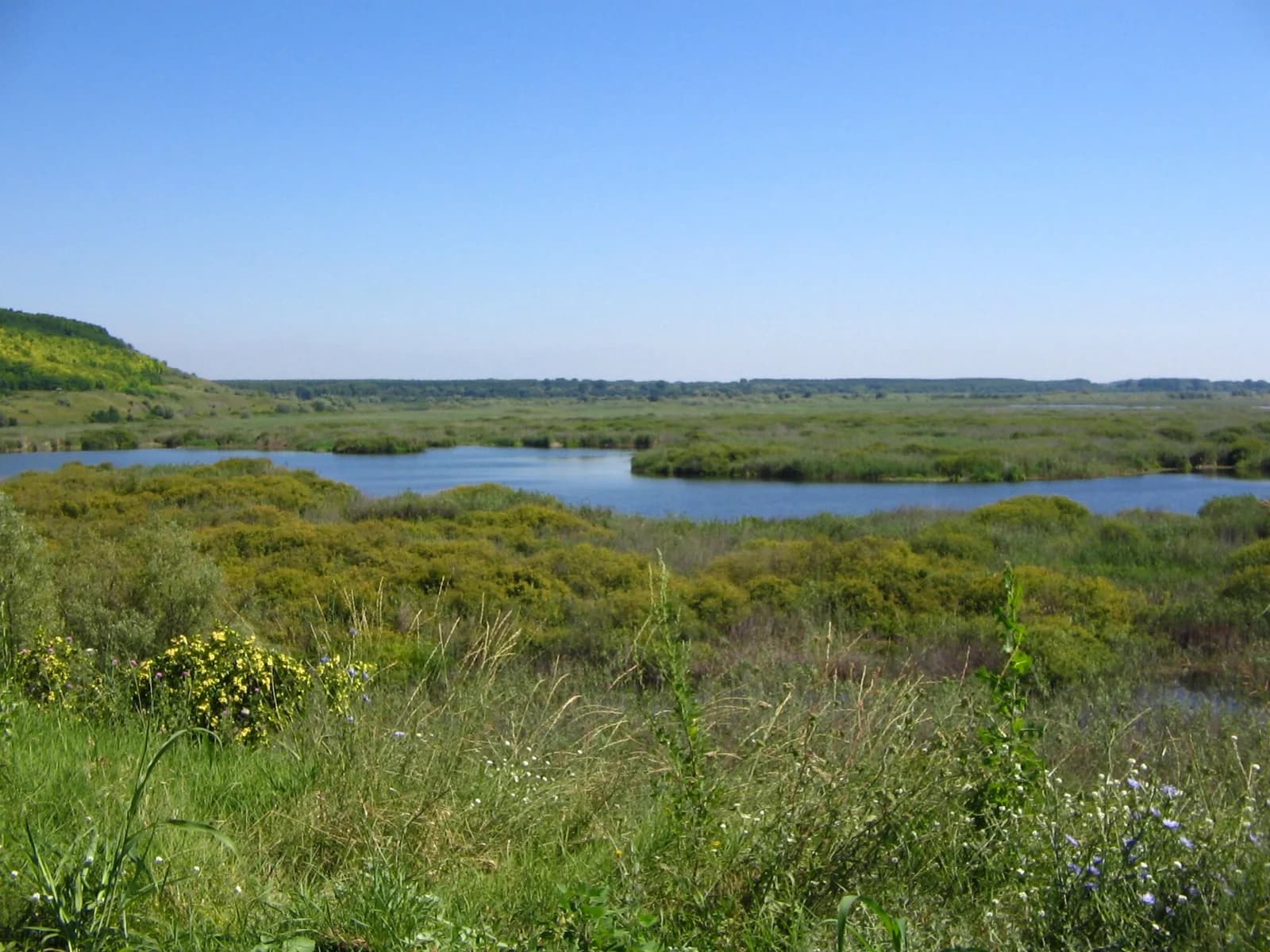
Srebarna Nature Reserve, 18 km west of Silistra and about 2 km south of the Danube (Srebarna), is a freshwater lake of more than 600 ha fed by the river's floods. It was inscribed as a UNESCO World Heritage Site in 1983. Almost 100 bird species breed here, including Bulgaria's only Dalmatian pelican colony and important breeding populations of pygmy cormorant, ferruginous duck, white-tailed eagle and corncrake, and some 80 more species shelter here in winter (UNESCO). A small museum in Srebarna village shows stuffed specimens of the reserve's birds (Srebarna).
You do not need a permit to use the visitor paths in the former buffer zone, known as the Pelicans area, as long as you follow the reserve rules. Two routes are marked (reserve routes):
- Route 1 runs from the natural history museum through the village to the Atanasovo fishing settlement, with eco-trails, an observation tower, shelters, benches and toilets. The pelican colony is visible from the Suhata Cheshma area, and mixed heron colonies from Draganova Lokva and Babushko Blato. There is spring water at Todoranka.
- Route 2 follows a 7 km gravel track from Fazanariyata to the South Sluice, with signs, benches and tables but no drinking water. It is one way, so plan the return.
Boats on the lake need a permit. Keep to the paths and bring binoculars rather than trying to get closer to the colonies.
How to plan your visit
Two days from Ruse: spend one day west on Svishtov, Kaleto and Novae, and the other east on Tutrakan, Silistra and Srebarna.
One day: choose a direction. Svishtov and Novae make a compact history day; Tutrakan, Medzhidi Tabia and a walk at Srebarna make a fuller one with more driving.
When to go: Medzhidi Tabia opens only from May to October, and the Svishtov museums are closed at weekends, so a weekday between May and early October gives you the most. Srebarna is worth seeing at any season, as resident and breeding birds give way to winter visitors.
Practical information
Getting there
The route is easiest by car, following the river from west to east: Svishtov and Novae, then Ruse, Tutrakan and Silistra. Tutrakan is roughly halfway between Ruse (58 km) and Silistra (62 km), and the Military Cemetery stands beside the Ruse-Silistra road (Tutrakan; Vagabond). Srebarna lies 18 km before Silistra if you are driving from the west.
Opening hours and tickets
Adult prices are shown; reduced tickets exist at most sites. Checked on 8 October 2026.
| Site | Hours | Adult ticket |
|---|---|---|
| Kaleto, Svishtov | Daily | Free |
| Aleko Konstantinov House and Sladkarova House, Svishtov | Monday-Friday 08:30-12:00 and 12:30-17:00 | Not published |
| Danube Fishing and Boatbuilding Museum, Tutrakan | Open daily through October 2026; March-October weekdays 08:00-17:00 with a 12:00-13:00 break, weekends 09:30-17:30 | €2.50 |
| History Museum, Tutrakan | Open daily through October 2026; seasonal hours | €2.50 |
| Military Cemetery 1916, Tutrakan | Daily 08:00-19:00 | Free |
| Tutrakan Epic 1916 museum | March-October daily 09:00-18:00; November-February 09:00-17:00 | Not published |
| Archaeological Museum, Silistra | October-March Monday-Friday 09:30-12:00 and 12:30-17:00; April-September Tuesday-Saturday 09:00-12:00 and 12:30-17:00 | €2.50 |
| Medzhidi Tabia, Silistra | May-October daily 10:00-17:30 | €4 |
| Roman tomb, Silistra | Closed to visitors | - |
Sources: Svishtov TIC, Tutrakan sight map, Tutrakan October notice, Tutrakan Epic 1916, Silistra museum, Medzhidi Tabia. Small museums along the river change hours with the season and sometimes open on request, so phone ahead for a winter or holiday visit: Tutrakan +359 876 408 900, Silistra +359 86 822 075.
For Vidin and the western end of the Bulgarian Danube, see the Belogradchik and Vidin guide.
Sources & further reading
- Svishtov - Wikipedia
- Historical Park Kaleto - Svishtov Tourist Information Centre
- Aleko Konstantinov House-Museum - Svishtov Tourist Information Centre
- Sladkarova House - Svishtov Tourist Information Centre
- Historical Museum Svishtov - Historical Museum Svishtov
- Novae (fortress) - Wikipedia
- Novae: legionary camp and late antique city - University of Warsaw
- Novae Sector IV fieldwork report: legionary baths and valetudinarium - University of Warsaw
- Persina Nature Park - Persina Nature Park Directorate
- Tutrakan - Wikipedia
- Ethnographic Museum - Danube Fishing and Boatbuilding - Historical Museum Tutrakan
- About the museum - Historical Museum Tutrakan
- Sight map: hours and tickets - Historical Museum Tutrakan
- October 2026 opening notice - Historical Museum Tutrakan
- Opening of the Tutrakan Epic 1916 museum, April 2024 - Historical Museum Tutrakan
- Tutrakan Military Cemetery - Vagabond
- Battle of Turtucaia - Wikipedia
- Silistra - Wikipedia
- Archaeological Museum Silistra - Regional Museum of History Silistra
- Northern and southern fortress wall - Regional Museum of History Silistra
- Roman Tomb - Regional Museum of History Silistra
- Roman Tomb: current access notice - Regional Museum of History Silistra
- Medzhidi Tabia Fortress - Regional Museum of History Silistra
- Medzhidi Tabia Fortress - Ministry of Tourism of Bulgaria
- Srebarna Nature Reserve - UNESCO World Heritage Centre
- Srebarna Nature Reserve - Wikipedia
- Tourist routes in Srebarna Managed Reserve - Srebarna Managed Reserve
Tags
- Danube
- Svishtov
- Novae
- Tutrakan
- Silistra
- Medzhidi Tabia
- Srebarna
- Persina