Ruse and Rusenski Lom guide: Ivanovo churches and Cherven
Ruse's best museums, the UNESCO rock-hewn churches of Ivanovo, medieval Cherven and walks in Rusenski Lom Nature Park, with day plans, hours and prices.
Sources checked - 8 October 2026
In this article
Ruse is Bulgaria's main Danube city, known as Little Vienna for its streets of late 19th and early 20th century Neo-Baroque and Neo-Rococo buildings (Ruse). In and around the centre are a Roman fort, an excellent natural history museum and several house museums. Just south of the city, the rivers of the Lom have cut a limestone canyon where medieval monks carved churches into the cliffs; the frescoes at Ivanovo are on the UNESCO World Heritage List, and the ruined town of Cherven crowns a ridge further upstream. A weekend covers both.
What to see in Ruse
Sexaginta Prista
On a rise above the Danube in the north-west of the city, Sexaginta Prista means "harbour of sixty ships". The museum ties the name to Domitian's Dacian wars of 85-89, when a legion of about 6,000 men was ferried across the river near the mouth of the Rusenski Lom and exactly sixty ships of the pristis type were needed. Long before the Romans, the hill was a Thracian sanctuary, and hundreds of ritual pits from the 1st century BC to the 1st century AD have been found (museum).
What you see belongs to later phases. In the 2nd-3rd centuries the hill held civilian buildings, among them a temple of Apollo where votive plaques of the Thracian Horseman and Apollo and an inscribed altar were found; its plan, unusually, resembles a Christian church. The temple went out of use at the end of the 3rd century, and in the early 4th century, under Constantine, the principia, the headquarters of the fort, was built on top of it. The open-air display, opened in 2002, shows about 50 m of the north-western wall with a tower, six buildings, the temple and the principia (museum). It is compact; 40 minutes is plenty.
EcoMuseum with Aquarium
Opened in 2014 but built on a natural history collection begun in 1889, the EcoMuseum fills four levels and more than 2,000 square metres. The basement holds Bulgaria's largest freshwater aquarium, six tanks with 65 tonnes of water and Danube fish including sturgeon, plus 13 terrariums of reptiles. The first floor pairs a wetland hall on the fishermen, boats, reeds and birds of the lower Danube with a palaeontology hall showing mammoth and mastodon fossils, a life-size woolly mammoth and the only known lower jaw of Mammuthus rumanus, the earliest mammoth species in Europe. Upstairs are six dioramas of Danube Plain habitats, a bat cave and an animal-watching hide, and the top floor opens the museum's stores to view. A free audio guide covers the halls in Bulgarian, English, Romanian, French and German (museum). This is the best choice in Ruse for children.
House of Kaliopa
The Museum of Urban Lifestyle occupies a house built in the 1860s as the Prussian consulate. After the Liberation it passed to the merchant Stefan Kamburov, who in 1886 invited a painter from Bucharest to decorate the walls and ceilings of the upper floor, as was the fashion; the paintings and the artist's signature survive. The rooms upstairs recreate a wealthy home of around 1900, with a guest salon, a music salon, the lady's room and a bedroom furnished from Austria and Germany, with porcelain, glass, silver and mother-of-pearl that speak of Ruse's trade with Europe. The ground floor hosts temporary exhibitions. The house is also called the House of Kaliopa after a town legend that the beautiful Kaliopa was the lover of Midhat Pasha (museum).
Pantheon of the Revivalists
The gilded dome on Vazrazhdenski Square marks the Pantheon, opened on 28 February 1978 for the centenary of the Liberation on the site of the All Saints church (1884-1889), which was demolished in 1975 (museum). It holds the graves of 39 leading figures of the Bulgarian Revival, among them Lyuben Karavelov, Zahari Stoyanov, Stefan Karadzha and Panayot Hitov, and lists the names of 453 more revolutionaries, volunteers and teachers around an eternal flame. A chapel of St Paisius of Hilendar inside is in active use (Visit Ruse), and the dome was regilded in 2019-2021 (museum).
The Regional History Museum's main exhibition is on Alexander Battenberg Square, and the museum also runs the Zahari Stoyanov and Baba Tonka house museums; see the table below for hours (visitor information).
Rusenski Lom Nature Park
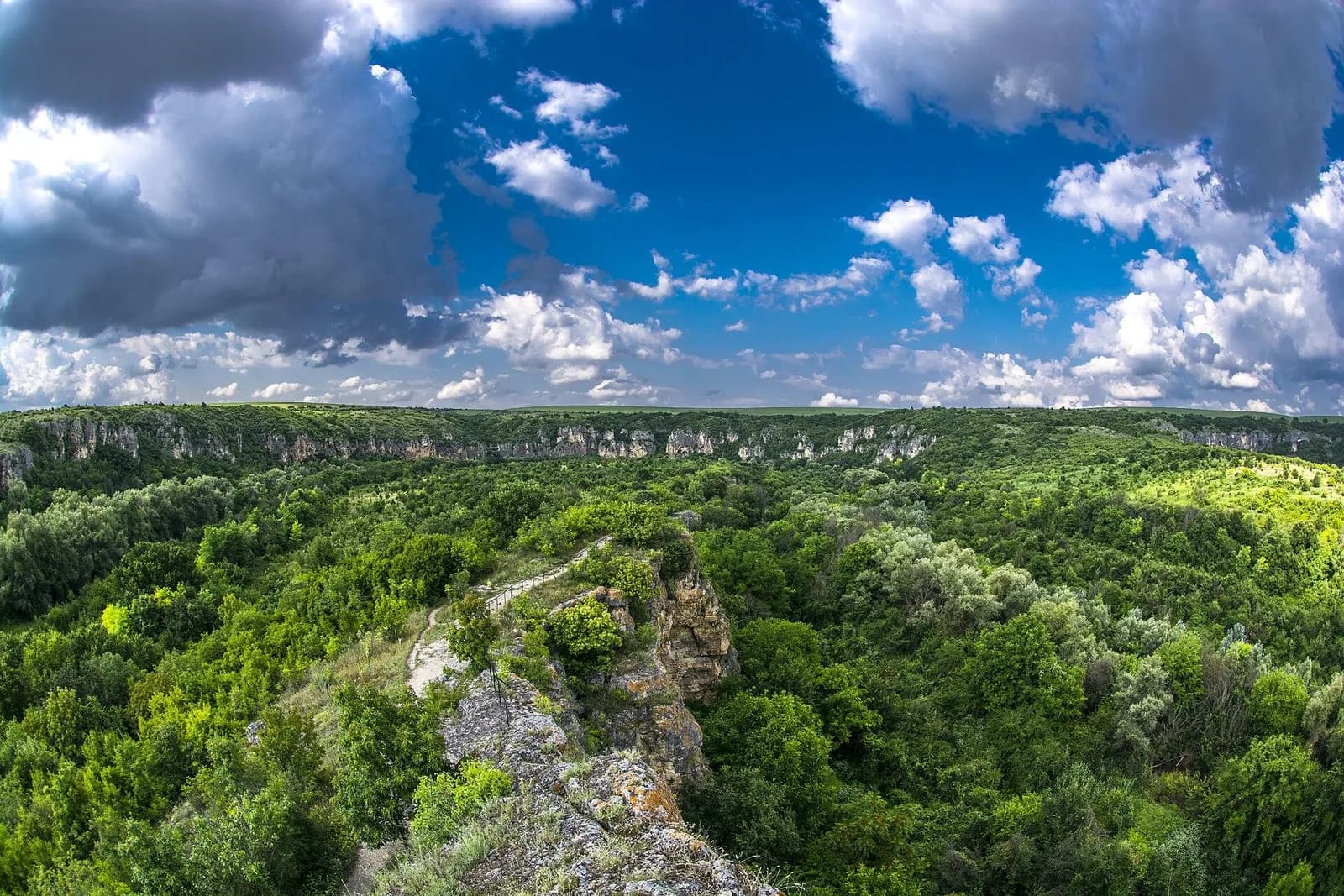
The park was declared in 1970 along the valleys of the Malki, Cherni and Beli Lom, about 20 km south of Ruse (park directorate). The rivers have cut deep, winding gorges into the limestone plateau, and from the 12th to the 14th centuries hermits and monks hollowed cells, chapels and churches into the cliffs.
Ivanovo Rock-Hewn Churches
About 3 km east of Ivanovo, at a spot locals call Pismata, cells and churches are cut high into the cliffs over a wide bend of the Rusenski Lom. At the start of the 13th century the monk Joachim settled here and, with the support of Tsar Ivan Asen II, founded the monastery of the Archangel Michael; in 1235 he became patriarch of the restored Bulgarian church. The complexes carry names such as Belbernitsata, the Buried Church, the Baptistery and the Demolished Church, and the walls preserve portraits of Ivan Asen II, Ivan Alexander and his two wives (museum).
The main reason to come is the Church of the Holy Virgin, known simply as the Church, painted in the 14th century, when the monastery flourished alongside the Hesychast movement. Most of its scenes show the Passion of Christ in Holy Week (museum). UNESCO, which listed the churches in 1979, singles out the artists of the Tarnovo school for a style that breaks with Byzantine convention, with a liking for the nude, landscape, architectural backgrounds, drama and emotion (UNESCO). The monastery declined after the Ottoman conquest; a graffito left in 1746 by a priest from Ruse marks its final abandonment. You reach the churches by asphalt road or by a marked footpath from the village of about 40 minutes (Ivanovo Municipality). The rock is unstable in places, so stay on the open route and behind the barriers.
Cherven
Cherven, about 30 km south of Ruse and a national archaeological reserve since 1965, is the other essential stop. The first walls went up in the 6th century under Anastasius I and Justinian I. Its heyday came in the 12th-14th centuries, when the town spread over the whole rocky ridge and down to the river as a centre of trade and crafts, ironworking and goldsmithing among them; after 1235 it was the seat of a metropolitan bishop. Excavations have revealed a castle, fortress walls, two underground passages that secured water, 16 churches, administrative buildings and houses. The Ottomans took Cherven in 1388, and Michael the Brave of Wallachia later burned it (museum). Look for the three-storey tower on the western inner wall of the citadel, the best-preserved part of the defences.
Walking in the park
The park's main regional route, Route 1, starts by a memorial plaque in the Dolapite quarter of Ruse and runs past Basarbovo and its rock monastery, Krasen and Bozhichen to the Ivanovo churches, then on through Koshov, Cherven and Tabachka to a monument near Shirokovo. Short branches make good half-day walks: branch 1-9 follows the panoramic road from the Ivanovo turning to the centre of Koshov (4.2 km), branch 1-11 leads from the bridge at the south end of Koshov past the Malak Rai and Golyam Rai rock monasteries, and branch 1-13 climbs 1.1 km from the foot of Cherven to the Moskov Dol rock church (route catalogue). Distances are one way, so plan to retrace your steps or arrange a lift. Use the park's online map to find the trailheads and ask the directorate at 7 Skobelev Boulevard in Ruse, +359 82 872 397, about the state of the paths (park directorate).
Byala: the 1877 headquarters
For a detour on the road south towards Veliko Tarnovo (Byala), the History Museum in Byala occupies an early 19th-century house that served as the main Russian imperial headquarters from 20 July to 13 August 1877. Tsar Alexander II, War Minister Dmitry Milyutin, the doctor Sergey Botkin and Count Nikolay Ignatiev lived here, and two war councils that shaped the campaign met in the house. It has been a museum since 1903-1907. In the 8.5-decare park are original guns, five ten-barrel Nobel machine guns in a pavilion, shells, mines, a section of the pontoon bridge on which Russian troops crossed the Danube at Svishtov, and models of the torpedo boats Mina and Tsesarevich (Byala Municipality). Hours are not published online, so phone the municipality on +359 817 72020 first.
How to plan your visit
Half a day in Ruse: walk from Sexaginta Prista through the centre to the Pantheon and the House of Kaliopa, or spend the time at the EcoMuseum if you have children. Most smaller sites close for lunch from 12:00 to 12:30.
One day in the park: drive to the Ivanovo churches in the morning, then on to Cherven for the afternoon, with a stop at Basarbovo if time allows.
Two days: combine the two, and on the second day add one of the short walks, such as the Koshov panoramic branch or the climb from Cherven to Moskov Dol. Spring and autumn are the most pleasant seasons for walking in the canyon.
Practical information
Getting there
Ruse is about 249 km from Sofia and 67 km from Bucharest. It is a rail hub with lines to Sofia, Varna and Bucharest, and the Danube Bridge links it with Giurgiu in Romania (Ruse). The Ivanovo churches and Cherven are easiest by car; both have asphalt road access (Ivanovo Municipality).
Opening hours and tickets
All sites below are run by the Regional History Museum Ruse and open every day. Reduced tickets for pupils, students and pensioners cost €2.50, and a €7.50 day ticket is sold for the city exhibitions. Checked on 8 October 2026.
| Site | Hours | Adult ticket |
|---|---|---|
| Regional History Museum, Alexander Battenberg Square 3 | 09:00-18:00 | €5 |
| EcoMuseum with Aquarium, 3 Etar Street | 09:00-18:00 | €5 |
| Sexaginta Prista, 2 Tsar Kaloyan Street | 09:00-12:00 and 12:30-17:30 | €4 |
| Museum of Urban Lifestyle (House of Kaliopa), 39 Ferdinand Street | 09:00-12:00 and 12:30-17:30 | €4 |
| Pantheon of the Revivalists, Vazrazhdenski Square | 09:00-12:00 and 12:30-17:30 | €4 |
| Zahari Stoyanov House, 12 Pridunavski Boulevard | 09:00-12:00 and 12:30-17:30 | €4 |
| Baba Tonka House, 40 Baba Tonka Street | 09:30-12:00 and 12:30-18:00 | €5 |
| Ivanovo Rock-Hewn Churches | 09:00-18:00 | €5 |
| Medieval town of Cherven | 09:00-18:00 | €5 |
Source: Regional History Museum Ruse. Guided talks cost €7.50 in Bulgarian and €12.50 in English. Hours can shorten in winter, so for a visit to Ivanovo or Cherven between November and March call +359 82 825 002 before setting out.
For Svishtov, Tutrakan, Silistra and Srebarna along the river, see the Bulgarian Danube towns guide; for the medieval capital to the south, see the Veliko Tarnovo guide.
Sources & further reading
- Ruse, Bulgaria - Wikipedia
- Visitors: opening hours and prices - Regional History Museum Ruse
- Sexaginta Prista - Regional History Museum Ruse
- EcoMuseum with Aquarium - Regional History Museum Ruse
- Museum of Urban Lifestyle (House of Kaliopa) - Regional History Museum Ruse
- Pantheon - Regional History Museum Ruse
- Pantheon of the Revival - Visit Ruse
- Rusenski Lom Nature Park - Rusenski Lom Nature Park Directorate
- Routes in Rusenski Lom Nature Park: Route 1 - Rusenski Lom Nature Park Directorate
- Ivanovo Rock-Hewn Churches - Regional History Museum Ruse
- Rock-Hewn Churches of Ivanovo - UNESCO World Heritage Centre
- Tourist sites and routes - Ivanovo Municipality
- Medieval town of Cherven - Regional History Museum Ruse
- Historical Museum Byala - Byala Municipality
- Byala, Ruse Province - Wikipedia
Tags
- Ruse
- Rusenski Lom
- Ivanovo Rock-Hewn Churches
- Cherven
- Sexaginta Prista
- Ruse EcoMuseum
- UNESCO
- Bulgaria