Vratsa guide: Ledenika Cave, Vratsata gorge and Rogozen
Ledenika Cave, the 400-metre cliffs of Vratsata, the Rogozen silver treasure, God's Bridge and Ritlite: how to see the best of Vratsa, with hours and prices.
Sources checked - 8 October 2026
In this article
Vratsa sits at the foot of the Vrachanski Balkan, where the Leva river has cut a gorge with the tallest limestone cliffs on the Balkan Peninsula. Through that gorge a mountain road climbs to Ledenika, among the most visited caves in Bulgaria (Vratsa), while the town museum holds the Rogozen Treasure of 165 Thracian silver vessels. Add a natural rock bridge to the north and the limestone fins of Ritlite in the Iskar Gorge to the south, and Vratsa makes a varied base for one to three days.
What to see
Vratsata gorge
Vratsata begins about 1 km from town on the road to Zgorigrad. Its near-vertical walls rise more than 400 m above the Leva, and climbers have traced over 400 routes on them, with names such as Mirrors, Winkel and Dog's Tooth. The remains of the medieval fortress of Vratitsa, from the 10th-12th centuries, survive inside the gorge (nature park). You can walk or drive in along an asphalt road beside the river. Even if you are not a climber, an hour here is worth it simply for the scale of the rock, and the road to Ledenika runs straight through.
Ledenika Cave
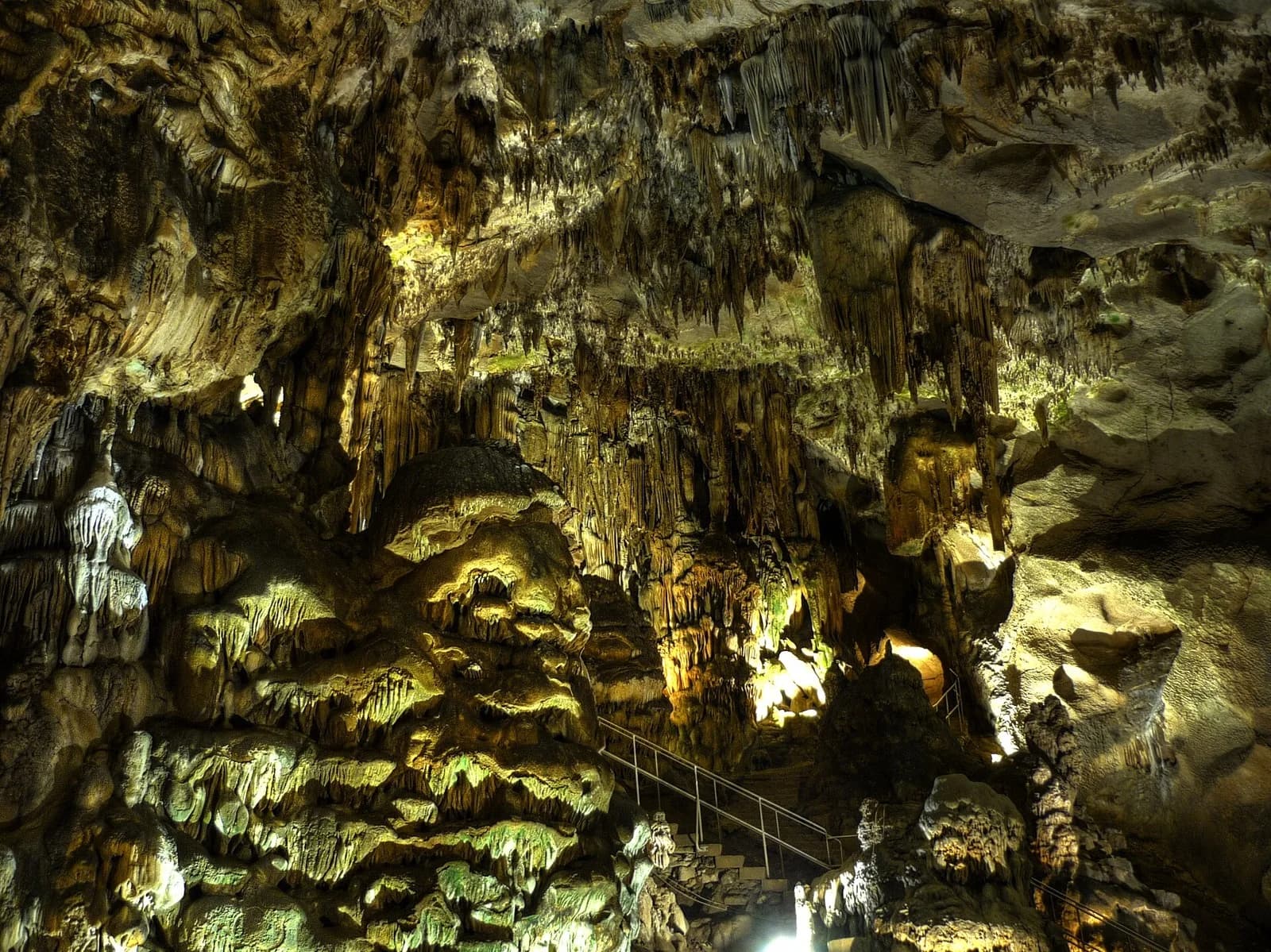
Ledenika lies 16 km from Vratsa up the asphalt road through the gorge, with its entrance at 830 m in the lowest part of the Ledenik karst hollow. The cave is 320 m long and has ten halls; it received its first visitors in 1961. The name comes from the ice stalactites and stalagmites that form in the first two halls in winter, when the temperature in the first hall can fall to minus 20°C. The rest of the year it stays at about 8-16°C with 92% humidity (Open Vratsa).
The highlight is the Concert Hall, where underground concerts are staged, and the halls are rich in columns, figures and draperies (nature park). Visits are guided only, starting on the hour, and need at least two adults, so a solo traveller may need to wait for other visitors. Ledenika is one of the 100 National Tourist Sites. Next to the entrance, the Ledenika amusement park, open since 2014, adds a visitor centre with exhibitions on the cave and the nature park, a rope park, a zip line and other activities for children, each paid separately (Open Vratsa). Bring a warm layer and shoes with grip even in summer.
Walking up to Ledenika
If you want to earn the cave, the nature park describes a three-hour route from the Vratsata pass, rated moderate and best from spring to autumn. After about 40 minutes of climbing you reach the Mechoto Kladenche spring; the path then rises to the rock crown of Garvanets, with views down into the pass, and ends with a 30-minute descent to the cave (route description). The three hours cover the ascent only. Arrange a lift back from the cave or leave enough daylight to walk down, and ask the park about the condition of the path before you set off.
Regional History Museum and the Rogozen Treasure
The museum's main building on Hristo Botev Square holds Vratsa's most famous find. In autumn 1985 a tractor driver, Ivan Dimitrov, was digging a trench for irrigation in his garden in the village of Rogozen when he struck silver; on 6 January 1986 museum archaeologists found a second part of the hoard (Rogozen Treasure). In all there are 165 silver vessels weighing 20 kg, 31 of them gilded: 108 phialae (shallow libation bowls), 54 jugs and three cups. Before this find only about 50 phialae and 18 jugs were known from the whole of Thracian archaeology (museum description).
The set was gathered over several generations, from the late 5th to the last quarter of the 4th century BC, and buried in the second half of the 4th century BC. Most pieces were made in workshops north of the Balkan range for the local Triballian rulers; others were gifts from the Odrysian kings Kotys, Kersebleptes and Satokos, or war booty. Look for the variety of decoration: geometric patterns, rosettes, palmettes, acorns, lotus and ivy, animal heads, human faces and scenes from Greek and Thracian myth with winged horses, griffins and hippocampi (museum description). The museum presents the hoard as the family service of a local dynasty (Rogozen hall).
The same building has halls for archaeology, the Vratsa treasures, Bulgarian history from the 15th to 19th centuries and Hristo Botev, the poet and revolutionary whom the town commemorates every year in the Botev Days (Rogozen hall and other halls; Vratsa). Plan at least an hour.
Towers and the Revival quarter in town
Two stone towers from the 17th century survive in the centre, both listed as monuments of national importance. The Kurtpashovtsi tower stands right in front of the museum: 11 m tall and 5.9 m square, it had a vaulted cellar, an entrance 2.5 m above the ground reached by a removable wooden ladder, a fireplace and loopholes on the first floor, and a projecting top floor with twelve embrasures and openings for pouring hot liquids on attackers. The larger Meshchii tower north-west of the square rises 13.4 m in stone and is crowned by a dome on four arches (medieval towers).
A short walk away, the Sv. Sofroniy Vrachanski ethnographic and Revival complex gathers three 19th-century houses, those of the Hadzhitoshev family, Ivan Zambin and Grigoriy Naydenov, together with the Ascension school and the Church of the Ascension on a 5.5-decare site. Opened in full in 1986, it shows the folk culture of the Vratsa area from the mid-19th to the early 20th century, with a shed of traditional carts and farm tools (ethnographic complex). It pairs naturally with the main museum on a rainy afternoon.
God's Bridge near Lilyache
About 15 km north of Vratsa, on the road to Chiren and Oryahovo, the Lilyashka river has carved a natural tunnel through the limestone. The entrance arch is about 20 m high and 25 m wide, and the passage runs for some 125 m with three small lakes inside, under vaults and thick rock columns lit by daylight. Water from the nearby Ponora cave emerges at the Zhabokrek karst spring and feeds the stream. The site has been a protected natural landmark since 1964 and covers 15 ha (environment inspectorate).
It lies outside the nature park, but the park directorate describes an eco-trail and a rest area there, together with the remains of the medieval fortress of Gradishte. Ponora itself can only be entered with professional equipment and a guide (park directorate), and the landmark rules forbid entering caves without permission or damaging formations. For a family outing, the arch and a picnic by the stream are the point.
Ritlite in the Iskar Gorge
Ritlite rises above the village of Lyutibrod on the left bank of the Iskar, in Mezdra municipality. Three parallel limestone walls, 200-400 m long and only 2.6-7 m thick, stand 50-80 m above the river; their name comes from the slatted sides of an ox cart, called ritli. They are hard white Aptian limestone, formed about 120 million years ago in a warm sea and left standing as the softer rock around them wore away. Above them lies Rashov Dol, linked to the last organised fight of part of Hristo Botev's band after the leader's death. The site has been protected since 1938 and covers about 123 ha (environment inspectorate).
Under the regime updated by Order RD-284 of 31 March 2026, motor vehicles may not enter, cross, camp or park inside the protected area, and damaging trees, picking plants and disturbing animals are banned (environment inspectorate). Leave the car outside the boundary and walk in.
How to plan your visit
Half a day: drive through Vratsata to Ledenika for a cave tour, stopping in the gorge on the way back.
One day: add the museum and the Rogozen Treasure in town, then the two towers and the Revival quarter nearby. Weekday hours run until 17:30, so the museum fits well after a morning at the cave.
Two or three days: hike from Vratsata to Ledenika on one day, and on another visit God's Bridge to the north and Ritlite to the south. The two are on opposite sides of town, so combine each with a different half of your trip if you are travelling on between Sofia and the Danube.
Spring and autumn are best for walking. In summer the cave is a cool escape and opening hours are longer; in winter you trade shorter days for the chance of ice formations in Ledenika's first halls.
Practical information
Getting there
Vratsa is about 112 km north of Sofia, on the railway from Sofia to Vidin and Lom, with regular buses to Sofia, Pleven, Vidin, Montana and Mezdra (Vratsa). Ledenika, God's Bridge and Ritlite are easiest by car; the road to Ledenika is asphalt all the way to the cave.
Opening hours and tickets
Checked on 8 October 2026.
| Site | Hours | Adult ticket |
|---|---|---|
| Ledenika Cave | Summer 09:00-18:00, last cave entry 17:00; winter 09:00-17:00, last entry 16:00; tours on the hour, minimum two adults | €8.18; students and pensioners €6.14; under 7 free |
| Regional History Museum, Vratsa | Monday-Friday 09:00-17:30, weekends 09:00-17:00 | €4; students €2 |
| Vratsata, God's Bridge, Ritlite | Open natural sites | Free |
Sources: Open Vratsa, Vratsa museum. The switch between summer and winter hours has no fixed date, so in spring and autumn call the box office on +359 92 623 553 before driving up (nature park).
For Belogradchik's rocks and the Magura cave further north-west, see the Belogradchik and Vidin guide.
Sources & further reading
- The gorge Vratsata - Vrachanski Balkan Nature Park Directorate
- Amusement Park and Ledenika Cave - Vrachanski Balkan Nature Park Directorate
- Ledenika Amusement Park: hours and prices - Open Vratsa
- Vratsa - Ledenika Cave route - Vrachanski Balkan Nature Park Directorate
- Regional History Museum Vratsa: hours and prices - Regional History Museum Vratsa
- The Treasure of Rogozen - Regional History Museum Vratsa
- Rogozen Treasure Hall - Regional History Museum Vratsa
- Medieval towers - Regional History Museum Vratsa
- Sv. Sofroniy Vrachanski ethnographic and Revival complex - Regional History Museum Vratsa
- Rogozen Treasure - Wikipedia
- God's Bridge - Vrachanski Balkan Nature Park Directorate
- God's Bridges natural landmark - Regional Inspectorate of Environment and Water Vratsa
- Ritlite natural landmark - Regional Inspectorate of Environment and Water Vratsa
- Vratsa - Wikipedia
Tags
- Vratsa
- Ledenika Cave
- Vratsata
- Rogozen Treasure
- God's Bridge
- Ritlite
- Vrachanski Balkan
- Bulgaria