Koprivshtitsa, Panagyurishte and Hisarya: Sredna Gora guide
Plan Koprivshtitsa's house museums around their rest days, then add Panagyurishte's gold treasure, the Starosel temples and Roman Hisarya.
Sources checked - 8 October 2026
In this article
Koprivshtitsa is a Revival-era town of painted houses, stone bridges and high courtyard walls in the Sredna Gora hills, and the place where the April Uprising broke out in 1876. It works as a day trip from Sofia, but the region around it rewards a second day. Further south, along the southern slopes of the Sredna Gora, lie Panagyurishte with its Thracian gold treasure, the under-mound temples at Starosel and the walled Roman spa town of Hisarya, with Pazardzhik as an optional stop on the way back.
Koprivshtitsa: the house museums
Koprivshtitsa sits in the Sredna Gora about 110 km from Sofia and 90 km from Plovdiv. It was declared a museum town in 1952 and has been an architectural and historical reserve since 1971, with 388 listed monuments (Ministry of Tourism). The uprising began here on 20 April 1876, and after it was declared Todor Kableshkov wrote the "Bloody Letter" that spread the revolt to other towns (Kableshkov House).
The town's Directorate of Museums runs six principal houses on one pass. They are worth choosing between, because each tells a different story.
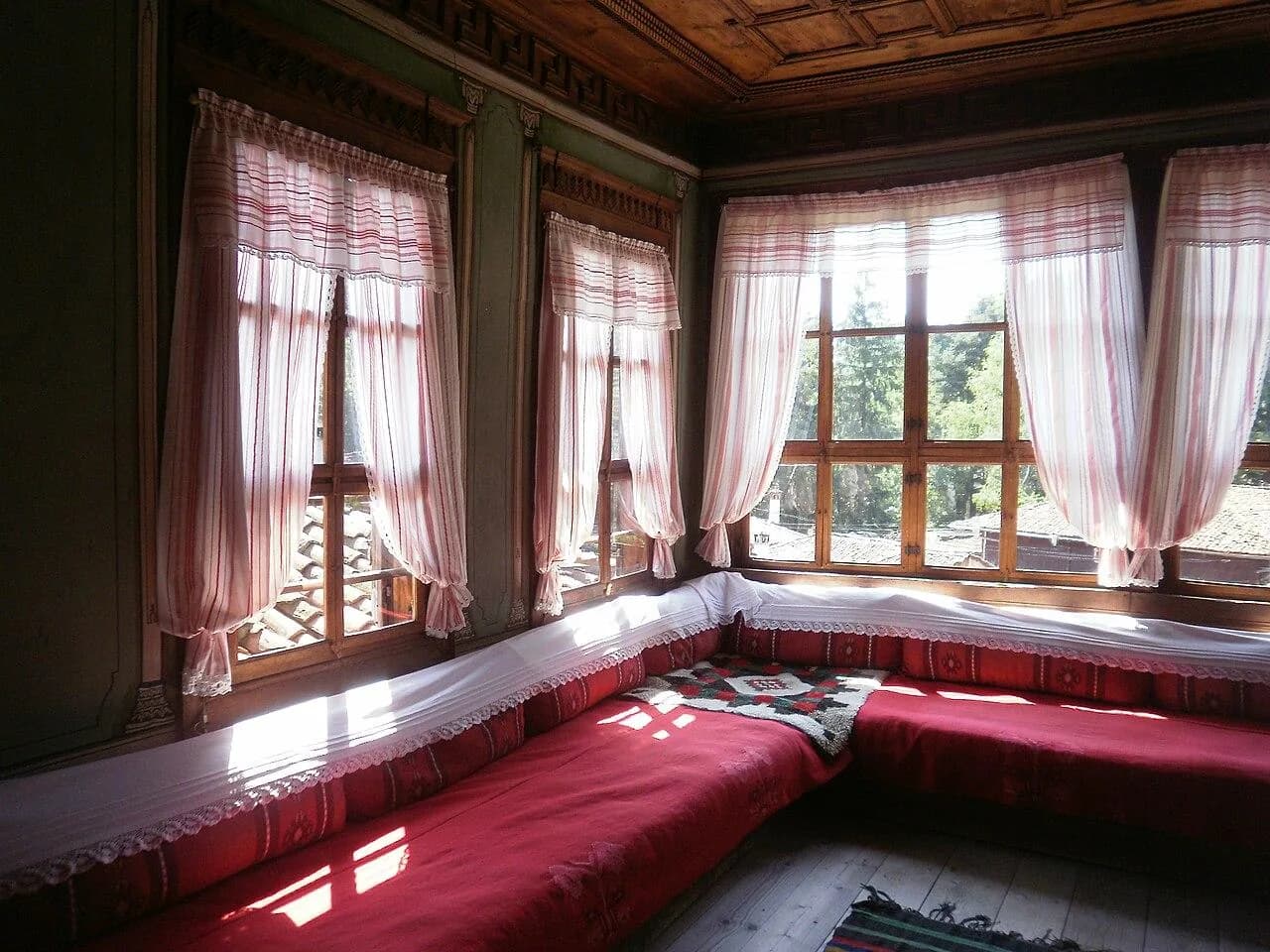
Todor Kableshkov House is both the architectural high point and the uprising museum. The Directorate calls it the peak of Koprivshtitsa building craft, with its curved gables and semicircular bays. Downstairs you see a wealthy household of the late nineteenth century, including a crystal mirror from Constantinople and the tray on which Kableshkov's stepmother served coffee to the officer who came to arrest him on 20 April 1876. Upstairs, a round hall opens onto six rooms of weapons, personal belongings and medals.
Lyuben Karavelov House is a family complex built around the writer and revolutionary. Its centrepiece is the printing press Karavelov bought in 1871 from the Serbian state printing house. It printed his newspapers Svoboda and Nezavisimost, Botev's Zname, and after the Liberation the Tarnovo Constitution (Karavelov House). A room in the summer house covers his younger brother Petko, three times prime minister, and keeps his desk.
Lyutova House has no heroic story, and that is its appeal. Plovdiv builders put it up in 1854 for a wealthy tax farmer and livestock trader; in 1906 it passed to the merchant Petko Lyutov, whose business reached Cairo and Alexandria. The painted medallions in the alafranga niches show distant ports and cities, and the oval ceiling of the upstairs hall is painted too. The ground floor holds a collection of felt carpets, non-woven wool rugs made by hot rolling and beating, for which Koprivshtitsa was known (Lyutova House).
Georgi Benkovski House belongs to the commander of the uprising's Flying Band, killed after being betrayed in May 1876. Above it, the equestrian monument "The man who gave the fatal sign" by sculptor Hristo Tanev was raised for the uprising's centenary in 1976 (Benkovski House).
Dimcho Debelyanov House is the quiet one. The poet was born here in 1887 and killed at the front in 1916. The house was restored in 1957 and holds his own belongings, books and manuscripts, while in the churchyard Ivan Lazarov's statue of his mother waits by his grave (Debelyanov House).
The Museum of Educational Work, opened in 2012 in the Dorosiev House of 1840, explains why such a small town produced so many teachers and revolutionaries. Neofit Rilski opened Bulgaria's second mutual school here in 1837, and Nayden Gerov opened the first Bulgarian class school in 1846. Reconstructions of a cell school and a mutual school fill the ground floor, and the icon of Saints Cyril and Methodius by Stanislav Dospevski is a highlight (Museum of Educational Work).
Between the houses, walk the lanes to the church of the Assumption of 1817 and the St Nicholas church of 1842-1843, and look out for the town's carved stone fountains, more than 40 of them (Ministry of Tourism).
Match the pass to the weekday
The six houses take turns resting. On Monday, Debelyanov, Kableshkov and Lyutova are closed; on Tuesday, Karavelov, Benkovski and the Museum of Educational Work are closed (opening hours). Come between Wednesday and Sunday if you want all six. The adult pass costs €10 and a single house €5, so the pass pays for itself from the third house; for pupils, students and pensioners it is cheaper from the second (price list). An audio guide in seven languages is available for €15 a day.
Every year on 1 May the town re-enacts the declaration of the uprising in a staged performance, "The First Rifle" (Directorate of Museums).
Panagyurishte: the gold treasure
Panagyurishte, south-west of Koprivshtitsa, is known worldwide for the Panagyurishte Treasure, found on 8 December 1949. Its nine gold vessels, a phiale, an amphora and seven rhytons weighing 6.164 kg together, were made in the late fourth or early third century BC and are decorated with scenes from Thracian and Greek myth and ritual.
The original treasure travels between museums. It was in Panagyurishte's Treasury Hall for more than a month in spring 2026 and left in May, and the hall now shows the donated copy (museum notice). The copy still explains the forms and decoration well, but check for a new announcement if seeing the gold itself is your reason to go.
The museum complex ticket also covers the archaeology hall, the April Uprising exhibition, Dudekova House, a model of the craft street and the Blue Hadzhidimitrova House; a wider ticket adds the Tuteva and Lekova houses, Rayna Knyaginya House and the Natural History Museum. At weekends only the complex and Rayna Knyaginya House are open (visitor information).
Starosel: Thracian temples under the mounds
The temples at Starosel, in Hisarya municipality, were found in 2000 by archaeologist Georgi Kitov. The Ministry of Tourism counts six under-mound temples and several royal burials in the area, two of which are open to visitors.
The main temple lies in Chetinyova Mogila, about 4 km north-west of the village. It is the largest known Thracian royal complex with a mausoleum, dated to the fifth and fourth centuries BC, and has been linked with the Odrysian king Sitalkes, though that remains a scholarly interpretation (municipal tourism portal). The approach is part of the monument. A wall of dressed granite blocks, 241 metres long and 3.5 metres high, rings the mound; a staircase climbs to a level platform used for ritual dances, and a corridor leads to a round chamber with ten half-columns and triglyphs painted blue and red (Ministry of Tourism).
The second temple, Horizon, is in the Manastircheto area about 1.5 km from Starosel. It is the only Thracian temple found with a colonnade: ten early Doric columns of the late fifth or early fourth century BC, built for a high-ranking burial that contained bronze arrowheads, silver beads and gold plaques. A sign and a small car park mark the mound, with a footpath up to the temple (Ministry of Tourism). Visits are guided and run all year.
Hisarya: a Roman spa inside its walls
Hisarya's mineral springs made it the Roman city of Diocletianopolis, founded by Diocletian in 293 and the third-largest city in the province of Thrace. An inscription records that under Hadrian, in 135-136, the springs were declared imperial property (Roman baths). The springs are still among the busiest spots in town.
The fortress wall is the reason to come. Built in the late third and early fourth centuries, it runs 2,327 metres around an area of 300 decares and survives in places to 10.5 metres, with 44 towers. Of the four gates, the south gate, known as Kamilite ("the Camels"), shows late-Roman fortification at its most developed. Inside the walls you can walk to the arena of the amphitheatre, built at the end of the third century and the latest Roman amphitheatre known, and to the Roman baths in Momina Salza park, begun in the mid-second century.
Outside the walls, the Roman tomb, found by a farmer in 1957, is the only one of the town's many tombs with murals and a mosaic floor. A vaulted corridor leads into a small chamber with a carpet-like geometric mosaic and niches painted with roses.
The Archaeological Museum covers the area from the Neolithic to the Revival, including finds from the Roman baths and a Thracian trading and cult complex near Krastevich. Hisarya is also where Bulgaria's first archaeological excavations took place, in 1909 (museum history). A free audio guide works through QR codes on your phone in the Diocletian and Constantine the Great halls and the lapidarium, and a 30-40 minute VR archaeology game suits visitors over ten.
Pazardzhik: worth a stop?
Pazardzhik makes a sensible break between Panagyurishte and the motorway. The cathedral church of the Holy Mother of God, built in 1836-1837, is the largest Revival church in Bulgaria, and its carved iconostasis by woodcarvers of the Debar school is one of the finest of the period (municipality).
At the Regional History Museum, the archaeology hall runs from Middle Palaeolithic flint tools through Neolithic finds and the Yunatsite tell to medieval and Ottoman material. The Revival hall has more than 200 exhibits, from coins and guild objects to weapons of 1876 and 1877-1878, and the courtyard lapidarium shows statues, milestones and altars. Nearby, the Konstantin Velichkov House keeps the writer's birth room, a painted study with an alafranga and the room where his sister Theofana sewed the insurgents' flag in 1876.
Suggested plans
One day from Sofia. Drive or take the train to Koprivshtitsa on a Wednesday to Sunday, see three or four houses on the pass, and leave time to walk the lanes and bridges. Kableshkov, Karavelov and Lyutova make the strongest trio.
Two days. Spend the first day in Koprivshtitsa and stay overnight. On day two, cross to Panagyurishte for the treasure and the complex, then continue to Starosel and finish at Hisarya's walls and baths in the late afternoon. Swap Pazardzhik for Hisarya if you are heading back to Sofia.
From Plovdiv. Hisarya and Starosel make a full day on their own. Combine them with the Plovdiv sites in our Plovdiv guide.
Best time to go
Late spring to early autumn is the obvious season for Koprivshtitsa's gardens and lanes, and 1 May brings the re-enactment. Avoid planning around Monday or Tuesday if all six houses matter to you, and remember that Panagyurishte's outlying houses are closed at weekends. The last Monday of each month is a free day at the Koprivshtitsa museums, but only half the houses open on Mondays.
Getting there
By train, BDZ runs several direct services a day from Sofia to Koprivshtitsa station; fast trains take about 1 hour 40 minutes and regional trains 2 to 2.5 hours (timetable). The station is outside the town, so arrange the last stretch before you set off. For Hisarya, two direct trains a day run from Plovdiv in about 1 hour 10 minutes, and other services change on the way (timetable). Panagyurishte, Starosel and the link between the towns are far easier by car.
Opening hours and tickets
Checked on 8 October 2026 on the operators' own pages. Adult prices are in euros.
| Sight | Opening hours | Adult ticket |
|---|---|---|
| Koprivshtitsa, six house museums | 09:30-17:30 from 1 April to 1 November, 09:00-17:00 in winter; Monday or Tuesday closed depending on the house | €10 pass; €5 one house; €20 family |
| Panagyurishte History Museum | Monday 12:00-17:00, Tuesday-Sunday 09:30-17:00; ticket desk closed 13:00-13:30 | €5.11 complex; €6.14 all sites |
| Starosel temples | Open all year, guided visits | Paid entry |
| Hisarya museum | Summer 09:00-12:30 and 13:30-17:30; winter 08:00-12:00 and 13:00-16:30 | €3.07 |
| Hisarya Roman baths | Summer 09:30-13:00 and 14:00-17:30; winter 09:30-12:00 and 13:00-16:30 | €3.07 |
| Hisarya Roman tomb | Summer 09:30-13:00 and 14:00-17:30; winter 09:30-16:00 | €2.56 |
| Hisarya combined ticket | Museum, Roman tomb and Roman baths | €6.14 |
| Pazardzhik History Museum | Monday-Friday 09:00-17:00, Saturday-Sunday 10:00-17:00 | Ask at the museum |
| Konstantin Velichkov House | Weekdays 09:00-17:00 | Ask at the museum |
Sources: Koprivshtitsa hours and prices, Panagyurishte visitor information, Hisarya prices and hours and Pazardzhik work time. Pupils, students and pensioners pay €5 for the Koprivshtitsa pass, €2.56 for the Panagyurishte complex and €3.07 for the Hisarya combined ticket.
Before you go, check the Koprivshtitsa Directorate's holiday schedule if you are travelling around a public holiday, and confirm Starosel's opening and fee with Hisarya's tourist information if you are making a special trip.
Sources & further reading
- Opening hours - Directorate of Museums - Koprivshtitsa
- Ticket prices - Directorate of Museums - Koprivshtitsa
- Directorate of Museums - Koprivshtitsa - Directorate of Museums - Koprivshtitsa
- Todor Kableshkov House Museum - Directorate of Museums - Koprivshtitsa
- Lyuben Karavelov House Museum - Directorate of Museums - Koprivshtitsa
- Lyutova House - Directorate of Museums - Koprivshtitsa
- Georgi Benkovski House Museum - Directorate of Museums - Koprivshtitsa
- Dimcho Debelyanov House Museum - Directorate of Museums - Koprivshtitsa
- Museum of Educational Work - Directorate of Museums - Koprivshtitsa
- Koprivshtitsa architectural and historical reserve - Ministry of Tourism
- Sofia to Koprivshtitsa timetable - BDZ
- Visitor information - Panagyurishte History Museum
- Panagyurishte gold treasure - Panagyurishte History Museum
- The original treasure leaves the Panagyurishte museum - Panagyurishte History Museum
- Thracian Temple Complex, Starosel - Ministry of Tourism
- Thracian Temple Complex, Starosel (Bulgarian) - Ministry of Tourism
- Thracian cult centre Starosel - Hisarya Municipality
- Prices and services - Archaeological Museum Hisarya
- Fortress wall - Archaeological Museum Hisarya
- Fortress gates - Archaeological Museum Hisarya
- Amphitheatre - Archaeological Museum Hisarya
- Roman baths - Archaeological Museum Hisarya
- Roman tomb - Archaeological Museum Hisarya
- History of the museum - Archaeological Museum Hisarya
- Museums - Hisarya Municipality
- Audio museum guide instructions - Archaeological Museum Hisarya
- Plovdiv to Hisar timetable - BDZ
- Work time - Regional Historical Museum - Pazardzhik
- Archaeology hall - Regional Historical Museum - Pazardzhik
- Bulgarian National Revival and national-liberation exhibition - Regional Historical Museum - Pazardzhik
- Konstantin Velichkov House Museum - Regional Historical Museum - Pazardzhik
- Landmarks and tourism - Pazardzhik Municipality
Tags
- Koprivshtitsa
- Panagyurishte Treasure
- Starosel
- Hisarya
- Pazardzhik
- house museums
- Thracian heritage
- April Uprising