Karlovo, Kalofer and Sopot: Levski, Botev and Vazov towns
Plan the sub-Balkan towns of Karlovo, Kalofer and Sopot: Levski's and Botev's museums, Vazov's renewed house and the walk to Anevsko Kale.
Sources checked - 8 October 2026
In this article
Three small towns at the foot of the Balkan range, in the valley between Stara Planina and Sredna Gora, gave Bulgaria its best-known revolutionary, its revolutionary poet and its national writer. Vasil Levski grew up in Karlovo, Hristo Botev in Kalofer and Ivan Vazov in Sopot, and each town keeps a museum built around the family home. Taken together with Karlovo's craft museums and the short climb from Sopot to the medieval fortress of Anevsko Kale, they make one of the most rewarding history trips within reach of Plovdiv.
One thing to know before you go: none of the three famous houses is the untouched original. All three burned or collapsed in the 1870s and were rebuilt in the twentieth century from foundations, family memories and, in Vazov's case, his own writing. That makes them memorials as much as historic interiors, and each museum is open about how its house was recreated.
Karlovo
Vasil Levski National Museum
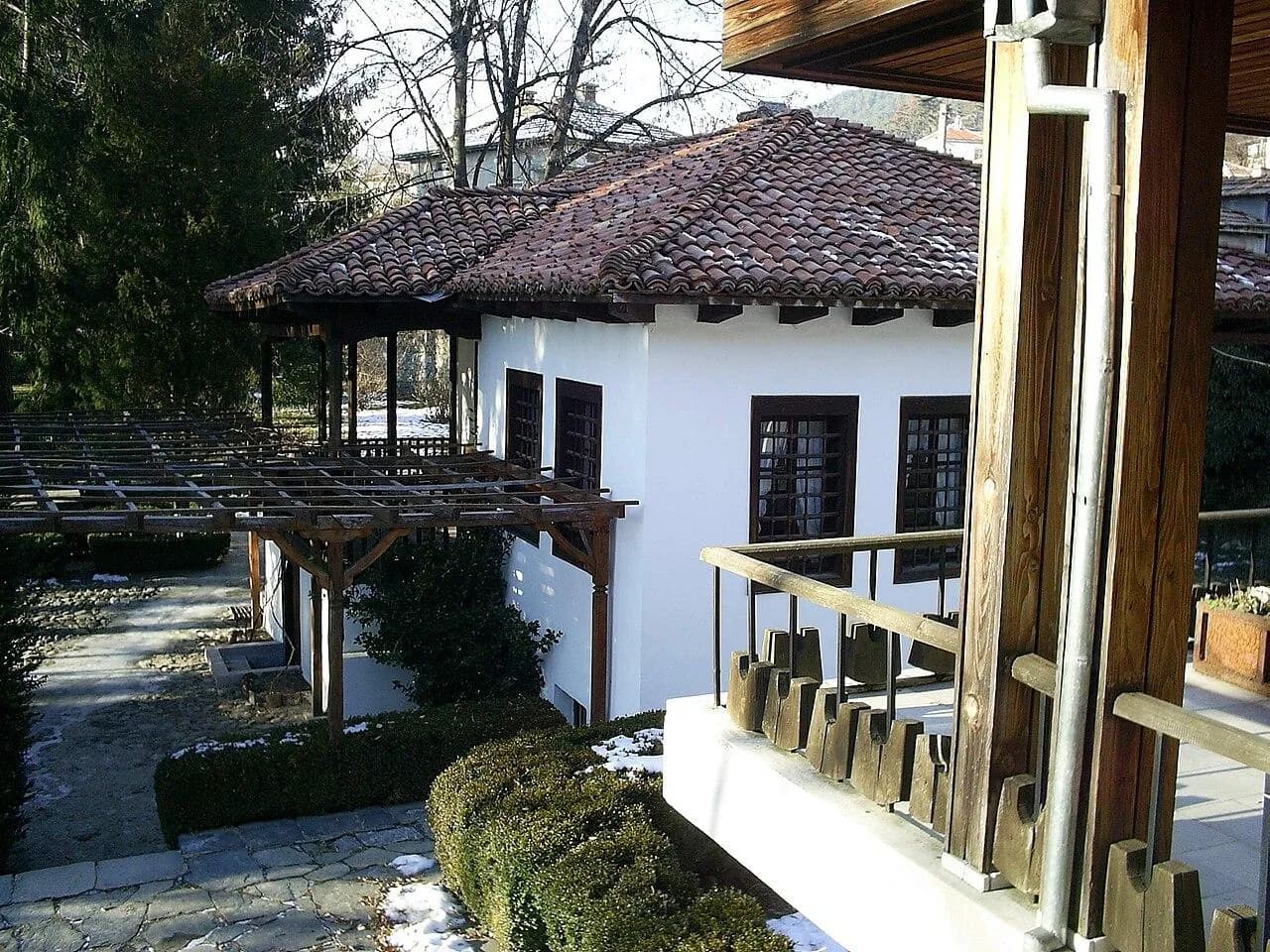
The Levski museum stands on the site of his family home, which stood empty and collapsed around the time of the Liberation. In 1933 architect Dimitar Ivanov rebuilt it over the original foundations, with townspeople and soldiers contributing labour and materials and Levski's nieces, the daughters of his sister Yana, helping with the details. It opened to visitors in 1937.
The house is modest, which is the point. Downstairs are the winter room, the larder and a hiding place; upstairs, the summer bedroom and the guest room. Beside it are the workshop where the family made woollen braid and the dye room, a reminder that Levski came from a family of craftspeople.
The exhibition hall, opened in 1965, holds original photographs of Levski, his brother Hristo and their mother Gina, a family album donated by his sister's descendants, the statute of the Bulgarian Revolutionary Committee, a uniform of the First Bulgarian Legion and the flag of the Karlovo revolutionary committee Levski founded in 1869. The complex also includes a memorial chapel and two neighbouring houses. A 30-minute general tour or an hour-long specialist tour can be booked, and most exhibitions are accessible to visitors with disabilities, with Braille information at the entrance (visitor information).
Karlovo History Museum
Karlovo grew rich in the Revival period on crafts, and the History Museum explains how. Its 800-square-metre exhibition gives pride of place to gaytan, the woollen braid used to trim clothing, alongside copper work, tanning, goldsmithing, wood-carving and rose-oil production, plus kukeri costumes and archaeology from the Stryama valley. Outside, working reproductions of a rose-oil distillery, a tailor's shop, a braid workshop with period machines and a fulling mill show how the goods were actually made. Look out for an 1848 wax-candle press and an 1892 shoe-wedge machine invented in the town.
The building is the town's boys' school of 1871. It stands on the plot of the earlier mutual school where Levski studied from 1846 to 1848, so he never sat in this building itself (museum history). The museum also runs an exhibition in the Kurshum Mosque and an ethnographic exhibition in the Mazakov House (working hours). On the square between Karlovo's two churches, the Levski monument had its foundation stone laid on 15 May 1903 in the presence of Prince Ferdinand (municipality).
Buhalov Han and Old Karlovo
Buhalov Han was built around the middle of the nineteenth century by the innkeeper Kirko Buhala and is now one of the Revival houses of the Old Karlovo complex on Vasil Levski Street, alongside the Rayno Popovich and Pateva houses and the White Yard (municipality; Old Karlovo). Inside, a carder, spinning wheel and loom stand beside woven rugs and costumes, so you can follow wool from fleece to finished cloth. The complex runs hands-on workshops in woodcarving, Kalofer lace, embroidery, weaving and pottery, and serves coffee brewed in hot sand with lokum or rose liqueur (Buhalov Han). If you want to take part in a workshop rather than just look round, call +359 882 487 085 in advance. It makes a hands-on counterpart to the History Museum's craft displays.
Kalofer: the Hristo Botev Museum
The Botev museum sits in Botev Garden, a park laid out in 1926 on the site of the family's last house. Botev was not born here, but he spent his childhood in this house and called it his home. He came back to it after studying in Odessa, and it was here that he received the issue of Slaveykov's paper Gayda that printed his first poem. The house was destroyed when Kalofer was burned in 1877. It was rebuilt from the recollections of his brother, General Kiril Botev, and older Kalofer residents, to a design by architect Baltadzhiev, and opened as a museum on 2 June 1944. Inside, the spinning wheel and sewing machine of his mother Ivanka are original.
The exhibition hall, built in 1973, holds the only surviving personal belongings of Botev, his pocket watch and writing implements, together with photographs, a model of the steamship Radetzky and the flag of Botev's band. In the garden stand the first Botev monument in Kalofer, from 1930, and a monument to his mother. The Daskal Botev School was built on the initiative of his father, the teacher Botyo Petkov, and is part of the same museum (National Museum Hristo Botev). The museum warns that it has no special facilities for visitors with additional access needs (visiting hours).
If you were hoping to walk into the Central Balkan National Park from Kalofer, note that the Byala Reka visitor complex above the town is closed to visitors and vehicles until construction work there is finished (park notice). Our Central Balkan waterfalls guide covers the alternatives.
Sopot: Ivan Vazov's town
Sopot lies 5 km from Karlovo and was one of the centres of the Bulgarian Revival, a town of wool, weaving and milling crafts (Ministry of Tourism).
Ivan Vazov House Museum
Vazov was born here on 9 July 1850, and the family home burned in July 1877. In 1920 Sopot natives living in Sofia formed a committee to rebuild it; architect Aleksandar Rashenov worked from the guidance of Vazov's brother, General Georgi Vazov, and his sister Vala Fetvadzhieva, and Vazov himself drew a sketch of the family hearth. Building began in 1931, the interiors were arranged from family accounts and descriptions in Under the Yoke, and the museum opened on 6 June 1935 (museum history).
At the end of September 2026 the house reopened after nearly two years of work with a completely new exhibition, "The Vazovs' Home", and an education centre for children and groups. It follows the whole family, which produced generals and politicians as well as the writer, through children's games, the family table, the letters the siblings exchanged throughout their lives, the schoolroom, Vazov's study and the writing of Under the Yoke (reopening announcement).
Radino School, the Girls' Monastery and the watermill
The same museum runs three more sites, all linked to Under the Yoke. Radino School, founded in 1851 with a donation from Father Kiril Nektariev, was one of Bulgaria's first secular girls' schools; the present building dates from 1879, after the 1877 fire, and has a model of the town's boys' school. Across the yard is the church of Saints Peter and Paul, and a path leads to the Girls' Monastery, where the nun Hristina hid Levski. An old vine in its yard is said to date from the mid-seventeenth century.
The Sopotski Esnaf ethnographic and crafts centre, opened in 2013 in two Revival houses, shows a village kitchen, a women's room with a horizontal loom and gardens, and serves coffee brewed in hot sand. Dyado Stoyan's watermill is the only one restored of Sopot's many nineteenth-century mills. It is not on the site described in the novel, where Kralich shelters from the storm, but it was rebuilt in the same form and opened in 2013. It works from Wednesday to Sunday in summer and is closed from December to March (mill hours).
Walk: Sopot Monastery and Anevsko Kale
The national park's Sopot itinerary links the town to a medieval fortress in about two hours and is one of the park's easiest routes. From the Vazov house it passes Radino School, the church of Saints Peter and Paul, built in 1846 and restored in 1879, and the Girls' Monastery, founded in 1667, where you can see the cell of Abbess Hristina and the hiding place she used for Levski.
The path then leaves town past the last houses and through pine woods to Sopot Monastery of St Spas, founded in the fourteenth century and burned in 1877. Bulgarians living in Romania helped restore it, which explains the unusual interior: the church was rebuilt without murals. Here, on 7 December 1858, Levski was ordained as the deacon Ignatiy, and in 1875 Kableshkov swore in the members of Sopot's revolutionary committee. The watermill is about 150 metres south of the gates.
From the monastery, the climb north-east to Anevsko Kale is steep and tiring. The fortress, at about 960 metres, dates from the Second Bulgarian Kingdom. What survives are walls 1 metre thick and 10-15 metres high: parts of a southern and a northern tower joined by a stretch of fortress wall. The Ministry of Tourism places it about 2 km from Sopot and describes it as part of the medieval town of Kopsis, which flourished in the thirteenth and fourteenth centuries. The view takes in the whole Karlovo valley and Sredna Gora. You can return the same way, or follow the itinerary south past Anevo village to the main road and back to Sopot in another 30 minutes. Allow half a day with visits and a break at the top.
Suggested plans
One day by car. Start in Karlovo with the Levski museum at 08:30 and the History Museum, have lunch, then drive east to Kalofer for the Botev museum in the afternoon. The museums break for lunch at different times, so check the table below.
One day in Sopot. Combine the Vazov house and Radino School with the walk to Sopot Monastery and Anevsko Kale. The combined ticket covers all four museum sites, though the mill only runs in the warmer months.
Two days. Do Karlovo and Kalofer on day one and Sopot with Anevsko Kale on day two. Coming from Plovdiv, any of these makes a day trip; see our Plovdiv guide. The same valley continues east into the Rose Valley, covered in our Kazanlak and Rose Valley guide.
Best time to go
Spring and autumn are the most comfortable seasons for the climb to Anevsko Kale. The Levski museum is free on 18 February and 18 July, and the Vazov museum on the first Monday of each month, which can mean crowds. The Botev, Vazov and Karlovo History museums open every day, so a weekday visit is calmer without limiting what you can see.
Getting there
All three towns have railway stations. From Sofia, direct trains reach Karlovo in about 2 hours 15 minutes on the fastest services, Kalofer in about 2 hours 35 minutes and Sopot in about 3 hours on regional trains (Karlovo, Kalofer and Sopot timetables). From Plovdiv, six direct trains a day run to Karlovo in 1 hour 10 minutes to 1 hour 30 minutes (timetable). A car makes it much easier to combine two towns in one day.
Opening hours and tickets
Checked on 8 October 2026 on the museums' own pages. Adult prices are in euros.
| Sight | Opening hours | Adult ticket |
|---|---|---|
| Vasil Levski National Museum, Karlovo | 08:30-13:00 and 14:00-17:30 | €3; family €7 |
| Karlovo History Museum | Daily 08:00-12:00 and 13:00-17:00 | Changed in January 2026; ask the museum |
| Old Karlovo complex and Buhalov Han | Daily; 09:15-18:00 from 1 April to 31 October, 08:45-17:30 in winter; break 11:45-12:30 | Ask the complex |
| Hristo Botev Museum, Kalofer | Daily; summer 08:30-17:30, last tickets 17:00; winter 08:30-17:00, last tickets 16:30 | €2.56 |
| Ivan Vazov House Museum, Sopot | Daily; summer 09:00-12:30 and 13:00-17:30; winter 08:30-12:30 and 13:00-17:00 | €6; family €12 |
| Sopot combined ticket | Vazov house, Radino School, ethnographic centre and watermill | €12; family €24 |
| Dyado Stoyan's watermill | Wednesday-Sunday 10:00-16:00 in season; closed December-March | €4 |
Sources: Levski museum, Karlovo museum hours and fees notice, Botev museum hours and prices, Vazov museum prices and hours. Concessions are €2 at the Levski museum, €1.53 at the Botev museum and €3 at the Vazov house. Guided tours cost extra: €12 or €15 at the Levski museum, €10.23 at the Botev museum and €10 at the Vazov house.
Before you go, phone the Karlovo History Museum on 0335 9 47 28 for its current ticket price, and if you plan the Anevsko Kale walk, check the weather and carry water.
Sources & further reading
- Information for visitors - Vasil Levski National Museum - Karlovo
- House of birth - Vasil Levski National Museum - Karlovo
- Exhibition hall - Vasil Levski National Museum - Karlovo
- Historical Museum Karlovo - Historical Museum Karlovo
- Museum exhibition - Historical Museum Karlovo
- Working hours - Historical Museum Karlovo
- Entrance fees - Historical Museum Karlovo
- Landmarks of Karlovo municipality - Karlovo Municipality
- Buhalov Han - Old Karlovo Ethnographic Complex
- Old Karlovo Ethnographic Complex - Old Karlovo Ethnographic Complex
- Buhalov Han - Old Karlovo - Karlovo Municipality
- National Museum Hristo Botev - National Museum Hristo Botev
- Hristo Botev Museum complex - National Museum Hristo Botev
- Visiting hours - National Museum Hristo Botev
- Byala Reka visitor complex closure - Central Balkan National Park Directorate
- Ivan Vazov House Museum - history - Ivan Vazov House Museum - Sopot
- Ivan Vazov House Museum reopens - Ivan Vazov House Museum - Sopot
- Ivan Vazov House Museum - prices - Ivan Vazov House Museum - Sopot
- Ivan Vazov House Museum - opening hours - Ivan Vazov House Museum - Sopot
- Radino School - history - Ivan Vazov House Museum - Sopot
- Dyado Stoyan's watermill - history - Ivan Vazov House Museum - Sopot
- Dyado Stoyan's watermill - opening hours - Ivan Vazov House Museum - Sopot
- Sopotski Esnaf ethnographic and crafts centre - Ivan Vazov House Museum - Sopot
- Town of Sopot - Sopot Monastery - Anevsko Kale fortress - Central Balkan National Park Directorate
- Sopot - Ministry of Tourism
- Sofia to Karlovo timetable - BDZ
- Sofia to Kalofer timetable - BDZ
- Sofia to Sopot timetable - BDZ
- Plovdiv to Karlovo timetable - BDZ
Tags
- Karlovo
- Kalofer
- Sopot
- Vasil Levski
- Hristo Botev
- Ivan Vazov
- Anevsko Kale
- Bulgarian Revival