Plovdiv guide: Roman sites, Old Town houses and day trips
Plan Plovdiv's Roman theatre, mosaics and Old Town houses, then add Bachkovo, Asen's Fortress, Perushtitsa or the Krumovo aviation museum.
Sources checked - 8 October 2026
In this article
Plovdiv is one of the few European cities where a Roman theatre, a Roman stadium and late-antique church floors sit in the middle of ordinary daily life. Above them, the cobbled Old Town keeps a cluster of nineteenth-century merchant houses with painted walls and carved ceilings. Two days is enough to see the city properly and add one trip south into the Rhodope foothills, where Bachkovo Monastery, Asen's Fortress and the early-Christian Red Church near Perushtitsa are all within easy reach.
Roman Plovdiv: what to see
The Roman city of Philippopolis spreads across the centre, so most of its sites are a short walk apart. The theatre and the Eastern Gate are up in the Old Town; the stadium, Odeon, mosaics and basilicas lie below, around the main pedestrian street and the boulevard to the east.
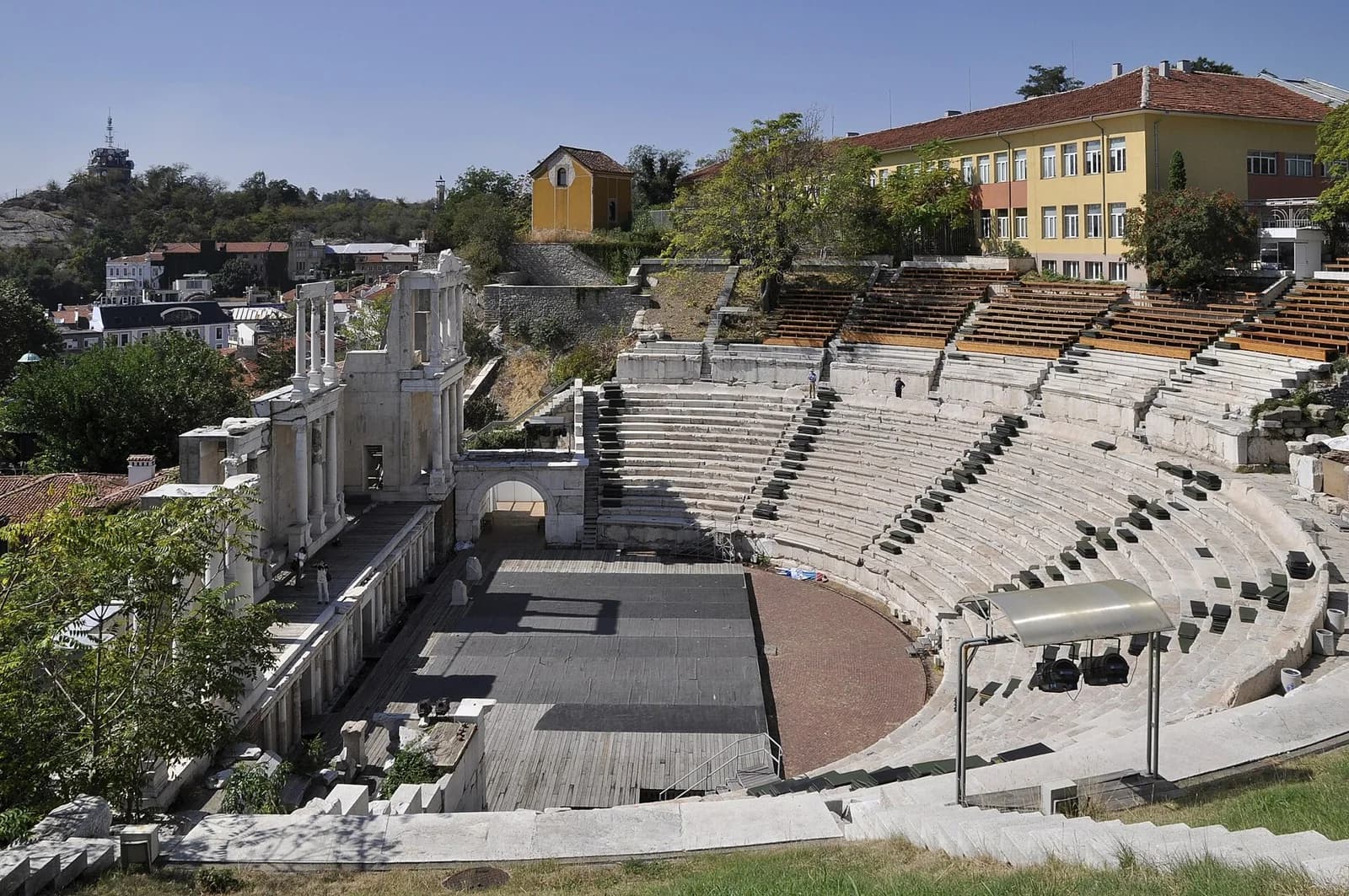
The Ancient Theatre
If you see one thing in Plovdiv, make it the Ancient Theatre. It was built in the 90s of the first century AD, under Emperor Domitian, and stayed in use until the end of the fourth century. Its 28 rows of marble seats curve down to the columned stage building, and from the top rows you look out over the city.
The theatre was more than an entertainment venue. The city's visitor portal notes that it hosted gatherings of the Union of Thracian Cities and gladiatorial fights as well as plays. What you see today was excavated between 1968 and 1979 and partly conserved, and the theatre is again a working stage for opera, drama and concerts. Visiting by day lets you walk the rows and look at the stage building closely; a performance is a separate ticket bought through the event's seller.
Bishop's Basilica, Small Basilica and Irene: the mosaic trail
The most rewarding addition to the theatre is the city's late-antique mosaic floors, and three sites can be seen on one combined ticket.
The Bishop's Basilica is the headline. At about 83 by 36 metres it is the largest basilica of the fourth to sixth centuries in Bulgaria, and it was in use from the middle of the fourth century to the end of the sixth. Its floors survive in two layers covering more than 2,000 square metres. The project's interpretation explains the contrast well: the fourth-century layer is geometric, with waves, rosettes and optical patterns in the side naves, plus a donation inscription identifying the church as a bishop's seat. The fifth-century floor adds Christian imagery, including more than a hundred birds in the central nave, peacocks as symbols of the soul's immortality and "Spring of Life" fountains. Give the earlier layer as much time as the famous peacock. The basilica has been on Bulgaria's UNESCO Tentative List since 2018.
The Small Basilica, a few minutes east, is a different kind of visit: a compact church of the second half of the fifth and sixth centuries, about 20 by 13 metres, found by accident in 1988 during apartment construction. Its highlight is the baptistery, a cross-shaped marble pool decorated with a pair of doves and a stag, which the operator reads as the Holy Spirit and the soul seeking faith. A donor inscription honouring the commander Basiliscus was partly destroyed after his brief reign as emperor in 475-476. The mosaics were lifted in 1993-1994, restored from 2010 and returned to their places in 2013, when the site reopened as a museum.
The third stop, the Late Antique Irene Building, is shown in situ in the "Archaeological" pedestrian underpass near the Forum. Its 160 square metres of mosaics include a portrait of Irene, the personification of peace, made in fine opus vermiculatum with glass tesserae. A street connected it to the Bishop's Basilica, and the operator suggests it may have been the bishop's residence. Together the three sites show a cathedral, a neighbourhood church with a baptistery and a wealthy house.
Roman Stadium, Odeon and Eastern Gate
The Roman Stadium dates from the early second century, under Hadrian. It was about 240 metres long and could hold up to 30,000 spectators, but only its curved northern end, the sphendone, has been uncovered, in the 1970s. Look for the marble seats carved with lion paws. A short 3D film in the projection hall reconstructs the whole structure.
Nearby, the Odeon was a small covered theatre for 300 to 350 people in the corner of the Forum, the largest forum complex in Bulgaria, and now hosts concerts. Up in the Old Town, the Eastern Gate began as a second-century triumphal arch for Hadrian's visit and was built into the city walls in the fourth century, when towers were added on both sides. It is open at all hours and free.
The Old Town houses
Old Plovdiv's merchant houses show the city in a later boom, when nineteenth-century traders built symmetrical homes with painted halls and bay windows. Several are museums run by the same municipal institute, so one combined ticket covers up to five of them.
Hindliyan House is the one to choose if you have time for only one. It was built in 1834-1835 for Stepan Hindliyan, an Armenian merchant whose surname came from his trade with India. Downstairs is a private bath whose heating system draws on the Roman hypocaust and the Turkish bath. A steep staircase leads to the upper hall, which once had a fountain of rose water and is painted with views of Saint Petersburg, Stockholm, Lisbon, Athens, Venice, Alexandria and Constantinople. The lower floor is an early example of paper-stencil decoration, and a separate service wing held the kitchen, laundry and servants' rooms.
Balabanov House is the place for carved wooden ceilings and the decorative alcoves known as alafrangas. Know what you are looking at: the original house, owned in turn by the merchant Hadji Panayot Lampsha, a nephew of Nayden Gerov and the timber merchant Luka Balabanov, was demolished in 1935. Architect Hristo Peev reconstructed it in 1976-1979. Today it also hosts temporary exhibitions and chamber concerts.
The same institute runs the Nedkovich, Klianti and Veren Stambolyan houses and the Hippocrates pharmacy museum, all listed on its ticket page. They suit a slower second day in the Old Town.
Day trips south of Plovdiv
Bachkovo Monastery
Bachkovo was founded in 1083 by Gregory Pakourianos (Grigoriy Bakuriani), a Byzantine commander, during the reign of Alexios I Komnenos. It is the country's second-largest monastery after Rila, set on a terrace above the Chepelarska river about 10 km from Asenovgrad and 30 km from Plovdiv (general information). It is a working monastery, with services at 07:00 and 17:00 (18:00 in summer), and the municipality notes that the last medieval patriarch, Evtimiy of Tarnovo, is believed to be buried here.
The main church dates from 1604. Its gilded, carved iconostasis from the early seventeenth century is one of the oldest in Bulgaria. Most of the interior painting is from 1850, by Mosko Velev of Edirne, but the narthex keeps the earlier paintings of 1643, including portraits of the donors Georgi and his son Konstantin in rich oriental dress. The monastery's miracle-working icon of the Virgin is the focus of pilgrimage.
Two paid stops repay the extra time. The old refectory has a marble table made in 1601 and murals of 1643, about 90 percent preserved. Its ceiling is a Tree of Jesse in which ancient philosophers, among them Socrates, Plato, Aristotle and Diogenes, appear with the Old Testament prophets, and the east wall shows the Last Judgement. The museum in the South Yard added a renewed icon hall in 2022, with icons from the thirteenth to nineteenth centuries. Look for the seventeenth-century Martyrdom of Saints Kirik and Yulita, probably painted on Venetian-ruled Crete, and a copy of the Kykkos Virgin from Cyprus with the Christ child playing at her right.
The oldest building is the ossuary, about 300 metres east of the monastery. Built by Bakuriani in 1083, it is a two-storey church with a crypt for the monks' bones and frescoes mostly of the late eleventh century by the painter Ioan Iveropulets, including a rare Vision of Ezekiel in the valley of dry bones. It is kept as a museum: ask at the monastery about a visit.
Asen's Fortress
Asen's Fortress stands on a ridge 2.5 km south of Asenovgrad, dropping almost vertically to the Asenitsa river, and pairs naturally with Bachkovo on the same road. The church of the Holy Mother of God of Petrich is the only complete building, which makes the site look like a lone chapel on a rock. Walk around it and the scale changes: a large square tower stands at the high western end, and excavations in 1976-1980 uncovered the foundations of more than 30 buildings across more than 12 decares. Above the southern entrance, an inscription cut into the limestone records that in 1231 Tsar Ivan Asen II built the town and appointed the sebastos Alexios.
Perushtitsa: the Red Church and the town of 1876
Perushtitsa, south-west of Plovdiv, combines two very different stories. The Red Church, 2 km north of the town, is an early-Christian building of red Roman brick with a four-lobed core once crowned by a dome about 17 metres high. The museum identifies three building periods, from the mid-fourth century through an enlargement under Emperor Anastasius around 500 to a late tenth or early eleventh-century phase, and fresco campaigns of the sixth and tenth to twelfth centuries. The approach is an 800-metre footpath from the road (visitor information).
In town, the History Museum tells the story of the April Uprising, declared here on 23 April 1876. On 1 May, in the church of St Archangel Michael, built in 1847-1849, 32 men, women and children chose death rather than capture. Danov School, opened in 1850, has a period classroom and the committee room where the revolutionary committees met in 1869 and 1876, and its basement gallery shows Dobri Dobrev's large painting The Defence of Perushtitsa. One ticket covers the museum, church, school and gallery; the Red Church has its own.
Krumovo Aviation Museum
The Aviation Museum at Krumovo, near Plovdiv Airport, is the easy choice for families and anyone who prefers machines to murals. The outdoor field runs from the Arado 196 seaplane and Il-2 of the Second World War through early jets such as the Yak-23 and MiG-15UTI to later MiGs, the Su-22, civil Il-14 and An-24 airliners, crop sprayers and a long line of helicopters. Indoors, the astronautics collection has the original descent module of Soyuz-33, which landed on 12 April 1979 with Georgi Ivanov and Nikolai Rukavishnikov aboard, together with material on Alexander Alexandrov's 1988 flight.
Suggested plans
Half a day in Plovdiv. Start at the Ancient Theatre when it opens, walk up to Hindliyan House, then down past the Eastern Gate and through the Old Town lanes to the Roman Stadium on the main street.
One day in Plovdiv. Spend the morning in the Old Town with the five-site ticket: theatre, Hindliyan and Balabanov houses and one or two others. After lunch, buy the basilica ticket and do the mosaic trail: Irene, the Bishop's Basilica and the Small Basilica, finishing at the stadium and Odeon. Most sites close for 30 minutes around lunchtime, at slightly different times, so stagger your stops.
Two days. Add a southern loop by car: Krumovo on the way out, Asen's Fortress and Bachkovo in the foothills above Asenovgrad, and lunch near the monastery. Perushtitsa makes a better second-day choice if early Christian architecture interests you more than icons. For a longer trip, the road beyond Bachkovo climbs into the Rhodopes, covered in our Smolyan and central Rhodopes guide.
Best time to go
The theatre and the Old Town are at their best on a spring or autumn morning, before tour groups arrive and before the summer heat builds on the marble seats. If you would like to see a performance, check the theatre's event calendar first. On Mondays, Balabanov and Hindliyan houses are closed, while the theatre, stadium and basilicas open daily. Krumovo opens Wednesday to Sunday only. Bachkovo is busiest at weekends and on major church feasts, so an early weekday visit is calmer. School pupils, students and seniors get free entry to the Old Plovdiv sites on the first Thursday of each month (ticket page).
Getting there
Plovdiv is a straightforward motorway drive from Sofia. By train, BDZ runs around a dozen direct services a day; the fastest take about 2 hours 40 minutes and most take nearly three (timetable). The Roman sites and the Old Town are all walkable from the centre, but the Old Town is steep and cobbled. For Bachkovo, Asen's Fortress, Perushtitsa and Krumovo, a car is the simplest option.
Opening hours and tickets
Checked on 8 October 2026 on the operators' own pages. Adult prices are in euros.
| Sight | Opening hours | Adult ticket |
|---|---|---|
| Ancient Theatre | Daily, 09:30-18:00 April-October, 09:00-17:30 November-March; break 12:30-13:00 | €3.58 |
| Bishop's Basilica | Daily, 09:00-18:00 | €7.57 |
| Small Basilica | Daily, 09:30-18:00; break 12:30-13:00 | €3.58 |
| Irene Building | Daily, 09:00-18:00; break 12:30-13:30 | €3.58 |
| Roman Stadium | Daily, same hours as the theatre | €3.58; 3D film €3.68 |
| Balabanov House | Tuesday-Sunday, same seasonal hours; break 13:00-13:30 | €3.58 |
| Hindliyan House | Tuesday-Sunday, same seasonal hours; break 12:30-13:00 | €3.58 |
| Combined tickets | Up to five sites, excluding both basilicas; or Bishop's Basilica, Small Basilica and Irene | €10.74; €12.78 |
| Bachkovo Monastery | Daily, 07:00-20:00 in summer, 07:00-19:00 in winter | Museum €3, refectory €5, plus VAT |
| Perushtitsa museum sites | October-May: Mon-Fri 08:30-17:00, Sat-Sun 09:00-17:00; June-September: Mon-Fri 09:30-18:00, Sat-Sun 10:00-18:00 | Four town sites 6 leva (€3.07); Red Church 5 leva (€2.56); all sites 9 leva (€4.60) |
| Krumovo Aviation Museum | Wednesday-Sunday; April-September 09:00-18:00 (from 09:30 at weekends); October-March 09:00-16:30 | €2.05 outdoor; €4.09 combined |
Sources: Old Plovdiv tickets, Bachkovo visiting hours, Perushtitsa visitor information and Krumovo admission. Old Plovdiv students pay €1.53 at most sites and €3.58 at the Bishop's Basilica, and children under seven enter free.
Before you go, check whether a concert or rehearsal affects daytime visits to the theatre, and call the Red Church's visitor centre on +359 877 644 331 to confirm it is open on your date.
Sources & further reading
- Tickets and opening hours - Ancient Plovdiv Municipal Institute
- The Ancient Theatre - Ancient Plovdiv Municipal Institute
- Ancient Theatre - Plovdiv Municipality
- The Bishop's Basilica of Philippopolis - Ancient Plovdiv Municipal Institute
- Roman mosaic heritage - Bishop's Basilica of Philippopolis project
- Small Basilica of Philippopolis - Ancient Plovdiv Municipal Institute
- Late Antique Irene Building - Ancient Plovdiv Municipal Institute
- Roman Stadium - Ancient Plovdiv Municipal Institute
- Ancient Odeon of Philippopolis - Ancient Plovdiv Municipal Institute
- The Eastern Gate of Philippopolis - Ancient Plovdiv Municipal Institute
- The Balabanov House - Ancient Plovdiv Municipal Institute
- Hindliyan's House - Ancient Plovdiv Municipal Institute
- History of Bachkovo Monastery - Bachkovo Monastery
- General information - Bachkovo Monastery
- Main monastery church - Bachkovo Monastery
- The old refectory - Bachkovo Monastery
- Monastery museum - Bachkovo Monastery
- Monastery ossuary - Bachkovo Monastery
- Contacts and visiting hours - Bachkovo Monastery
- Bachkovo Monastery - Asenovgrad Municipality
- Asen's Fortress - Asenovgrad Municipality
- Visitor information - Historical Museum Perushtitsa
- Historical Museum Perushtitsa - Historical Museum Perushtitsa
- The church of St Archangel Michael - Historical Museum Perushtitsa
- Danov School - Historical Museum Perushtitsa
- Art gallery - Historical Museum Perushtitsa
- The Red Church - Historical Museum Perushtitsa
- Visit the Aviation Museum - Aviation Museum Krumovo
- Outdoor exhibition - Aviation Museum Krumovo
- Astronautics collection - Aviation Museum Krumovo
- Sofia to Plovdiv timetable - BDZ
Tags
- Plovdiv
- Roman Plovdiv
- Old Plovdiv
- mosaics
- Bachkovo Monastery
- Asenovgrad
- Perushtitsa
- day trips