Kyustendil, Pernik and Tran: What to See in Western Bulgaria
Roman Pautalia and medieval churches in Kyustendil, Pernik's mine museum and Krakra fortress, Kadin Bridge and the Erma gorge near Tran, with day plans.
Sources checked - 8 October 2026
In this article
The corner of Bulgaria between Sofia and the Serbian and North Macedonian borders packs in Roman baths, a fifteenth-century bridge, a key chapter in the Holocaust history of Bulgaria, a real coal mine you can walk into and a limestone gorge. Kyustendil is the main draw, a spa town that was Roman Pautalia. Pernik, the coal city, is close enough to Sofia for a half-day trip, and Tran, near the Serbian border, combines a short gorge walk with pottery and a museum devoted to yogurt.
How the region fits together
Pernik lies 20 to 30 km south-west of Sofia on the Struma. The railway continues through Radomir to Kyustendil, about 90 km from Sofia at the foot of Osogovo. Kadin Bridge spans the Struma at Nevestino, east of Kyustendil. Tran is on a different road, north-west towards Serbia, about 85 km from Sofia. In practice that makes two separate day trips: Pernik, Radomir and Kyustendil along the Struma, and Tran with its villages.
Kyustendil
Known as Pautalia in antiquity and Velbazhd in the Middle Ages, Kyustendil grew around more than 40 mineral springs. Most of its sights are run by the Regional History Museum and sit in or near the centre.
Archaeological exhibition
The museum's archaeological exhibition in the Asclepius Hall runs from the seventh millennium BC to the seventeenth century, and it is the best introduction to the town. The prehistoric section has pottery and tools from Slatino and a fifth-millennium BC oven model with an incised pattern that the museum reads as a calendar. The Iron Age material comes largely from the Katrishte necropolis, with jewellery in bronze, electrum and amber.
The Roman section is the core. Pautalia became a city under Trajan and grew under Hadrian, and the displays mix civic, religious and everyday objects: Pautalia's own coins, chariot fittings, and votive monuments to the Thracian Horseman, Asclepius, Hygieia, Mithras and others. Look for the second-century busts of Zeus and Hera from Kopilovtsi and the third-century four-wheeled Thraco-Roman vehicle from Radlovtsi. The medieval rooms cover Velbazhd, with enkolpion crosses of the tenth and eleventh centuries, and the Razhdavitsa treasure of sixteenth and seventeenth-century European and Ottoman coins and jewellery. A separate numismatic exhibition in the same building follows money in the region from Macedonian silver to Venetian ducats and Ottoman coins.
Roman Pautalia in the streets
The excavated town is part of the visit. The Pautalia Asclepion, Roman baths of the early second century in the centre, covered more than 3,000 square metres; nine rooms have been explored, with hypocaust underfloor heating and traces of marble decoration. In the museum courtyard, the open-air lapidarium displays columns, capitals, sarcophagi and inscriptions, including a second-century sundial. On the hill above town, the late fourth to early fifth-century Hisarlaka fortress had 14 towers, and the medieval Pirgova Tower, about 15 metres high, stands in the centre.
St George Church
In the Kolusha district, St George is the oldest surviving medieval church in Kyustendil, dated to the eleventh or twelfth century. Its most valuable murals are twelfth-century full-length saints, warriors, healers, clergy and women saints, attributed to painters probably from Thessaloniki. Later layers from the fifteenth, sixteenth and nineteenth centuries sit alongside them, the last from a renovation in 1878-1882, so look at each figure's style rather than assuming everything is medieval. Local tradition holds that Tsar Mihail III Shishman, killed at the Battle of Velbazhd in 1330, is buried here. A neighbouring Revival-period building displays icons, church plate and early printed books.
Dimitar Peshev House Museum
In March 1943 citizens of Kyustendil acted against the planned deportation of Bulgaria's Jews, and Dimitar Peshev, the town's member of parliament and deputy speaker, intervened to halt it. The house museum is an exact replica of Peshev's birthplace, built in the town centre and opened in October 2002; the exhibition followed on 9 March 2003 and was refreshed in 2013. Through original objects, photographs and facsimiles it tells the story of Peshev and four fellow citizens, Asen Suichmezov, Vladimir Kurtev, Ivan Momchilov and Petar Mihalev.
The wider record is harder. In the same weeks, Bulgarian authorities deported 11,343 Jews from the Bulgarian-occupied territories to Treblinka, where they were killed, and in May 1943 some 20,000 Jews were expelled from Sofia to the provinces and the men sent to forced-labour camps. The museum is small and an hour is enough, but it rewards reading the documents closely.
Art Gallery Vladimir Dimitrov - Maystora
Kyustendil was the home town of Vladimir Dimitrov, known as Maystora, "the Master" (1882-1960). The gallery named after him, founded in 1972, has seven top-lit halls with more than 100 of his paintings, plus works by the Kyustendil school of painters and changing exhibitions. If you saw his Reaper in Sofia's National Gallery, this is where to see his work in depth.
Kadin Bridge at Nevestino
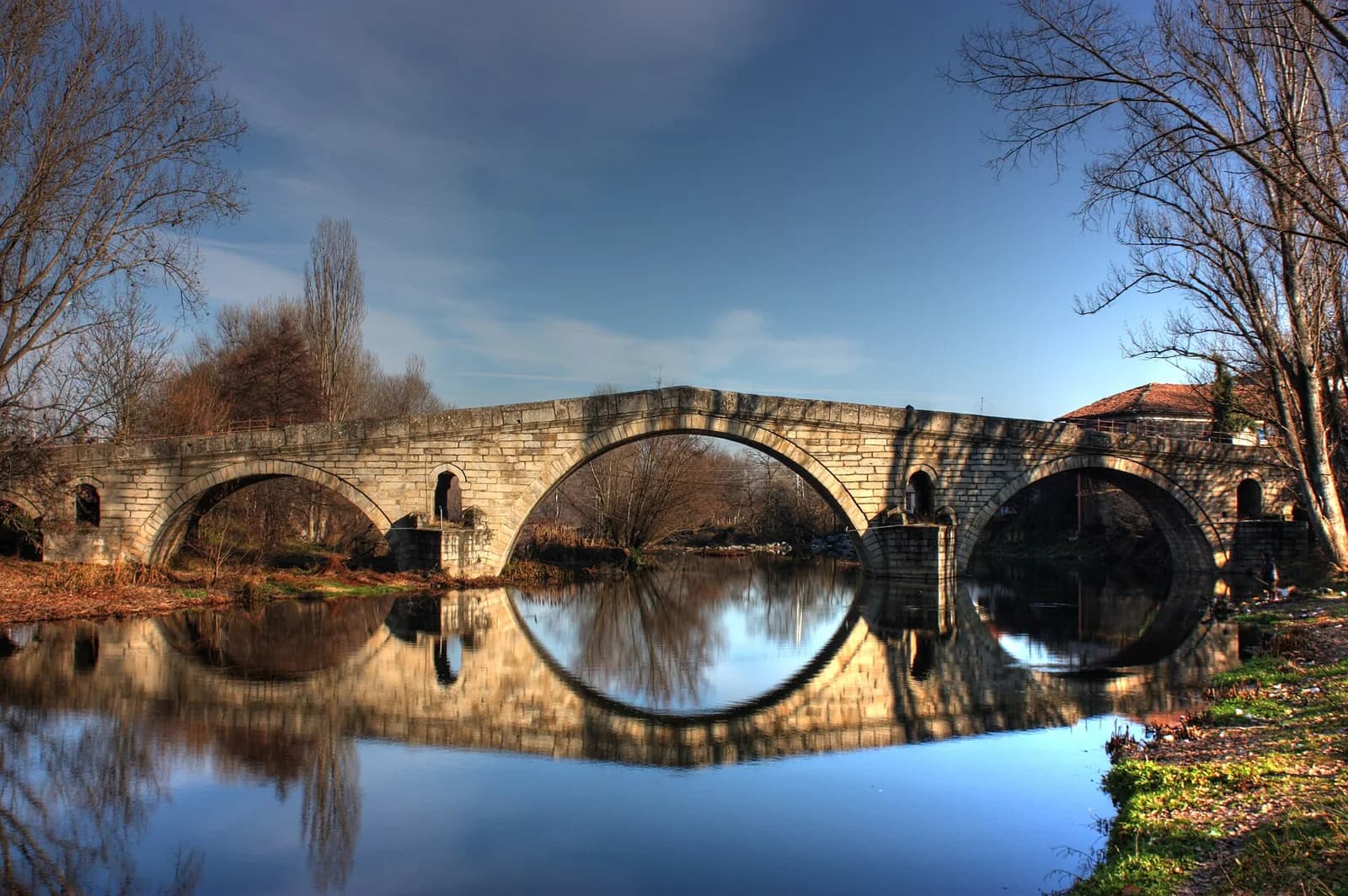
Built in 1470 for Grand Vizier Isak Pasha, Kadin Bridge crosses the Struma on three stone arches, about 100 metres long, with a longest span of 20 metres. An Ottoman inscription on one side records that it was built for travellers. Local tradition ties the name to the legend of Master Manol's bride, Struma, walled into the foundations so that the bridge would stand. It is still a working road bridge, so watch for traffic; a small park beside it is the best place to look at the arches and their reflection.
Pernik
Pernik grew from a village into an industrial city on the back of coal. It is also known for the Surva festival of masked kukeri, held at the end of January.
Regional History Museum
The new permanent exhibition, Pernik - the Industrial Heart of Bulgaria, opened on 29 January 2026. It begins with the village of the late nineteenth century, passes under an arch inscribed "Bog na pomosht" ("God help us"), words long associated with the mine, and follows the coal basin from its exploration through the mid-twentieth-century peak to the closures of the 1990s. The mine, heavy industry and the railway station share the space with schools, culture, sport and the people of the town, which is what makes it more than a technical display.
Underground Mining Museum
The mining museum uses two preserved galleries of the first Pernik mine, the Old Mines of 1891, about 630 metres long and 50 metres underground. The route follows the change from hand extraction with wooden carts and sledges to horse haulage, Siemens electric locomotives and mechanised coal-cutting complexes. Visits start on the hour in groups of 3 to 20, and you can arrange a time on the spot at the Regional History Museum or by phone on +359 882 990 222. It is one of the 100 National Tourist Sites.
Krakra Fortress
On a rocky plateau south-west of the centre, Krakra Fortress is an archaeological site rather than a castle. Remains suggest a fortress here as early as the sixth to fifth century BC; the medieval fortifications are traditionally linked to Khan Omurtag, and the site is named after Krakra, the early eleventh-century boyar who held out against Basil II. The walls were about two metres thick. Inside you can trace houses and three churches, including a rare two-storey church-tomb by the gate. A visualised corner tower and West Gate, an observation tower and replica siege engines help you read the foundations. Entry is free.
Radomir
Between Pernik and Kyustendil, Radomir has two small museum sites. The Soldiers' Uprising exhibition, laid out like a front-line dugout, covers September 1918, when soldiers in revolt after years at the front proclaimed a republic at Radomir station on 27 September, with photographs of Aleksandar Stamboliyski and Rayko Daskalov and period documents. Stoyova House, a two-storey house from the second quarter of the nineteenth century, shows the town's crafts, especially boza-making and tailoring. Both open only on weekdays.
Tran and its villages
The Erma gorge
Just north of Tran, the river Erma has cut a 2.8 km gorge about 120 metres deep through Upper Jurassic limestone; at its narrowest the walls are only about 5 metres apart. It has been a protected natural landmark since 1961. An eco-trail starts at the southern end, about 4 km from Tran, crosses the river on a wooden bridge and passes through a tunnel cut into the rock; the classic view is from the clifftop known as Tsarkvishteto, "the Church". The marked eco-trail, about 13 km in all, continues beyond the gorge for those who want a longer walk.
St Petka rock chapel
Above the Barintsi quarter of Tran, a cave in the rock has long been a chapel of St Petka. Water drips from the cave roof and is regarded as healing, and legend tells that the saint hid here from her pursuers, leaving footprints and a loaf of bread turned to stone. A viewpoint on top of the rocks looks over the town. In summer the chapel is open Wednesday to Sunday; in winter, call the day before on 0888 383 877.
Busintsi pottery
Busintsi, 8 km from Tran, was one of the most important old pottery centres in Bulgaria; master potter Kostadin Gigov won first prize at the 1892 Plovdiv exhibition with his figurative vessels. The museum complex, opened in 1982, shows jugs, storage jars, cooking pots, cups and baking dishes in two halls, a working demonstration studio and a kiln more than a century old. From April to October the museum runs 90-minute workshops by reservation: children make a clay bread-baking pan, while adults and families decorate a vessel in the Busintsi style, for €9 per person or €18 per family. Book on +359 877 035 581 or [email protected].
Yogurt Museum, Studen Izvor
Studen Izvor is the birthplace of Stamen Grigorov (1878-1945), who in 1905, working in a Geneva laboratory, identified the bacterium behind yogurt, now named Lactobacillus delbrueckii subsp. bulgaricus (Institute of Microbiology, BAS). The village museum covers his life and science and the place of yogurt in nutrition. Families can book a children's programme in which the milk is set at the start of the visit and checked at the end.
Suggested plans
Half a day in Pernik. Take a morning train from Sofia, book a mine entry at the Regional History Museum, see the industrial exhibition while you wait, then walk up to Krakra. Back in Sofia by mid-afternoon.
A day in Kyustendil. Start at the archaeological exhibition, then walk the Roman baths, Pirgova Tower and lapidarium. After lunch, visit the Peshev house and St George, and finish at the art gallery or on Hisarlaka hill for the view. Drivers can stop at Kadin Bridge on the way. Choose Wednesday to Sunday: St George and the Peshev house close on Mondays and Tuesdays.
A day around Tran. Walk the Erma gorge in the morning, visit St Petka chapel, then drive to Busintsi and Studen Izvor in the afternoon. All three Tran sites close on Mondays and Tuesdays.
A weekend. Day one: Pernik in the morning, Kyustendil in the afternoon, overnight in Kyustendil. Day two: Kyustendil's remaining sights and Kadin Bridge. Radomir's museums are open only on weekdays, so keep them for a midweek trip.
Getting there and practical details
Trains from Sofia to Pernik run roughly hourly and take 45 minutes to an hour. For Kyustendil there is one direct train in the morning, taking 2 hours 45 minutes; other journeys change at Radomir or Pernik and take around three hours or more, so a car is much more practical for Kadin Bridge and the Tran area. There is no railway to Tran.
Hours and prices below were checked on 8 October 2026.
| Site | Opening hours | Adult ticket | Good to know |
|---|---|---|---|
| Kyustendil archaeological exhibition | Daily; Oct-Mar 08:30-12:00 and 12:30-17:00, Apr-Sep 09:30-12:00 and 12:30-18:00 | €2.56 | Free on the last Thursday of the month; all museum exhibitions €6.14 |
| St George Church, Kyustendil | Wed-Sun, same seasonal hours | €2.56 | 1 Kolusha Street |
| Dimitar Peshev House Museum | Wed-Sun, same seasonal hours | €2.56 | 11 Tsar Simeon I Street |
| Pernik Regional History Museum | Daily; Oct-Apr 08:30-17:00, May-Sep 08:30-18:00 | €3 | Guided talk €6 |
| Underground Mining Museum | Daily; Oct-Apr 09:00-17:00, May-Sep 09:00-18:00 | €5 | Entry on the hour, 3-20 people; English talk €6 |
| Krakra Fortress | Daily; Oct-Apr 08:30-17:00, May-Sep 08:30-18:00 | Free | Guided talk €6 |
| Radomir museum sites | Mon-Fri 08:00-12:00 and 13:00-17:00 | €1.02 | Weekend groups by arrangement; +359 777 80 343 |
| St Petka rock chapel, Tran | Summer Wed-Sun 09:00-17:00; winter by request | - | Call the day before in winter |
| Busintsi Ceramics Museum and Yogurt Museum | Wed-Sun 09:00-17:30, break 12:30-13:00 | €2.50 | Family ticket €5; workshops €9 by reservation |
Reduced tickets for students and pensioners cost €1.53 in Kyustendil and €1.50 to €2 in Pernik. Village museums keep short staff hours, so call ahead before a long drive.
Sources & further reading
- Kyustendil - Wikipedia
- Archaeological exhibition - Regional History Museum - Kyustendil
- Numismatic exhibition - Regional History Museum - Kyustendil
- Prices and opening hours - Regional History Museum - Kyustendil
- Following ancient Pautalia and medieval Velbazhd - Kyustendil tourism routes portal
- Музеен комплекс „Св. Георги“ - Bulgarian Ministry of Tourism
- House Museum Dimitar Peshev - Regional History Museum - Kyustendil
- Bulgaria - United States Holocaust Memorial Museum
- Art Gallery Vladimir Dimitrov - Maystora - Bulgarian Ministry of Tourism
- Kadin Bridge - Kyustendil Chamber of Commerce and Industry
- Kadin most - Wikipedia
- Pernik - Wikipedia
- Pernik - the industrial heart of Bulgaria - Regional History Museum Pernik
- Underground Mine Museum - Regional History Museum Pernik
- Подземен минен музей - Regional History Museum Pernik
- Medieval fortress Pernik - Regional History Museum Pernik
- Opening hours and prices - Regional History Museum Pernik
- The town on Krakra hill - Pernik Municipality
- Soldiers' Uprising 1918 exhibition - Radomir Municipality
- Stoyova House - Radomir Municipality
- Historical Museum Radomir - Bulgarian News Agency
- Tran Gorge - Wikipedia
- The beauty of Bulgaria: the Erma River Gorge eco trail - Bulgarian National Television
- St Petka rock chapel - Tran Tourism Association
- Tran pilgrimage brochure - Tran Municipality
- Places to visit in Tran Municipality - Tran Municipality
- Busintsi Ceramics museum complex - Tran Municipal History Museum
- Museum educational activities 2026 - Tran Municipal History Museum
- Бусинци - Wikipedia
- Yogurt Museum - Tran Municipal History Museum
- Stamen Grigorov - Wikipedia
- Documentary on the life and work of Stamen Grigorov - Institute of Microbiology, BAS
- Train timetable Sofia - Pernik - BDZ Passengers
- Train timetable Sofia - Kyustendil - BDZ Passengers
Tags
- Kyustendil
- Pernik
- Tran
- Kadin Bridge
- Pautalia
- industrial heritage
- day trips from Sofia
- Bulgaria