Shumen, Madara and Preslav: Bulgaria's first capitals
Plan the Madara Rider, Pliska, Veliki Preslav and Shumen Fortress, plus Roman Abritus at Razgrad and Misionis near Targovishte, with hours and tickets.
Sources checked - 8 October 2026
In this article
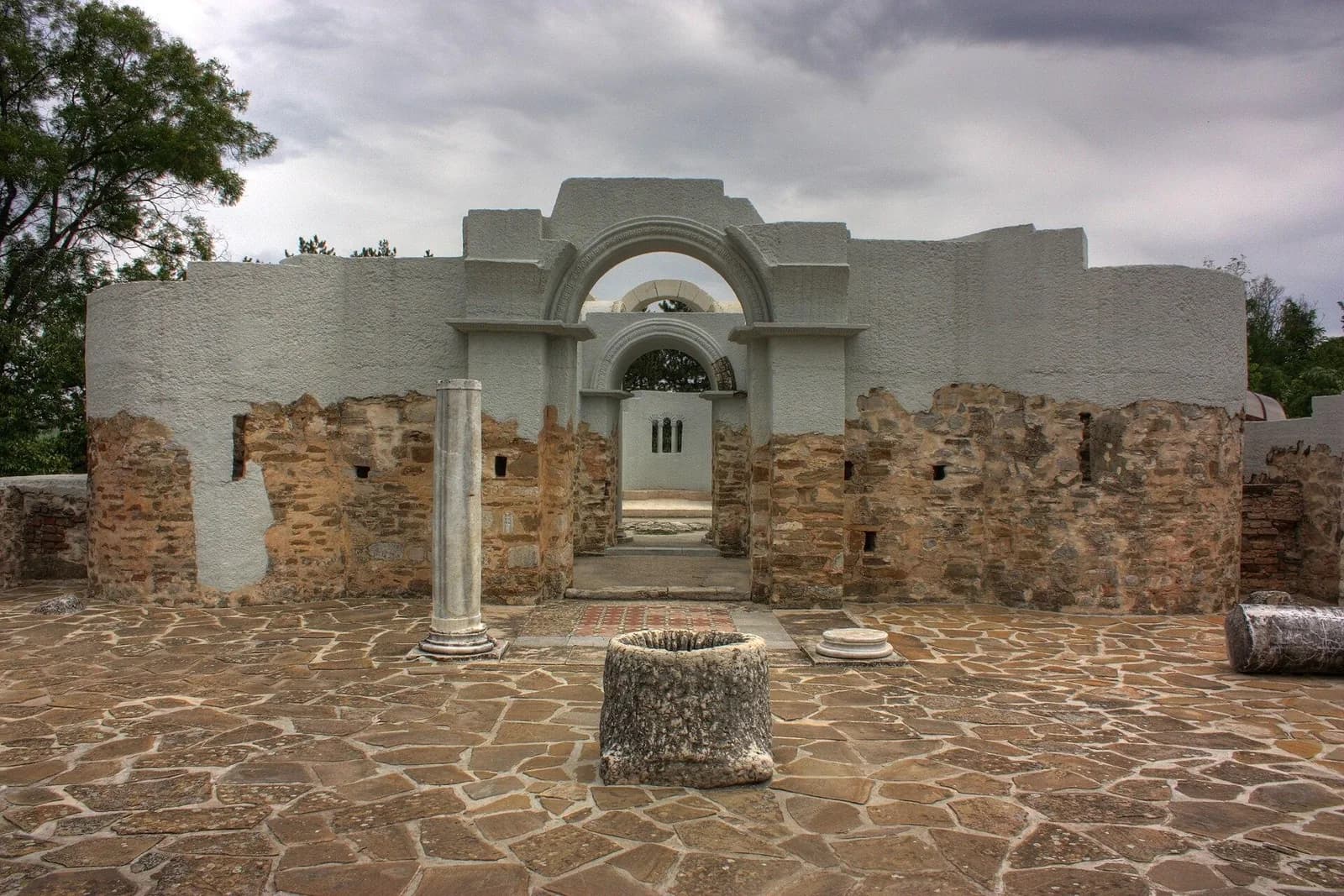
The country around Shumen holds the cradle of the medieval Bulgarian state. Pliska was the capital from 681 to 893, Preslav took over until the 970s, and between them the Madara Rider, carved into a cliff in the early 8th century, is on the UNESCO World Heritage List. All three lie within about 25 km of Shumen, a town with its own hilltop fortress, so one base covers them all. Roman Abritus at Razgrad and Misionis near Targovishte extend the trip west.
What to see
Madara Rider and the Madara reserve
The relief shows a horseman spearing a lion, with a hound running behind. It is carved about 23 metres up a cliff some 100 metres high, and Greek inscriptions around it name the khans Tervel, Krumesis and Omurtag (RIM Shumen). UNESCO dates it to the beginning of the 8th century and inscribed it in 1979 (UNESCO). The scholar Felix Kanitz brought it to scientific attention in 1872, and in 2008 it was named a global symbol of Bulgaria (Shumen Municipality).
The Rider is only one layer. The reserve, 17 km north-east of Shumen and 2 km from Madara village, has a museum that first opened in 1935 (BTA). People lived here from the 5th millennium BC to the 15th century AD. Look for the Thracian sanctuary, the remains of a Roman villa, the fortress on the plateau above and, cut into the rock, the largest Christian rock monastery in Bulgaria, from the 14th century, with more than 150 cells (RIM Shumen). Caves, springs and rich plant life make it a place to walk around, not just a photo stop (Shumen Municipality).
Pliska, the first capital
Pliska, 23 km from Shumen, was the capital from 681 to 893, under Khan Asparukh and the rulers who followed him. Spread over about 23 square kilometres, it was one of the largest medieval cities in Europe. An outer earthen rampart and ditch enclosed it; inside stood stone walls, the khan's residence with ceremonial and residential palaces, pagan temples and a water supply that used clay and lead pipes. The Great Basilica, 1.3 km north-east of the residence, with its marble columns and mosaics, became the seat of the Bulgarian archbishop in the second half of the 9th century (RIM Shumen).
Pliska is about scale more than standing buildings. Two palaces have been partly reconstructed, and the museum, opened in 1940 and expanded in 2006, incorporates part of the northern fortress wall in its hall and displays seals of medieval Bulgarian rulers. The Great Basilica lies well outside the palace area, so allow time to walk or drive between them.
Veliki Preslav, the Golden Age capital
In 893 the Council of Preslav confirmed Simeon as ruler and moved the capital from Pliska to Preslav, about 20 km south-west of Shumen. The city stayed capital until 972, and the literary school that had begun at Pliska became a centre of Old Bulgarian writing here (Preslav).
Start with the museum. Its highlights are the ceramic iconostasis from the Palace Monastery, a copy of the monumental icon of St Theodore and the Preslav treasure (museum guide). The treasure was found in 1978 at Castana near the town: more than 170 gold, silver and bronze objects decorated with cloisonné enamel, precious stones and pearls. Most are 10th-century women's jewellery made in Constantinople and Preslav, but some pieces date from the 3rd-7th centuries. Fifteen Byzantine coins of Constantine VII and Romanos II suggest it was hidden in 969-972, during the siege by Prince Sviatoslav of Kiev and the conquest by Emperor John Tzimiskes (Preslav treasure). Photography is not allowed in the treasury (prices and rules).
Then walk the reserve. The museum's suggested route starts at the northern Iron Gate, about 300 metres from the car park, passes through pine woods and the monastery of Sts Cyril and Methodius, reaches the palace complex, and continues past the Patriarchate's basilica and baths and an administrative building where more than 500 lead seals were found. It leaves through the restored South Gate and ends at the Round, or Golden, Church, discovered in 1927 (suggested walk). If time is short, see the museum and the Round Church.
Shumen
Shumen Fortress stands on the plateau 3 km west of the town. Thracians lived here in the 5th-2nd centuries BC, the Romans held it in the 2nd-4th centuries AD, Justinian I refortified it and it was reoccupied in the 8th-10th centuries. Its peak came in the 12th-14th centuries, when it was one of the main towns of the Second Bulgarian Kingdom. Three outer walls and an inner citadel enclosed six residential quarters with six churches, and four more churches stood outside the walls. The Ottomans took it in 1388, and it was destroyed in 1444 during fighting between the crusaders of Władysław III and the Ottoman garrison (RIM Shumen). You can drive up or follow marked paths from Kyoshkovete Park (Shumen Municipality).
The Founders of the Bulgarian State monument, also on the plateau at 450 metres, was opened on 28 November 1981 for the 1,300th anniversary of the state. Its concrete figures represent Asparukh, Tervel, Krum, Omurtag, Boris and Simeon, and the municipality calls its mosaic triptych the largest open-air mosaic in Europe (Shumen Municipality). It pairs naturally with the fortress, which is on the same plateau above the town.
The Regional History Museum at 17 Slavyanski Boulevard is worth an hour for its Treasury hall. The oldest object is a tubular gold bead from Sushina, from the second half of the 5th millennium BC. There are Thracian gold and silver, including 42 pieces of horse harness from a tomb near Ivanski, medieval jewellery from Shumen Fortress and finds from Pliska, plus coins from a 5th-century BC Cyzicene piece to Ottoman issues and a display of lead seals (Treasury). In town, the Tombul Mosque of 1744 is the largest Ottoman-period mosque in Bulgaria (Shumen Municipality).
The Regional Museum of History in Shumen runs the central museum, the fortress, Madara and Pliska, and sells a three-day ticket for all its sites for €12.78 (prices). If you plan to see all four, it costs less than separate tickets.
Further west: Abritus and Misionis
Abritus, 2 km east of Razgrad, began as a Roman town in the late 1st century AD on a Thracian site. In summer 251 the Goths defeated a Roman army nearby, killing Emperor Trajan Decius and his son Herennius Etruscus. Under Constantine I the town was walled: 15 hectares, four gates and 35 towers, with walls about 1,400 metres long and up to 12 metres high. By the 5th-6th centuries it was a bishop's seat and one of the largest cities of Moesia Inferior (Abritus reserve).
Choose an itinerary before you start (itineraries). Itinerary 1 is the full circuit: along the eastern wall, protected by a steep slope and the river, then the thick southern wall to Tower 17, where a metal frame shows its presumed original height of 15 metres. Inside are Building X, a Roman bath later turned into a basilica, and a 6th-century building with a colonnaded courtyard, before the Interactive Museum, with activities such as minting coins, and the archaeological exhibition (Itinerary 1). Itinerary 4 is designed for wheelchair users, with ramps, a lift in the Interactive Museum and a path to the peristyle building (Itinerary 4).
In Razgrad itself, the Ethnographic Museum presents the life of the local Kapantsi community (Ethnographic Museum), and the house of Ananie Yavashov, the teacher and botanist who began excavating Abritus, hosts temporary exhibitions (Yavashov House).
Misionis lies 7 km south-west of Targovishte, 1.6 km from the main Sofia-Varna road. Its walls enclose more than 12 hectares within a town area of over 70. Excavations since the 1960s have uncovered early Byzantine walls and towers, three basilicas of the 5th-7th centuries, part of an unfortified early Bulgarian settlement of the 9th-10th centuries and the gate of a medieval fortress (Misionis). It is an easy break on a drive between Sofia and Varna.
In Targovishte, the Regional History Museum's archaeological exhibition, with the Ovcharovo ritual scene and the Kralevo gold horse-harness treasure, and its ethnographic exhibition are both closed for repairs, with no reopening date announced (archaeology notice; ethnography notice). Sveshtarova House, built in 1860 with a Tryavna-influenced interior, shows regional icons and church plate (Sveshtarova House), and the Slaveykov School of 1863 has a reconstructed Revival-era classroom (school).
Which sights to prioritise
- One sight only: Madara, for the Rider and the walk around the cliffs.
- Medieval capitals: Veliki Preslav for the museum and treasure, Pliska for the scale of the first capital.
- In Shumen: the fortress and the Founders monument together, then the museum's Treasury.
- Roman history: Abritus, the best-explained site of the group.
- Can skip on a short trip: Misionis and the Targovishte museums, unless you are passing on the Sofia-Varna road.
Suggested plans
One day by car. Madara in the morning, then Pliska, both north-east of Shumen. Return through Shumen and finish at Veliki Preslav, south-west of the town, for the museum and the Round Church.
Two days, based in Shumen. Day one: Shumen Fortress and the Founders monument in the morning, the Regional History Museum after lunch, Madara late in the day in summer, when it stays open until 19:00. Day two: Pliska in the morning and Veliki Preslav in the afternoon.
Three days. Add a day for Abritus and the Razgrad museums, or stop at Misionis if you are continuing towards Sofia.
Best time to go
From April to October the main reserves and museums open daily, and Madara and Pliska stay open until 19:00. Spring and autumn are the most comfortable seasons for walking the large open sites. In winter, check before travelling: the Preslav treasury on winter weekends needs arranging in advance, Abritus opens at weekends only by request, and the Misionis information centre closes from November to April.
How to get there
A car is by far the easiest way to combine these sites. By train, Shumen is on the line from Varna: on 8 October 2026 there were 16 services, taking from about 1 hour 40 minutes (BDZ timetable). From Shumen, seven trains a day ran to Madara, taking 11-16 minutes (BDZ timetable); the reserve is 2 km from the village (BTA). Shumen is also an easy add-on to a stay on the coast; see our Varna guide.
Opening hours and tickets
Hours and adult prices were checked on 8 October 2026. The Shumen museum's summer hours below run until 31 October, and its winter hours had not yet been published, so call +359 892 28 04 44 for November to March visits.
| Sight | Opening hours | Adult ticket |
|---|---|---|
| Madara reserve | 1 Apr-31 Oct daily 09:00-19:00 (RIM Shumen) | €3.58; pensioners €2.56; pupils and students €1.53 (prices) |
| Pliska reserve | 1 Apr-31 Oct daily 08:30-19:00 | €3.58; pensioners €2.56; pupils and students €1.53 |
| Shumen Fortress | 1 Apr-31 Oct daily 08:30-17:00 | €3.07; pensioners €2.05; pupils and students €1.02 |
| Regional History Museum, Shumen | 1 Apr-31 Oct daily 10:00-18:00 | €3.58; three-day ticket for all RIM Shumen sites €12.78 |
| Founders of the Bulgarian State monument | Apr-Oct 08:30-19:00; Nov-Mar 08:30-17:00 (municipality) | Ticket at the site |
| Veliki Preslav museum and reserve | Apr-Oct weekdays 09:00-18:00, weekends and holidays 10:00-18:00; Nov-Mar daily 09:00-17:00, treasury by arrangement on Dec-Mar weekends (museum) | €5; family €9; students €2; pensioners €3 (prices) |
| Abritus | 1 Apr-30 Oct daily 09:30-18:00; 1 Nov-31 Mar 09:00-17:00, weekends by request (museum) | €3.07 with the Ethnographic Museum; Interactive Museum €5.11 (prices) |
| Razgrad Ethnographic Museum and house museums | Weekdays 08:30-17:00, break 12:00-12:30; weekends by request | House museums €2.05 |
| Misionis information centre | May-Oct Wed-Sun 09:00-17:00; Nov-Apr guided visits by arrangement (museum) | Ask at the centre |
For Preslav's treasury on a winter weekend call +359 538 43243; for Abritus out of season, +359 878 901431.
Sources & further reading
- Working hours - Regional Museum of History - Shumen
- Prices - Regional Museum of History - Shumen
- Shumen Fortress historical and archaeological complex - Regional Museum of History - Shumen
- Madara National Historical and Archaeological Reserve - Regional Museum of History - Shumen
- Pliska National Historical and Archaeological Reserve - Regional Museum of History - Shumen
- Treasury hall - Regional Museum of History - Shumen
- Madara Rider - UNESCO World Heritage Centre
- Madara National Historical and Archaeological Reserve - Bulgarian News Agency (BTA)
- Madara reserve - Shumen Municipality
- Shumen Fortress - Shumen Municipality
- Founders of the Bulgarian State memorial complex - Shumen Municipality
- Sights of Shumen - Shumen Municipality
- Preslav - Wikipedia
- Tour of the archaeological reserve - Archaeological Museum Veliki Preslav
- Preslav golden treasure - Archaeological Museum Veliki Preslav
- Prices - Archaeological Museum Veliki Preslav
- Contacts - Archaeological Museum Veliki Preslav
- Abritus Archaeological Reserve - Regional History Museum - Razgrad
- Tourist itineraries - Regional History Museum - Razgrad
- Tourist Itinerary No. 1 - Regional History Museum - Razgrad
- Itinerary No. 4 - for people with disabilities - Regional History Museum - Razgrad
- Ticket prices and services - Regional History Museum - Razgrad
- About the museum - Regional History Museum - Razgrad
- Ethnographic Museum - Regional History Museum - Razgrad
- Ananie Yavashov House Museum - Regional History Museum - Razgrad
- About the Misionis site - Regional History Museum - Targovishte
- History of the museum - Regional History Museum - Targovishte
- Upcoming repairs: Archaeological Exhibition - Regional History Museum - Targovishte
- Ongoing repairs: Ethnographic Exhibition - Regional History Museum - Targovishte
- Sveshtarova House - Regional History Museum - Targovishte
- Sv. Sedmochislenitsi (Slaveykovo) School - Regional History Museum - Targovishte
- Timetable Shumen - Madara - BDZ Passenger Services
- Timetable Varna - Shumen - BDZ Passenger Services
Tags
- Shumen
- Madara Rider
- Pliska
- Veliki Preslav
- Shumen Fortress
- Abritus
- Razgrad
- Targovishte
- First Bulgarian Empire