Veliko Tarnovo guide: Tsarevets, Trapezitsa and Arbanasi
What to see in Veliko Tarnovo: Tsarevets and Trapezitsa, the best town museums, Arbanasi's painted church and Roman Nicopolis, with plans and hours.
Sources checked - 8 October 2026
In this article
Veliko Tarnovo was the capital of the Second Bulgarian Kingdom from the uprising of 1185 until the Ottoman conquest of 1393, and the city still has the shape of a medieval capital: a fortress hill inside a loop of the Yantra, a second fortified hill facing it, and Revival-era houses stacked up the slopes in between. Few places in Bulgaria pack this much history into walking distance. Add the painted churches of Arbanasi on the plateau above town and the Roman city of Nicopolis ad Istrum to the north, and there is easily enough for two full days.
What to see
Tsarevets fortress
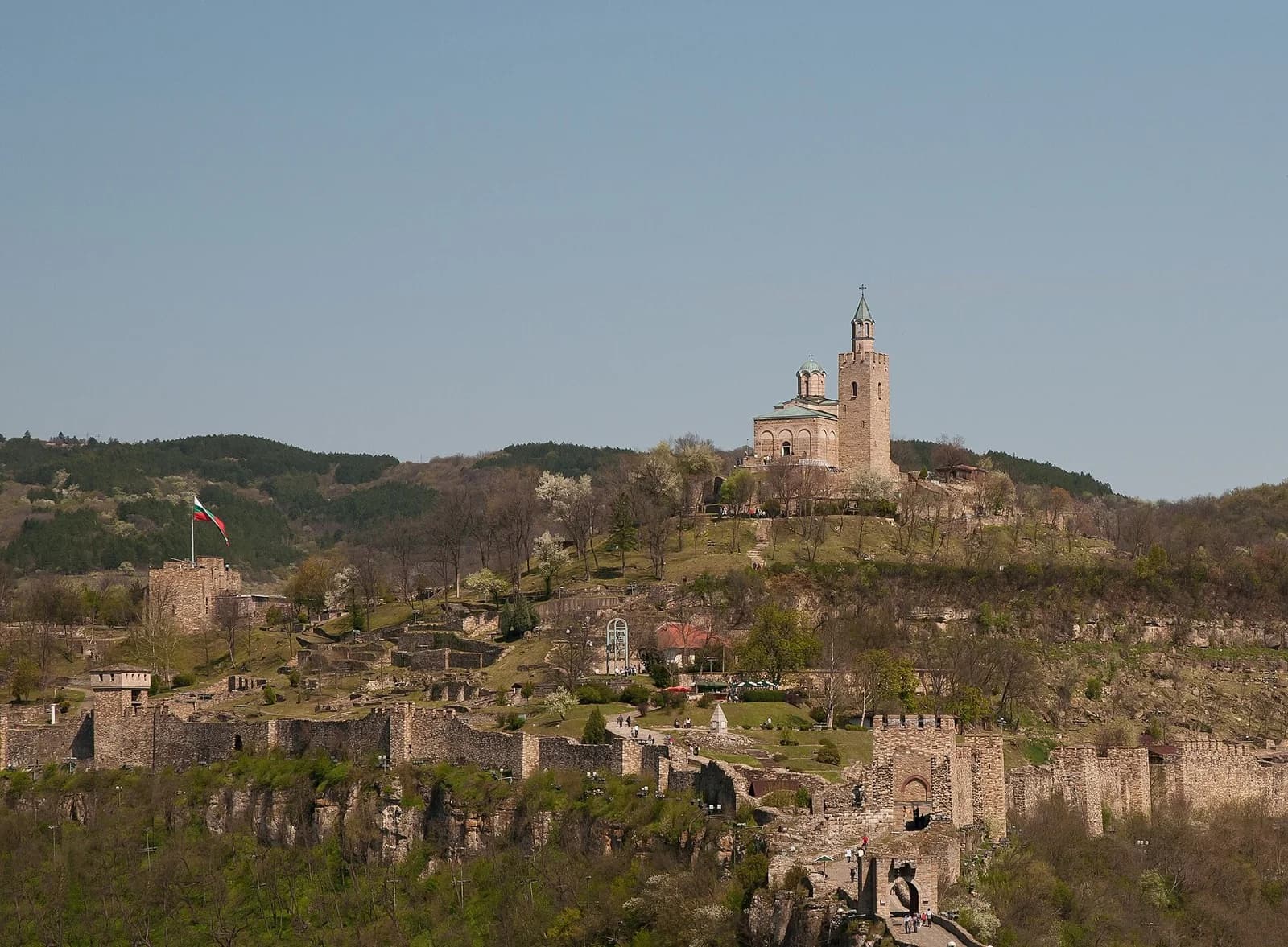
Tsarevets was the main stronghold of the medieval kingdom from 1185 until 17 July 1393, when it was taken and burned after a three-month Ottoman siege (Tsarevets history). The approach still works as intended. You walk in from the west along a narrow stone causeway and pass through four successive gates and towers, which once included a drawbridge (Regional History Museum).
The hilltop is far bigger than it looks from town. Excavations have uncovered about 470 houses, 23 churches and four monasteries inside the walls. Two complexes stand out. The royal palace covered 2,872 square metres, with a throne room, royal chambers, offices and a palace church that held the relics of St Petka. On the summit, the Patriarchal complex covered 2,413 square metres, with the Church of the Ascension, a library, a scriptorium and monks' cells (museum description).
The church you see on top today was rebuilt in 1981 and painted in 1985 by Teofan Sokerov. His murals show the people and turning points of medieval Bulgarian history in a bold modernist style rather than standard iconography, so expect something closer to a history painting than a traditional church interior (museum description; Tsarevets history).
Walk on to the north-eastern edge for Baldwin's Tower, a reconstruction marking where the Latin emperor Baldwin I died as a prisoner of Tsar Kaloyan, and Execution Rock above the river (Tsarevets history). The museum singles out these cliff-edge spots, together with a church with a water cistern, as the hazardous parts of the hill, so keep children close there. A proper circuit takes about two hours. The Patriarchal Church keeps its own hours and closes at 17:30, so a late afternoon entry to the fortress leaves very little time for it.
Sound and Light over the fortress
On selected evenings the walls and churches of Tsarevets are lit up in the Sound and Light show, a programme of coloured lights, lasers, music and bells that has run since 1985 (fortress history). It lasts about 21 minutes including a three-minute introduction. On public holidays and dates set by the municipality you can watch it free from Tsar Asen I Square below the fortress; on other dates tickets are sold for a glazed viewing hall at 6 Nikola Pikolo Street. Show dates are posted on the organiser's site.
Trapezitsa
Across the river to the north-west, Trapezitsa was the fortified quarter of Tarnovgrad, known for its many churches and nobles' residences (city overview). Digging began in 1879 and still continues. Archaeologists have identified 21 churches here, from Church No. 16 of the late 10th or early 11th century to royal churches with portraits of rulers and funerary churches with tombs. Church No. 5 is the only one with mosaic decoration. The largest, Church No. 8, measures 20 by 14.5 metres and was built in five phases. Tsar Asen I placed the relics of St Ivan of Rila here in 1195, and they stayed until 1469, when they were taken back to Rila Monastery (museum account).
What survives are foundations and lower walls rather than roofed buildings, so Trapezitsa suits visitors who enjoy archaeology and a quieter hilltop more than those looking for one big monument. The heritage centre on the hill fills the gap with finds from recent excavations that show the customs and daily life of both aristocrats and ordinary townspeople. It is also the best place to look back at Tsarevets.
A funicular climbs the hill from May to October. It runs 09:00-16:00 with a break from 12:00 to 13:00 and does not run on Mondays, so if you want to ride down as well, come back to it before 16:00 even though the site itself stays open later.
The town museums
The four museums below all belong to the Regional History Museum and sit in or near the old Varusha quarter, so they are easy to fit around the fortresses. Choose by interest:
- Archaeological Museum. The best indoor companion to Tsarevets and Trapezitsa. Hall one covers prehistory, from the Samovodene tell (5700-5000 BC) to the gold Hotnitsa treasure of about 4100 BC and finds from the Emen cave. Hall two is Roman and early Byzantine, with material from Nicopolis ad Istrum, the legionary fort of Novae, votive tablets and engraved gems. Hall three shows the medieval capital through royal gold and lead seals, weapons, jewellery, architectural pieces and ceramics of the 12th-14th centuries (museum catalogue).
- Tsarevgrad Tarnov multimedia centre. On Nikola Pikolo Street near the fortress entrance. Sculpted figures and painted scenes introduce the rulers, clergy, boyars, warriors and craftsmen of the Second Kingdom, which makes it a good primer before Tsarevets, especially with children (centre page). An audio-guide app in Bulgarian, English and Romanian was introduced in September 2026 (museum notice).
- Prison Museum. The Ottoman prison beside the former konak was in use by 1854 and served as a prison until 1954. Its thick stone walls now enclose reconstructed cells, a solitary-confinement cell, a torture room and a board naming 399 activists held here, among them Vasil Levski, Bacho Kiro and Todor Kableshkov. The subject matter is grim and not suited to young children (museum page).
- Sarafkina House. Built in 1861 for the merchant Dimo Sarafina on a plot so steep that it rises five storeys on the river side and two on the street. The main floor has a carved sun ceiling; the upper floors hold the region's folk art: pottery, silver candlesticks, carved chests, distaffs, bread stamps, costumes with the local "sokai" headdress, jewellery and photographs of Tarnovo from the Liberation to the mid-20th century. Reaching them means climbing a winding wooden staircase (museum page).
Arbanasi and the Nativity Church
Arbanasi sits on the plateau above the city, and its finest interior is the Church of the Nativity. The church grew in stages, and its painted walls build up in layers, the oldest from the end of the 16th century. The building has a naos, a narthex, a gallery and a chapel of St John the Baptist. In the narthex, look for the genealogical tree of Christ accompanied by twelve ancient philosophers. In the gallery is the Wheel of Life, which the museum describes as the earliest depiction of this scene on the walls of a Bulgarian church (church page). If you want the imagery explained, guided talks must be requested by the day before on +359 885 105282.
The Church of the Archangels Michael and Gabriel and the Konstantsalieva House are separate tickets in the same village (prices), so Arbanasi easily fills a morning.
Nicopolis ad Istrum
About 20 km from the city near the village of Nikyup, Nicopolis ad Istrum was founded by the emperor Trajan to celebrate his victories over the Dacians in 101 and 106 (museum page). Unlike the medieval sites, this is a planned Roman town on a grid. The main north-south and east-west streets, the cardo and decumanus, are paved with limestone over drains. At the centre, the agora had a civic basilica on its north side for trade and courts, shops and business halls to the east, and a council chamber and small odeon. Public baths stood to the north, and a 26 km aqueduct brought water from the west. Visitors interested in how a Roman provincial town worked will get the most from it; anyone expecting standing temples may find it flat.
How to plan your visit
Half a day. Tsarevets, arriving by mid-morning so there is time for the Patriarchal Church, then a walk down through Varusha.
One day. Tsarevets in the morning, the Archaeological Museum or Sarafkina House after lunch, and the Sound and Light show if one is scheduled that evening.
Two days. Add Trapezitsa to day one, taking the funicular before 16:00. On day two, spend the morning in Arbanasi and drive or take a taxi to Nicopolis ad Istrum in the afternoon, keeping the Prison Museum or the multimedia centre for a spare hour.
From 1 April to 30 October the museum sells a two-day package for any ten of its sites at €20.45, or €25.56 for parents with up to three children aged 7-18. The choice includes Tsarevets, Trapezitsa, the Archaeological Museum, the Prison Museum, Sarafkina House, the Arbanasi churches, Konstantsalieva House and Nicopolis ad Istrum, but not the multimedia centre. Tsarevets, the Nativity Church and one €5.11 museum already add up to the package price (prices).
Each site has a weekly maintenance slot, and they fall on different days. The Archaeological Museum and the multimedia centre open late on Monday mornings, the Patriarchal Church and the Nativity Church on Tuesday mornings, and the Prison Museum and Sarafkina House on Wednesday mornings; the last two are also closed on Sundays and Mondays. Spring and early autumn are the most comfortable months for the open-air sites.
Practical information
Getting there
Veliko Tarnovo is about 230 km from Sofia and 240 km from Varna, with bus services to both and rail connections through the junction at Gorna Oryahovitsa next to the city (city overview). By car from Sofia, take the Hemus motorway to its junction with the I-4 near Brestnitsa and follow the I-4 east via Sevlievo (I-4 route). City buses 20, 40, 50 and 110 serve the fortress area and the Varusha museums. Tsarevets has cobbled, uneven paths and steps; Sarafkina House is mostly stairs.
Opening hours and tickets
Hours below are the autumn schedule that began on 23 September for Tsarevets and 1 October for the other sites (museum notice); adult prices come from the museum's price list, which also lists student, senior and family tickets. Checked on 8 October 2026.
| Site | Entry times | Adult ticket |
|---|---|---|
| Tsarevets | Daily 09:00-17:00, closes 18:00; Patriarchal Church 09:15-17:30, Tuesday from 11:00 | €7.67 |
| Trapezitsa | Daily 09:00-17:00; funicular 09:00-16:00 (not 12:00-13:00 or Mondays) | €5.11; funicular €5.11 return, €2.56 one way |
| Archaeological Museum | Daily 09:00-17:00, closes 18:00; Monday from 11:00 | €5.11 |
| Multimedia centre | Daily 09:30-17:00, closes 18:00; Monday from 11:00 | €7.67 |
| Prison Museum | Tuesday-Saturday 09:30-17:00; Wednesday from 11:00 | €5.11 |
| Sarafkina House | Tuesday-Saturday 09:30-17:00; Wednesday from 11:00 | €5.11 |
| Nativity Church, Arbanasi | Daily 09:00-16:30; Tuesday from 11:00 | €7.67 |
| Nicopolis ad Istrum | Daily 09:00-16:00 | €5.11 |
Winter can bring bigger changes: last year Trapezitsa closed from December to March and Nicopolis ad Istrum opened by appointment only (Trapezitsa; Nicopolis). For a winter trip or any date-specific question, call the museum on +359 885 105282.
For the craft villages and monasteries south of the city, see the Gabrovo, Tryavna and Etar guide; for Lovech, Troyan and the caves to the west, see the Lovech, Troyan and Pleven guide.
Sources & further reading
- Museum sites switch to autumn opening hours, 16 September 2026 - Regional History Museum - Veliko Tarnovo
- Prices and tickets - Regional History Museum - Veliko Tarnovo
- Architectural reserve Tsarevets - Regional History Museum - Veliko Tarnovo
- Architectural reserve Trapezitsa - Regional History Museum - Veliko Tarnovo
- Archaeological Museum - Regional History Museum - Veliko Tarnovo
- Tsarevgrad Tarnov Multimedia Visitor Centre - Regional History Museum - Veliko Tarnovo
- Audio-guide system from 3 September at the Tsarevgrad Tarnov centre - Regional History Museum - Veliko Tarnovo
- Prison Museum - Regional History Museum - Veliko Tarnovo
- Sarafkina's House - Museum - Regional History Museum - Veliko Tarnovo
- Church of the Nativity in Arbanasi - Regional History Museum - Veliko Tarnovo
- Archaeological reserve Nicopolis ad Istrum - Regional History Museum - Veliko Tarnovo
- Sound and Light: frequently asked questions - Tsarevgrad Tarnov Sound and Light
- Tsarevets (fortress) - Wikipedia
- Veliko Tarnovo - Wikipedia
- I-4 road (Bulgaria) - Wikipedia
Tags
- Veliko Tarnovo
- Tsarevets
- Trapezitsa
- Arbanasi
- Nicopolis ad Istrum
- Second Bulgarian Kingdom
- museums
- Bulgaria