Smolyan and the Central Rhodopes: caves, villages and stars
Plan the Central Rhodopes around Smolyan: lakes, planetarium, Shiroka Laka, Wonderful Bridges, Trigrad caves, Rozhen Observatory, Madan and Zlatograd.
Sources checked - 8 October 2026
In this article
Smolyan sits in the middle of the Rhodopes, a long mountain town with forested ridges on every side and some of Bulgaria's best caves, karst scenery and village architecture within easy driving distance. You come here for the variety: a planetarium and lakes on the edge of town, a living music village, a river that roars through a cave in Trigrad gorge, marble arches in spruce forest and the country's main astronomical observatory high above Chepelare.
The region spreads out, so it pays to think in clusters. Smolyan, its lakes and Shiroka Laka form one; Pamporovo, Chepelare, Rozhen and the Wonderful Bridges a second; the Trigrad caves to the west a third; Madan and Zlatograd to the east a fourth. Uhlovitsa Cave, southwest of town, fits into a half day on its own.
What to see in and around Smolyan
Smolyan Planetarium
The planetarium's star hall projects onto a 12.5-metre dome above 98 seats, each row raked at a different angle so everyone has a clear view. Shows run Tuesday to Saturday. The current schedule has English-language sessions at 09:30 Tuesday to Friday, alternating Eclipse - Moments of Wonder and The Sun - Our Living Star; the rest of the day is in Bulgarian, including a seasonal sky walk and, on Saturdays, a children's animation. Seats are not reserved, and the shows are not suitable for children under four.
A second visitor centre adds around half an hour of hands-on displays: Solar System models, constellation games and interactive screens. It is recommended for children over 12. On clear Tuesdays you can also book a telescope session, either in the afternoon (14:30) or at night (20:40), in groups of six for up to 25 minutes. Night observing is not recommended for under-14s, and clouds cancel it while the dome show goes ahead regardless.
Smolyan Lakes
The Smolyan Lakes are a chain of small landslide lakes between about 1,100 and 1,600 m. Twenty once filled the hollows of the slope; seven remain. The lowest, Ribkata, sits beside the Smolyan-Pamporovo road at the end of the Kaptazha district and makes a quick roadside stop.
The better walk is higher up. Follow the road towards Stoykite and Shiroka Laka, turn towards the Smolyan Lakes-Snezhanka chairlift, and look for St Duh chapel, less than two kilometres before the lift station. That is where Trevistoto and Bistro lie side by side: Trevistoto almost half covered by a peat layer with plants growing on it, Bistro open water. A short but steep forest path climbs to Mutno above them. The three-lake eco-trail is a 1.2 km loop of about an hour, rated easy apart from that climb, and passes habitat of the bog clubmoss, a protected Red Book plant. Smolyan Lakes hut near the start serves food.
Shiroka Laka
Shiroka Laka is an architectural and folklore reserve 24 km from Smolyan on the road to Devin, at 1,059 m. Traditional Rhodope houses climb the slopes of a winding valley; the village name itself comes from an old word for a bend. The Zgurovska, Uchikova and Grigorova houses are the classic examples. The Church of the Assumption was built in 38 days in 1834; its iconostasis may be the work of pupils of the Samokov painters.
Music is the other half of the village's identity. A school of folk song and dance, founded here in 1972, trains young musicians, and on the first Sunday of March the village hosts Pesponedelnik, an international kukeri festival of masked dancers. People live in these houses, so look from the streets and enter courtyards only when invited.
For an indoor stop, the Vladimir Rilski Museum-Gallery occupies the two-storey school built in 1888 next to the church, which replaced a single-storey school of 1834. Its displays cover Christianity in the Central Rhodopes, two centuries of local education and paintings by Vladimir Rilski, and currently a temporary exhibition of architectural models of Shiroka Laka on loan from the Smolyan regional museum.
Trigrad gorge: Devil's Throat and Yagodina
West of Shiroka Laka the road drops towards Trigrad gorge, home to two very different show caves.
At Devil's Throat a 150-metre tunnel leads into the Roaring Hall, more than 35 m high and 100 m wide, where the Trigrad River falls 42 m in a thundering underground waterfall, the highest on the Balkan Peninsula. Spray and noise fill the chamber. You leave by a steep, winding concrete staircase to the natural entrance, so this is the cave for drama, not for anyone who struggles with stairs. About 400 m from the entrance the river sinks into a flooded siphon more than 150 m long before it resurfaces. The cave also shelters Bulgaria's largest wintering colony of Schreiber's bent-winged bats.
Yagodina Cave is the opposite experience: a 1,250-metre walk along the lowest of its levels, almost flat, between separate artificial entrance and exit tunnels. The formations are richer here, with stalactites, stalagmites, draperies, flowstone pools and cave pearls, and a 360-metre section is adapted for visitors with disabilities. It stays around 6°C all year. The Eneolithic dwelling at the natural entrance is temporarily closed for technical reasons. Choose Yagodina for formations and an easy walk, Devil's Throat for the river and the climb, or do both in one day.
Uhlovitsa Cave
Uhlovitsa is about 25 km southwest of Smolyan, 3 km from the village of Mogilitsa. Its developed route is only 330 m, but the formations are some of the most delicate in the Rhodopes: branching dendrites that look like coral, and seven crystalline flowstone pools that fill with water in early spring and spill into a stone "waterfall". The effort is the approach. From the parking area you climb an 800-metre steep path and 190 metal steps, gaining about 160 m, then take another 280 metal steps inside. It is 10-11°C underground.
Wonderful Bridges
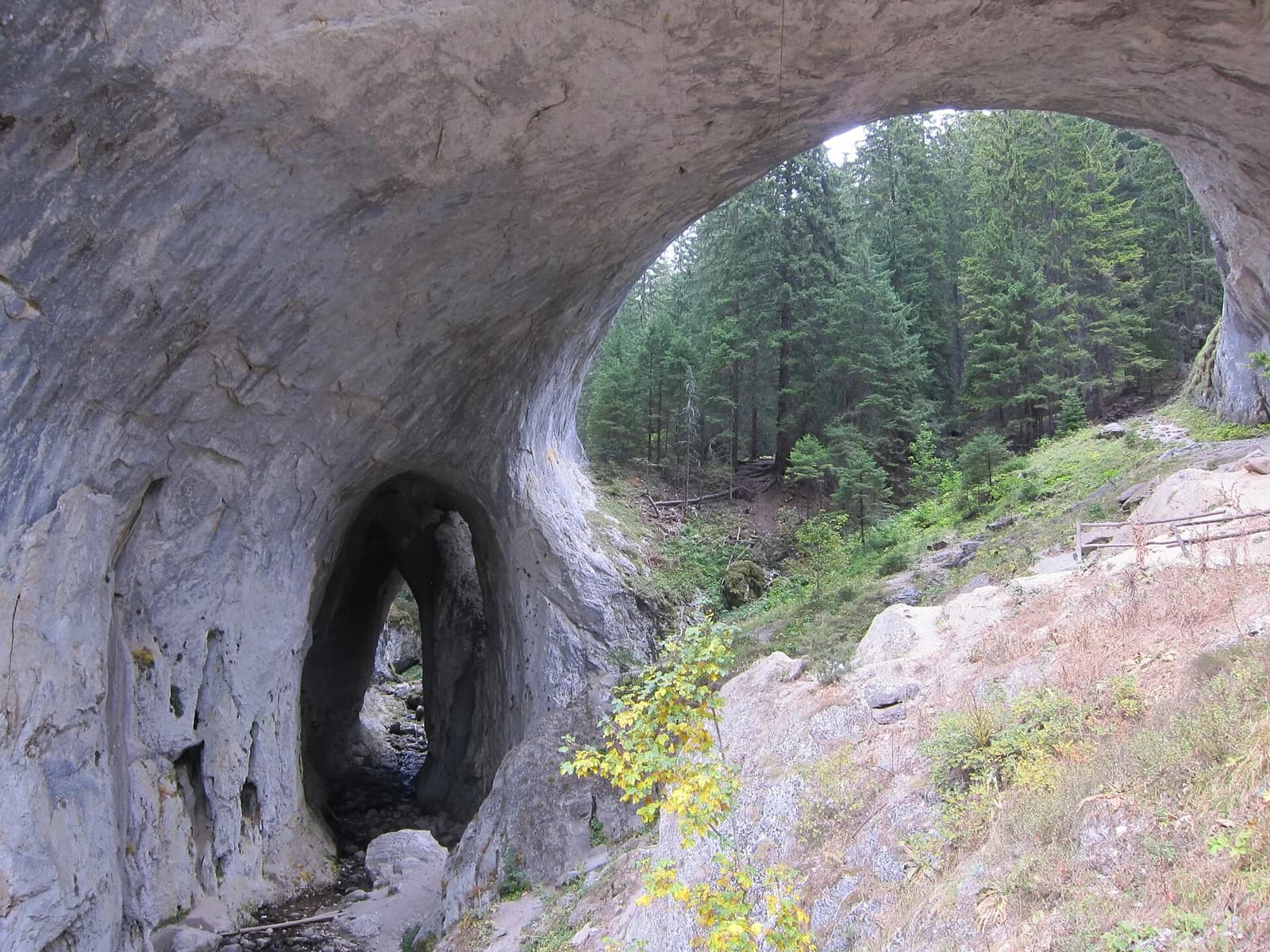
The Wonderful Bridges are two natural marble arches at 1,450 m, the remains of a cave carved by the Erkyupriya stream whose roof collapsed. The larger bridge is almost 100 m long with three arches, the biggest about 45 m high. The smaller one lies a short way downstream. The site has been a protected landmark since 1949. It is reached by a 16 km side road off road II-86; railings and cut steps make the viewpoints easy, but there are no staff on site and the ground is uneven.
Chepelare: Rhodope Karst Museum
The Rhodope Karst Museum explains what you see in the caves. It grew from the finds of a school geology club and cavers who surveyed almost 200 Rhodope caves in the 1960s, and has been a museum since 1980. Five sections cover geology, rocks and cave formations, cave wildlife, palaeontology and cave archaeology. The highlight is a complete skeleton of a cave bear, a species extinct for about 22,500 years. There is also the lower jaw of a cave leopard, the latest such find in Europe, a bronze axe from Chaya Cave and material from the Yagodina cave dwelling, more than 6,000 years old. It opens daily, including public holidays.
Rozhen Observatory
The National Astronomical Observatory Rozhen stands at 1,750 m, 15 km from Chepelare. It opened in March 1981 and remains the largest professional astronomy facility in southeast Europe, with a 2-metre telescope and, since 2023, a 1.5-metre one. A daytime visit is a lecture under the dome of the 2-metre telescope for groups of 6 to 50, on the hour from 10:00 to 16:00. It does not include looking through a telescope, and night visits are not offered this season. Open days change with the season: from October to November the observatory is closed Monday to Wednesday, and from December to February it takes no visitors.
Madan: Rhodope Crystal Hall
Madan is a mining town, and its Crystal Hall shows what came out of the local mines. It opened in 1984 and displays 581 mineral specimens. Read the labels for the mine as well as the mineral. Galena from the 9 September mine, quartz from Krushev Dol and sphalerite from Borieva show how the same ore can grow in very different crystal forms, often with chalcopyrite or milky quartz alongside.
Zlatograd: Delyu Voivoda Museum
Zlatograd lies 55 km from Smolyan near the Greek border. Its ethnographic complex combines museums with working craft workshops in weaving, pottery, jewellery and metalwork. Its Delyu Voivoda Museum tells the story of the haiduks, armed outlaws of the Ottoman period, then turns to Delyu, the local hero remembered in song. Period clothing, jewellery and weapons set the scene, alongside photographs of Zlatograd in the early 20th century. The surprise is a copy of the Voyager Golden Record: NASA's selection includes Valya Balkanska singing Izlel e Delyo Haydutin, so a Rhodope ballad is travelling beyond the Solar System.
Snezhanka Cave is not near Smolyan
The Snezhanka chairlift above the Smolyan Lakes shares its name with a well-known show cave, but Snezhanka Cave is near the town of Peshtera, about 125 km from Sofia, on the northern edge of the mountains. It is a separate trip, better combined with Plovdiv. The cave is open every day of the year and explored independently with an audio guide along a 145-metre route through the Great, Music and Magic halls, after an uphill walk of about 30 minutes from the parking area. Adult entry is €7.16.
How to plan your time
One day from Smolyan. Catch a 09:30 English show at the planetarium, walk the three-lake eco-trail before lunch, then spend the afternoon in Shiroka Laka.
Two days. Add a day in Trigrad gorge, pairing Yagodina and Devil's Throat. Both admit visitors on the hour, so plan one in the morning and one after lunch.
Three days. Use a base in Pamporovo or Chepelare for a northern day: the karst museum, the Wonderful Bridges and a Rozhen lecture on an open day. Alternatively head east through Madan to Zlatograd and continue towards the Eastern Rhodopes and Kardzhali.
Seasons. Spring is when Uhlovitsa's pools fill, and a good time for walking around the lakes. Summer brings the longest opening hours. Autumn colour around the lakes is superb, but Rozhen closes three days a week from October and shuts entirely in winter. Winter means snow on the passes; the caves stay open and the temperature underground hardly changes.
How to get there
Smolyan is 250 km from Sofia and 100 km from Plovdiv. The bus from Sofia takes about 4.5 hours and the drive about 3.5. Regular buses also run from Plovdiv and Kardzhali, and the town has two bus stations, in Smolyan and Ustovo districts. There is no railway. Local buses reach the villages, but the caves, the Wonderful Bridges and Rozhen are far easier by car.
Many roadside fountains in the Rhodopes are fed by village networks, others by untreated springs. ViK Smolyan publishes water-quality notices for the networks it runs. Treat a spring with no posted information as untested; boiling kills germs in clear water but does not remove chemicals (CDC).
Opening hours and prices
Checked on 8 October 2026. Mountain sites change hours with the season, so phone ahead if you are arriving late in the day or between seasons.
| Sight | Hours | Adult ticket |
|---|---|---|
| Smolyan Planetarium | Tue-Sat 09:00-17:30 | €5 Bulgarian show, €10 English show, €6 show plus visitor centre |
| Rozhen Observatory | Lectures hourly 10:00-16:00. Mar-May and Oct-Nov Thu-Sun; Jun-Sep closed Tue; Dec-Feb closed | €4 |
| Yagodina Cave | Oct-Apr 10:00-16:00, May-Sep 09:00-16:00, on the hour | €8; groups under six pay €20 extra |
| Devil's Throat | Oct-Apr 10:00-16:00, May-Sep 10:00-17:00, on the hour, no closing day | Pay on site |
| Uhlovitsa Cave | May-Sep daily 09:00-17:00; Oct-Apr 10:00-17:00, closed Mon-Tue; last group 16:00 | Pay on site |
| Vladimir Rilski Museum-Gallery | Daily 09:30-17:00; closed Wed-Thu until 14 October 2026 | Pay on site |
| Rhodope Karst Museum | Daily, including holidays | Pay on site |
| Crystal Hall, Madan | Summer 09:00-18:00, winter 08:00-17:00; closed Sun-Mon unless arranged on 0894 393 896 | Pay on site |
| Delyu Voivoda Museum | 09:00-12:00 and 13:00-18:00, winter until 17:00 | €5; €8 with the ethnographic museum |
| Wonderful Bridges, Smolyan Lakes eco-trail | Open access, no staff on site | No ticket office |
Telescope sessions at the planetarium cost €3 by day and €5 at night and are booked on +359 301 83074.
Sources & further reading
- How to get to Smolyan - Official Smolyan Tourist Guide
- Visits - prices and screening schedule - Planetarium Smolyan
- Посещения - цени на билети - Planetarium Smolyan
- Star hall - Planetarium Smolyan
- Telescope observations - Planetarium Smolyan
- Smolyan Lakes - Official Smolyan Tourist Guide
- Three Smolyan Lakes eco-trail - Official Smolyan Tourist Guide
- Architectural reserve Shiroka Laka - Official Smolyan Tourist Guide
- Vladimir Rilski Museum-Gallery - Shiroka Laka village
- Devil's Throat Cave - Bulgarian Tourist Union
- About Yagodina Cave - Yagodina Cave
- Yagodina Cave prices and opening hours - Yagodina Cave
- Uhlovitsa Cave - Official Smolyan Tourist Guide
- Uhlovitsa Cave visiting hours - Bulgarian Tourist Union
- Uhlovitsa Cave - Uhlovitsa Cave
- Chudnite Mostove (The Wonderful Bridges) - Ministry of Tourism of Bulgaria
- Чудните мостове - Visit Chepelare
- Музей на родопския карст - Visit Chepelare
- НАО Рожен - Visit Chepelare
- Visiting the National Astronomical Observatory - National Astronomical Observatory Rozhen
- Crystal Hall Rhodope Crystal - Madan Municipality tourism portal
- Кристална зала Родопски кристал - Madan Municipality tourism portal
- Delyu Voivoda Museum - Ethnographic Complex Zlatograd
- Golden Record: sounds and music - NASA
- Snezhanka Cave - Snezhanka Cave
- Пещера Снежанка - Ministry of Tourism of Bulgaria
- Water quality - ViK Smolyan
- Water treatment options when hiking, camping or traveling - US Centers for Disease Control and Prevention
Tags
- Smolyan
- Central Rhodopes
- Shiroka Laka
- Rhodope caves
- Wonderful Bridges
- Rozhen Observatory
- Zlatograd