Kardzhali and the Eastern Rhodopes: Perperikon to Tatul
Plan Perperikon, Tatul, Kardzhali's museum and icon gallery, the Stone Wedding and Devil's Bridge, with hours, prices and a one- or two-day route.
Sources checked - 8 October 2026
In this article
The low, rocky hills around Kardzhali hide some of the most striking archaeology in Bulgaria. Perperikon, a whole hilltop city carved into the rock, and Tatul, a sanctuary shaped from a single crag, are the two big names. Kardzhali's museum and icon gallery give them context, and two short stops, the Stone Wedding rock pillars and the Devil's Bridge on the Arda, show the volcanic landscape and Ottoman-era engineering of the Eastern Rhodopes.
What to see
Perperikon
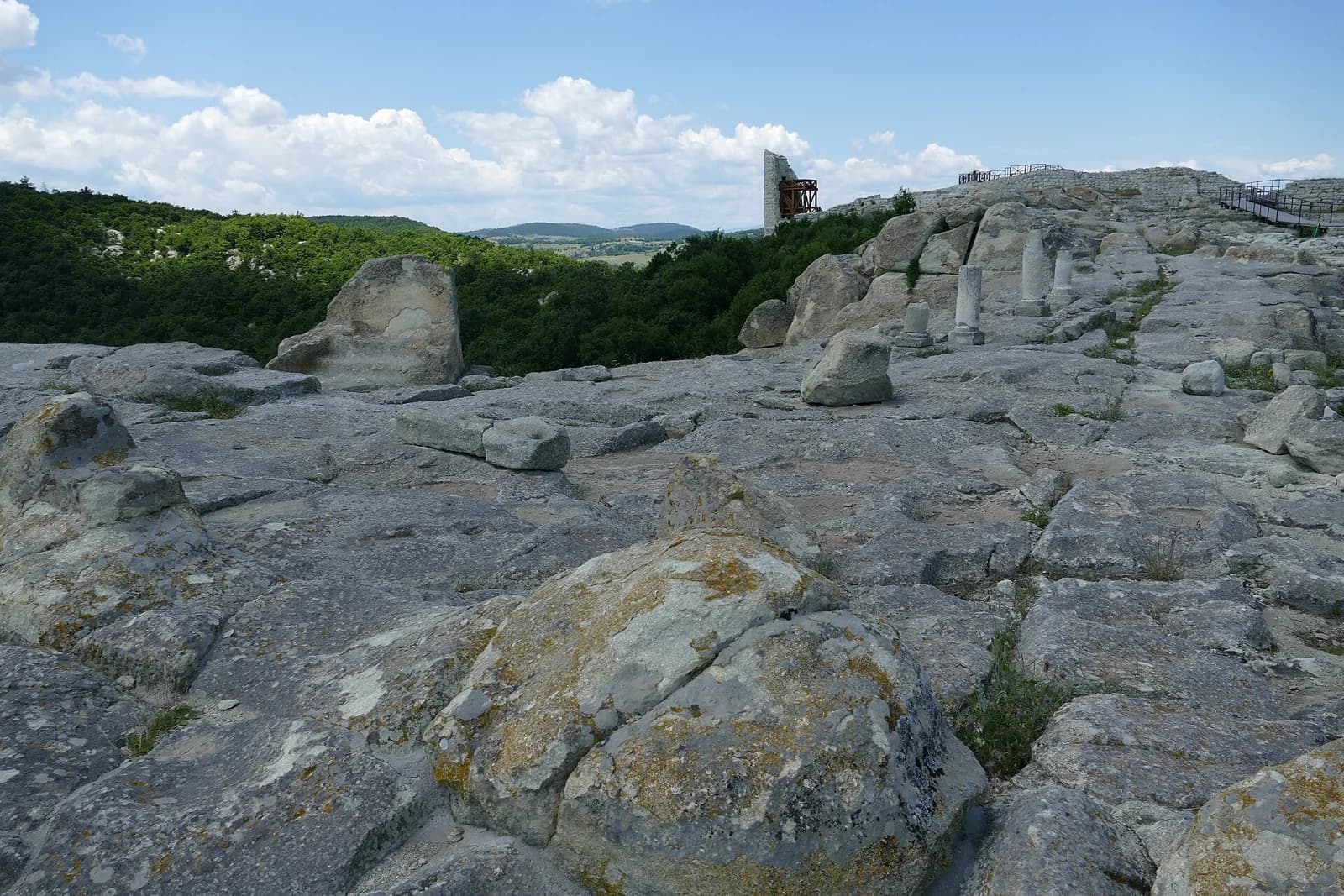
Perperikon sits on a rocky hill 18 km northeast of Kardzhali, reached by an asphalt road to the foot of the rock. What makes it remarkable is how long people kept coming back. Traces of ritual go back to the end of the 5th millennium BC, the sacred place was used again in the 2nd millennium BC, and in Thracian times a large rock-cut cult complex grew up here. Under Rome the hill became a fortified town, and in the Middle Ages it remained a stronghold: a letter from the Ecumenical Patriarch names it a bishopric in 1339, and it was captured and burned after the Ottomans took Didymoteicho in 1362.
The approach gives a sense of how the builders used the rock. A natural fault, cut into a corridor with steps in its floor, leads up from the base of the crag to the so-called palace-sanctuary, where a broad corridor splits a maze of rock-cut rooms and stairs into two unequal halves and a throne is carved into the western part. In the northwest corner is a large oval room open to the sky, with a round altar about 2.5 m across. It is identified as the heart of the sanctuary of Dionysus-Zagreus, linked with ancient accounts of an oracle there; the altar is plain to see, while the attribution is an interpretation worth hearing a guide explain.
On the summit, a 2.5-metre-thick wall of dressed stone encloses the acropolis. Its south gate is cut straight through the rock. Inside is a large rock reservoir that held water through sieges, while a separate rock-cut cistern supplied the southern quarter below. Elsewhere on the hill are the foundations of churches, including a three-aisled basilica in use from the mid-5th to the 14th century.
Perperikon is exposed bare rock with uneven steps, so bring sun protection and decent shoes, and aim for early morning in summer. The site does not provide guides and no talks are given on arrival without an arrangement. If you want one, book a licensed guide from the municipal list before you go.
Tatul
Tatul lies at the southern edge of Tatul village, about 17 km northeast of Momchilgrad. Its centrepiece is a crag shaped by hand into a truncated pyramid. One rock-cut grave lies open on the top; a second sits in a south-facing niche under an arched cut in the rock, an arrangement with no known exact parallel. A stairway climbs from the east to the main altar and graves, and the surrounding rock is full of platforms, niches, basins, channels for liquids and a three-metre well.
Popularly called the Sanctuary of Orpheus, the hill has a long and layered history. Its first flourishing dates to the 18th-11th centuries BC. A wall and buildings followed in the 3rd-1st centuries BC, then a Roman phase ended by fire in the 3rd century AD, and renewed activity in the 9th-10th centuries, with a medieval cemetery used until about the mid-13th century. Excavations in 2022-2023 uncovered a Roman pagan temple of the 3rd-4th centuries with an early Christian church of the 5th-6th centuries built over it. Tatul is far smaller than Perperikon, and the carved rock is easier to take in at a glance.
Regional History Museum, Kardzhali
The Regional History Museum occupies one of the town's most handsome buildings, designed by the architect Pomerantsev and built between 1922 and 1930 as a Muslim religious school, a role it never actually served. Adapted as a museum, it opened in 1987 with 30 halls on three floors, and it is accessible to visitors with disabilities.
Each floor has its own subject. The first floor holds eight archaeology halls running from the 6th millennium BC to the late Middle Ages, which is where finds from sites like Perperikon fall into a regional sequence. The second floor covers botany, palaeontology and minerals, together with four halls on the town's growth from 1912 to the 1940s. The third floor has eleven ethnography halls on folk life in the late 19th and early 20th centuries, and the museum also has a hall of church art. If time is short, choose archaeology if you are visiting the sites, and minerals or ethnography if you have already seen them.
Stanka Dimitrova Art Gallery
The museum's art department is in a late 19th-century former konak on Respublikanska Street. Its most moving collection is in the crypt: icons from the Eastern Rhodopes rescued in the late 1960s and 1970s from crumbling or abandoned churches in villages such as Kostilkovo, Dolno Lukovo, Perperek, Mandritsa and Pelevun. They are hung in date order, from a 1695 Christ Pantocrator from Dolno Lukovo to works of the early 20th century. Most of the painters were Greek and almost all the inscriptions are in Greek, so read the labels for the painters' names, such as Zisios and Nikolaos Adrianoupolitis. Upstairs, the painting floors show Bulgarian art from the late 19th century to the 1960s, including Ivan Mrkvička's portrait of Tsar Ferdinand, and contemporary work.
Stone Wedding
On the edge of Zimzelen village, 4-5 km from Kardzhali, the Stone Wedding is a cluster of pale, multicoloured rock pillars from half a metre to more than 10 m tall, spread over about 5 hectares and protected since 1974. Seen from a distance the group looks like a crowd of figures. The Ministry of Tourism explains them as rhyolitic tuff laid down by volcanic activity under an ancient sea and later shaped by weathering, with different minerals giving the colours. Local legend tells of a wedding party turned to stone by a magic wind as punishment for impure thoughts, leaving only the grieving groom, who in time was petrified too. The path is easy, there is free parking and the site can be visited all year, which makes it a good late-afternoon stop. The municipal portal also points to the Stone Mushrooms near Beli Plast village, another weathered rock group in the same area.
Devil's Bridge near Ardino
The Devil's Bridge spans the Arda gorge beside the abandoned village of Dyadovtsi, about 10 km from Ardino, at 420 m above sea level. Built in the early 16th century by order of Sultan Selim I on a route through the mountains, it is 56 m long and 3.55 m wide, rising 11.5 m at its highest point over three arches, with oval openings in the piers that were used to monitor the water level. The legend gives it its name: a young builder called Dimitar wagered with the Devil to finish the bridge in 40 days and build in an image of him that could be seen but not touched.
Suggested plans
One day. Start at Perperikon when it opens at 08:00, before the rock heats up. Return to Kardzhali for lunch, then visit the museum, keeping in mind that the ticket desk closes at 16:30, and the icon crypt if you have time. Finish at the Stone Wedding in the softer evening light.
Two days. Add Tatul via Momchilgrad on the second morning, then drive west to the Devil's Bridge. From Ardino you can continue into the Central Rhodopes; see our Smolyan guide.
When to go. Spring and autumn are the most comfortable seasons for the exposed hill sites. In summer, go early and carry water. The museum keeps shorter winter hours and closes on Sundays and Mondays in winter.
How to get there
Kardzhali has a railway station, but trains from Plovdiv take 3.5 hours or more, most with a change in Dimitrovgrad. Regular buses run between Kardzhali and Smolyan. Perperikon, Tatul and the Devil's Bridge are all outside town with little or no public transport, so a car is the practical way to see them. The municipal tourist information centre is at 54 Belomorski Boulevard, phone +359 879 317 974.
Opening hours and prices
Checked on 8 October 2026. Hours at the open-air sites change with the season, so call ahead if you are travelling in spring or autumn.
| Sight | Hours | Adult ticket |
|---|---|---|
| Perperikon | Daily 08:00-20:00 | €7.16; reduced €3.07; family of four €15.34 |
| Tatul | Summer daily 09:00-20:00, winter daily 09:00-17:00 | Pay on site |
| Regional History Museum | Summer Tue-Sun 09:00-18:00; winter Tue-Sat 09:00-17:00; ticket desk until 16:30 | €3.58; free on the last Tuesday of the month |
| Stanka Dimitrova Gallery | Ask the museum on 0361 635 84 | €2.05; €4.09 combined with the museum |
| Stone Wedding | Open all year | Free parking |
| Devil's Bridge | Open site in the gorge | - |
Children under seven enter free at Perperikon, Tatul and the museum.
Sources & further reading
- Perperikon - Official tourism portal of Kardzhali Municipality
- Local guides - Official tourism portal of Kardzhali Municipality
- Tatul - Sanctuary of Orpheus - Official tourism portal of Kardzhali Municipality
- A Roman temple was discovered near the Sanctuary of Orpheus - Momchilgrad Municipality
- Regional History Museum Kardzhali - visitor information - Official tourism portal of Kardzhali Municipality
- Regional History Museum Kardzhali - Regional History Museum Kardzhali
- Contact, opening hours and admission - Regional History Museum Kardzhali
- Icons from the Eastern Rhodopes, 17th-20th century - Regional History Museum Kardzhali
- Stanka Dimitrova Art Gallery - Official tourism portal of Kardzhali Municipality
- The Stone Wedding - stone phenomenon - Official tourism portal of Kardzhali Municipality
- The Petrified Wedding - Ministry of Tourism of Bulgaria
- The Devil's Bridge - VisitArdino
- Train timetable Plovdiv - Kardzhali - Bulgarian State Railways
- How to get to Smolyan - Official Smolyan Tourist Guide
Tags
- Kardzhali
- Eastern Rhodopes
- Perperikon
- Tatul
- Thracian archaeology
- Stone Wedding
- Devil's Bridge