Things to do in Varna: museums, Roman baths and day trips
Varna's prehistoric gold, Roman Thermae and Sea Garden museums, plus Aladzha Monastery, Pobiti Kamani and Ovech fortress, with current hours and prices.
Sources checked - 8 October 2026
In this article
Varna is the obvious base for the northern Bulgarian Black Sea coast if you want more than a beach. The city keeps the gold from the Varna Chalcolithic cemetery, more than 6,000 years old, and the walls of a Roman bath complex that covered over 7,000 square metres. Within an hour you can stand in a monastery cut into a cliff, walk among stone columns rising out of sand, or climb to a medieval town on a flat-topped plateau above Provadia.
What to see in Varna
Archaeological Museum and the Varna gold
The museum fills a former girls' high school built in 1892-1898 to a design by Petko Momchilov, with around 2,150 square metres of exhibition space on two floors around a courtyard (Regional Museum of History). The halls run in order from the Palaeolithic, about 100,000 years ago, to the 7th-8th centuries AD (Visit Varna).
Most visitors come for the Chalcolithic (Copper Age) cemetery found by chance in 1972 during construction work in Varna's industrial zone. Archaeologists excavated 294 graves. The gold from them alone runs to more than 3,000 objects of over 38 types, weighing more than 6 kg, and the same graves held over 160 copper objects, more than 230 flint pieces, around 1,100 shell ornaments and more than 650 pottery vessels (Visit Varna). Radiocarbon dating places the burials at around 4569-4340 BC (Varna Necropolis), which is why the Varna finds are counted among the oldest worked gold anywhere.
Give the copper axes, flint blades and shell jewellery the same attention as the gold cases. Seen together, they show what these burials actually contained, rather than only their most precious metal. The later halls cover Greek and Roman Odessos and the Middle Ages, and the museum also keeps a permanent collection of icons from the 16th-19th centuries. The basement holds a library and a small Educational Museum aimed at children (museum building).
At €10 for adults this is the most expensive museum ticket in town, and it is sold only at the ticket office; there are no online sales (prices and tickets). If you see only one museum in Varna, make it this one.
Roman Thermae
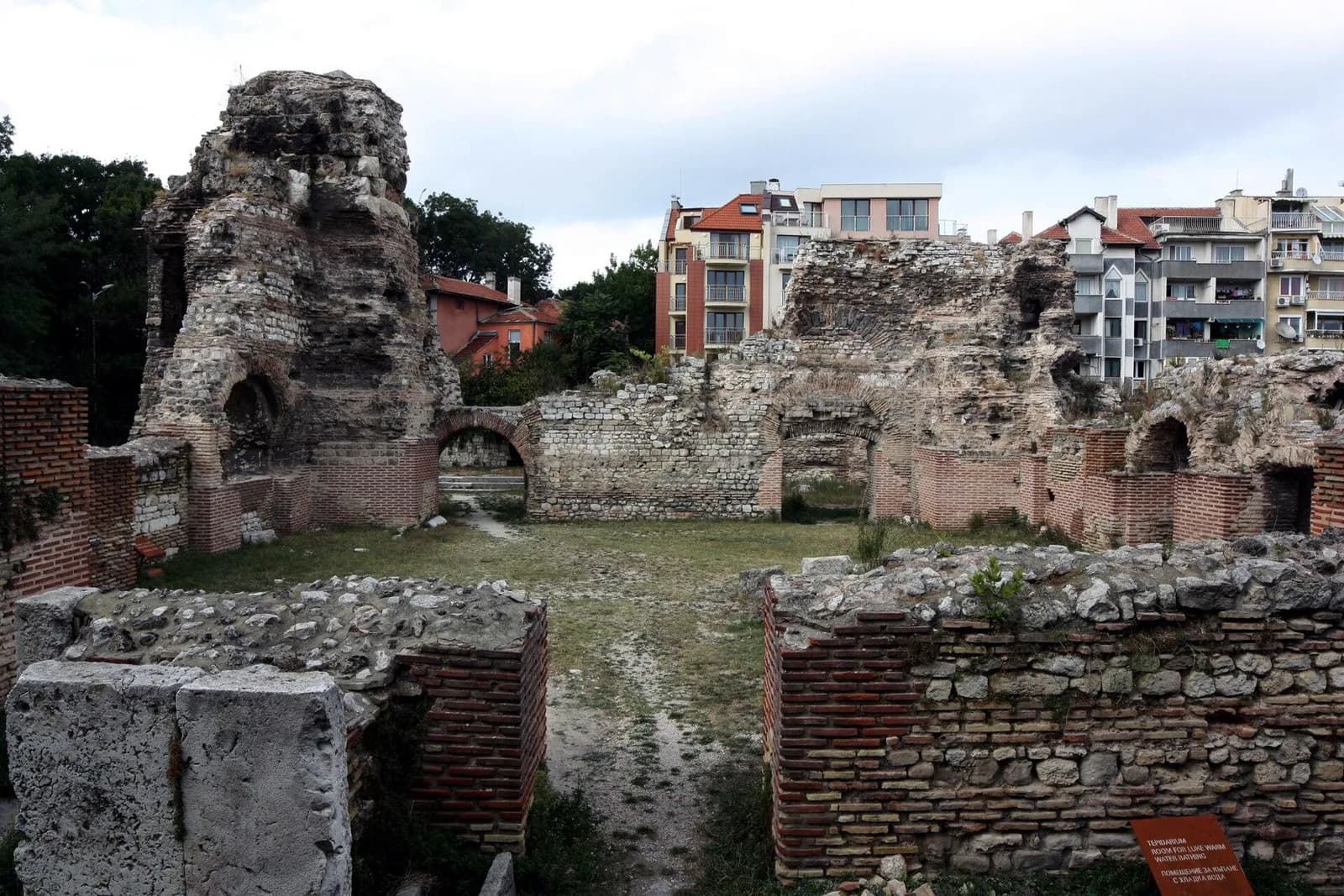
The public baths of Roman Odessos were built in the 2nd century AD, in the reign of Antoninus Pius, after an aqueduct was completed around AD 157. They cover more than 7,000 square metres (Roman Thermae).
The ruins make sense once you follow a Roman bather's route. Entrances on the north side led through vestibules to the apodyteria, the changing rooms, which were among the largest spaces in the building. From there the cold room (frigidarium), warm room (tepidarium) and hot room (caldarium) lined up along a central axis. Heat came from the hypocaust underfloor system, fed from a half-buried service gallery on the south side with six hearths, two boiler rooms and four chimneys. A latrine in the south-west corner had its own double-doored entrance from the street (museum description).
The entrance is on San Stefano Street, not at the museum's Maria Luiza Boulevard address, and an adult ticket is €4 (prices and tickets). The Thermae are the natural partner to the Archaeological Museum: one shows the objects, the other a whole public building in its town setting. The smaller Roman baths elsewhere in the city are closed from 1 October to 31 May (winter hours notice).
Sea Garden: Naval Museum, Aquarium and Zoo
The long seafront park holds three easy, inexpensive stops that suit families and work well on a hot afternoon.
The Naval Museum at 2 Primorski Boulevard was founded on 20 May 1923, building on a collection that Danube Fleet officers began in 1883. Its compact indoor halls hold anchors recovered from the Black Sea floor, ship figurehead decorations, uniforms, models, flags, torpedoes and lighthouse optics, with material from the 1885 Serbo-Bulgarian War, the Balkan Wars and both World Wars (Visit Varna). The star exhibit sits outside: the torpedo boat Drazki, built in 1904-1908 at the Schneider yard in Chalon-sur-Saône as one of six identical boats for the Bulgarian Navy. During the First Balkan War in 1912 it attacked the Ottoman cruiser Hamidiye from about 100 metres and damaged it for the rest of the war; a hole left by a shell fragment is still in its funnel. Drazki opened as a ship museum on 21 November 1957 (Drazki). The ship, the outdoor collection, temporary exhibits and the Pilot-2 wheelhouse are priced separately, so check which ticket you need (visit and prices).
The Aquarium, run by the Institute of Fish Resources at 4 Primorski Boulevard, shows the main groups of Black Sea fish, including Mediterranean species that have entered through the Bosphorus, alongside freshwater and exotic fish. Further halls use preserved specimens from the world's oceans to explain migration and marine food chains (Visit Varna). It is small and cheap at €2 for adults, and tickets are cash only (Institute of Fish Resources).
The Zoo lies in the Sea Garden between the Pantheon and the Dolphinarium. Younger children may enjoy its contact zone, a 10-minute session with animals for €2, held on weekdays from 11:00 to 12:00 in June-August and October-March (Zoo Park Varna).
Day trips from Varna
Aladzha Monastery
North of the city, inside Golden Sands Nature Park, hermit monks of the 13th-14th centuries hollowed a monastery out of a limestone cliff about 40 metres high. The lower level held the monastery church, cells, a refectory and kitchen, a small cemetery church, a crypt used as an ossuary and farm rooms. The upper level is a natural recess with a chapel at its eastern end (Visit Varna), where frescoes from the 13th-14th centuries survive (Regional Museum of History). The community declined after the Ottoman conquest and was probably abandoned by the 15th or 16th century.
Start in the museum building near the entrance, then climb the walkways to the rock rooms and try to tell the shared spaces from the cramped cells. The so-called Catacombs, another group of caves 600-700 metres to the west, are older: pottery and coins link them to early Christian use in the 5th-6th centuries (Visit Varna). Aladzha suits anyone with a couple of hours and is easily combined with a walk in the nature park; it is closed from December to February.
Pobiti Kamani, the Stone Forest
About 18 km west of Varna, groups of stone columns stand in open sand on both sides of Beloslav Lake. The museum-run site has around 300 columns up to 6 metres high, within 253.3 hectares of protected land (Regional Museum of History).
Despite the nickname, these are not petrified trees. Geologists link the columns to an ancient methane-seep system under an Early Eocene sea: methane-bearing fluids rose through sandy sediment, and reactions involving methane and microbes caused calcite to precipitate and cement the sand into hard tubes. The researchers tested this with mineral observations, carbon-isotope measurements and molecular traces of microorganisms (De Boever and colleagues, 2008). The loose sand washed away; the cemented pipes remained.
The site is open sand and scrub, so in summer go early or late; it stays open until 19:30. It is a quick stop of an hour or so and pairs well with Provadia, which lies further west in the same direction. Leave stones and plants where they are: the sandy habitat is protected.
Provadia: Ovech Fortress and the town museum
Ovech sits on a flat plateau above Provadia, about 50 km west of Varna, ringed by cliffs 11-25 metres high. The Byzantines called it Proaton, Bulgarians Ovech and the Ottomans Taş Hisar, and it was lived in from the mid-3rd century to the late 17th, with a break between the 7th and 11th centuries. On top you will find the foundations of three medieval churches, one of them a metropolitan church, medieval streets, houses and shops, thirteen cisterns for rainwater and grain, and a well 79 metres deep. A 150-metre bridge once linked the northern gate to the neighbouring Tabiite plateau (Visit Varna). Standing at the cliff edge makes the logic plain: steep rock on every side, one narrow approach, and stored water to survive a siege.
Two staircases reach the plateau. The eastern approach climbs a broad dirt track to the ticket office and rock-cut steps; the western one follows a forest path near the Ovech restaurant and ends in metal spiral stairs (BDZ). Both involve a real climb, so this is not a step-free site.
Down in town, the Historical Museum Provadia at 3 Opalchenska Street adds the people behind the walls. Its medieval room has a gold seal-ring with an eagle from the Second Bulgarian Kingdom, a 14th-century silver eagle ring, a Cuman-type sabre of the 10th-11th centuries and a 14th-century mail hood. It also holds a large collection of early medieval inscriptions and drawings on stone from the monastery at Ravna, writing styluses and a lead seal of Prince Simeon I (medieval exhibition). The prehistory hall includes finds from the salt-production settlement at Provadia-Solnitsata (prehistory).
Devnya Museum of Mosaics (closed for renovation)
Devnya's museum stands over a late Roman town house in Marcianopolis, built in the late 3rd or early 4th century and used until the early 7th. Five rooms and the portico had mosaic floors, three of which remain where they were laid: Medusa in the dining room, the abduction of Ganymede in the reception hall and Satyr and Antiope in a bedroom (Devnya Municipality). The building has been closed to visitors since the start of August 2026 for a renovation worth more than €2.5 million, with no reopening date announced (closure notice). Keep it in mind for a later trip; Devnya lies on the way to Provadia.
Which sights to prioritise
- One museum only: the Archaeological Museum, for the gold.
- Best outdoor sight: Aladzha for history, Pobiti Kamani for landscape and geology.
- Families with children: the Naval Museum with Drazki, the Aquarium and the zoo, all in the Sea Garden.
- Walkers and fortress fans: Ovech, especially if you arrive by train.
- Can skip: the Aquarium and zoo if you are short of time and have no children with you.
Geography helps. The Archaeological Museum and Thermae are in the centre; the Sea Garden runs along the shore. Aladzha lies north towards Golden Sands, while Pobiti Kamani, Devnya and Provadia all line up to the west. With more time, head north along the coast with our Balchik, Kaliakra and Dobrich guide or inland to the first Bulgarian capitals around Shumen.
Suggested plans
Half a day in Varna. Archaeological Museum in the morning, then the Roman Thermae. Outside the summer season both close on Sunday and Monday, so plan them for Tuesday to Saturday.
One day in Varna. Add the Sea Garden in the afternoon: the Naval Museum and Drazki, then the Aquarium, ending with a walk along the shore.
Two days. Spend day one in the city as above. On day two, visit Aladzha in the morning and Golden Sands Nature Park, or head west for Pobiti Kamani and Ovech.
Three days. Do both day trips: Aladzha on one day, Pobiti Kamani with Ovech and the Provadia museum on the other. Go to Provadia on a weekday or summer Saturday, since the museum closes at weekends in winter.
Best time to go
From June to September the city museums, the Aquarium and Aladzha open daily, but the Naval Museum still closes on Sunday and Monday, and Pobiti Kamani and Ovech on Monday and Tuesday. From October to April, avoid Monday: the Archaeological Museum, Thermae, Naval Museum and Aquarium are all shut, and Pobiti Kamani and Ovech are closed too. Aladzha closes completely from December to February. Pobiti Kamani and Ovech are exposed, so in summer aim for the morning or the last hours before closing.
How to get there and around
In the city. Buses 7, 12, 31, 31A and 148 stop at "Muzeya" by the Archaeological Museum, and 9, 14 and 409 at "Sevastopol" (Visit Varna). Lines 17A and 20 run along the Sea Garden, with the "Baseyna" stop for the Naval Museum (Visit Varna).
Aladzha. City buses 29, 109 and 409 serve the monastery, or drive (Visit Varna).
Pobiti Kamani. A car is simplest. By public transport, take bus 43 to the "Razklon Banovo" stop in Slanchevo and walk from there (Regional Museum of History).
Ovech by train. Take a train to Dobrina halt: on 8 October 2026 there were 12 departures from Varna, taking 50-60 minutes (BDZ timetable). From the halt it is about half an hour on foot to the eastern entrance; from Provadia station, allow another 10-15 minutes through town (BDZ).
Opening hours and tickets
Hours and adult prices below were checked on 8 October 2026 against each operator's website. Schedules change around public holidays, so check the operator's page before a long trip.
| Sight | Opening hours | Adult ticket |
|---|---|---|
| Archaeological Museum | May-Sep daily 10:00-17:00; Oct-Apr 10:00-17:00, closed Sun-Mon (museum) | €10; schoolchildren €4; under 7 free |
| Roman Thermae | Jun-Sep daily 10:00-18:00; Oct-May 10:00-17:00, closed Sun-Mon (museum) | €4; schoolchildren €2 |
| Naval Museum | Tue-Sat 10:00-18:00, last tickets 17:30 (operator) | €4.09 indoor, outdoor and temporary; Drazki €3.07 extra; free on the last Wednesday of the month (tariff) |
| Aquarium | Jun-Sep daily 09:00-19:00; Oct-May 09:00-17:00, closed Mon; last entry 30 min before closing | €2; ages 6-18 €1; cash only |
| Zoo | Ticket desk Oct-Mar 09:00-16:30; Apr-May and Sep 09:00-18:00; Jun-Aug 09:00-19:00 | €3; ages 7-18 and pensioners €2.50 |
| Aladzha Monastery | May-Oct daily 09:00-17:00; Nov 10:00-17:00, closed Mon-Tue; Dec-Feb closed (museum); Mar-Apr 10:00-17:00, closed Mon-Tue (Visit Varna) | €5; schoolchildren €3 |
| Pobiti Kamani | May-Oct 10:00-19:30 and Nov 10:00-17:00, closed Mon-Tue; Jan-Apr 10:00-18:00, closed Sun-Mon; Dec by request | €3; schoolchildren €2 |
| Ovech Fortress | Wed-Sun 09:00-17:30 (Visit Varna) | €2.05; children €1.02 |
| Historical Museum Provadia | Weekdays 09:00-18:00; summer Saturdays 09:30-17:30; winter weekends closed (museum) | Ask at the desk |
| Devnya Museum of Mosaics | Closed for renovation since August 2026 | - |
Regional Museum of History sites sell tickets only on the spot (price list).
Sources & further reading
- Archaeological Museum - Regional Museum of History - Varna
- Prices and tickets - Regional Museum of History - Varna
- Winter working hours from 1 October - Regional Museum of History - Varna
- Museum of Archaeology - Varna Municipality
- Varna Necropolis - Wikipedia
- Roman Thermae - Regional Museum of History - Varna
- Visit and prices - Naval Museum - branch of the National Museum of Military History
- Посети ни - Naval Museum - branch of the National Museum of Military History
- Naval Museum - Varna Municipality
- The Drazki Torpedo Boat Museum - Naval Museum - branch of the National Museum of Military History
- Aquarium - Varna - Varna Municipality
- Aquarium Varna opening hours - Institute of Fish Resources - Varna
- Zoo Park Varna - working time and ticket prices - Zoo-SC Varna Municipal Enterprise
- Aladzha Monastery - Regional Museum of History - Varna
- Aladzha Monastery - Varna tourism - Varna Municipality
- Petrified Forest (Pobiti Kamani) - Regional Museum of History - Varna
- Methane-related fluid migration and carbonate diagenesis: Pobiti Kamani - Bulgarian Geological Society
- Museum of Mosaics: renovation and visitor access notice - Devnya Municipality
- Museum of Mosaics in Devnya - Devnya Municipality
- Крепост Овеч - Varna Municipality
- С влак до Провадия и крепостта Овеч - BDZ Passenger Services
- Timetable Varna - Dobrina - BDZ Passenger Services
- Medieval exhibition - Historical Museum Provadia
- Prehistory exhibition - Historical Museum Provadia
- Contacts and opening hours - Historical Museum Provadia
Tags
- Varna
- Varna Archaeological Museum
- Roman Thermae
- Aladzha Monastery
- Pobiti Kamani
- Ovech Fortress
- Sea Garden
- Black Sea coast