Lovech, Troyan and Pleven: bridges, monasteries and caves
Lovech's Covered Bridge and Varosha, Troyan Monastery and its crafts, the Devetashka, Prohodna and Saeva Dupka caves, and Pleven's Panorama, with current hours.
Sources checked - 8 October 2026
In this article
Between the Danube plain and the main ridge of the Balkan range, the valleys of the Osam and its neighbours hold some of the most rewarding stops in northern Bulgaria. Lovech has its Covered Bridge, the old Varosha quarter and the story of Vasil Levski's revolutionary network. Up the valley, Troyan Monastery keeps Zahari Zograf's murals and the town below it a long pottery tradition. The limestone country around them is riddled with caves, from Devetashka's vast daylight hall to the natural rock bridge of Prohodna, and Pleven, to the north, tells the story of the 1877 siege of Plevna. The region lies on the main road from Sofia to Veliko Tarnovo, and slowing down here gives two or three very full days.
Lovech
The Covered Bridge
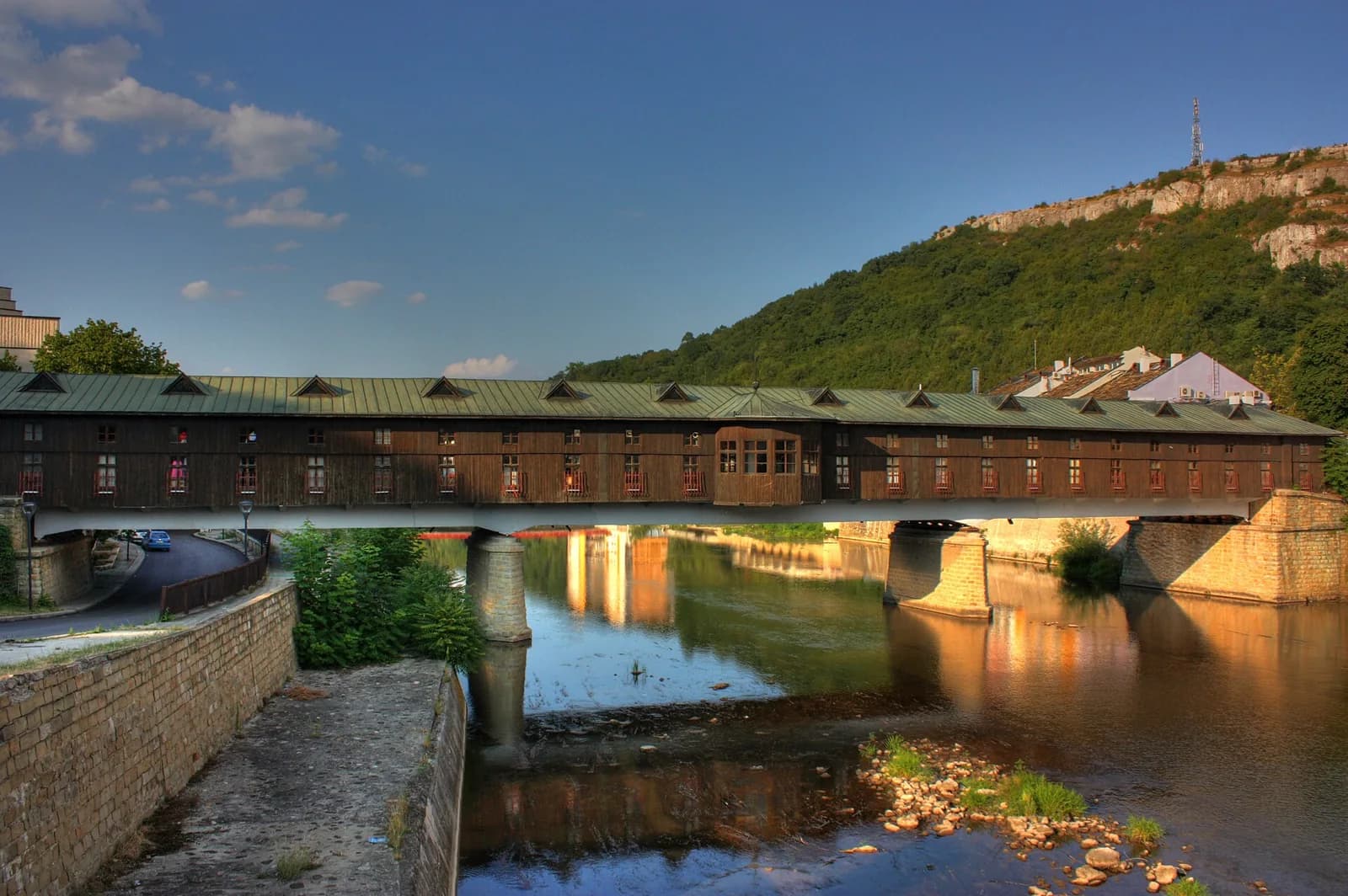
Lovech's symbol has been rebuilt more than once, and knowing that makes it more interesting. Kolyu Ficheto built the first covered bridge over the Osam between 1874 and 1876, of oak and beech, 84 metres long with 64 small shops. It burned down on the night of 2-3 August 1925. A reinforced-concrete bridge by the architect Stefan Olekov replaced it in 1931, and in 1980-1982 that structure was clad in oak boards and given a pitched roof covered in copper sheet, so that it once again recalls Ficheto's design. Reopened on 9 September 1982, today's bridge is 82 metres long and has about ten shops (municipal history). It is still what it always was, a street of shops across the river.
Varosha and the new museum
The bridge leads into Varosha, the old quarter, where the ethnographic complex pairs two neighbouring homes from different eras. Drasova House, from the mid-19th century, belonged to a prosperous merchant and has vessels for making and ageing wine downstairs. Rashova House dates from 1834 but is furnished as an intellectual's home of the 20th century; the teacher and local historian Nencho Rashov left the house and his library to the museum (ethnographic complex).
In July 2026 the Regional History Museum opened a new permanent exhibition of about 5,000 objects in seven halls: archaeology, spirituality, science, music and space, the city of Lovech, ethnography, industrial development, and "Duty and Honour" (BTA). The museum's main building is at 1 Todor Kirkov Square in Varosha (contacts).
Hissarya fortress
The fortress crowns Hissarya hill above a bend of the Osam. The hill falls in three terraces, and the walls occupy the upper two. Its history swings between hill and plain: a Thracian settlement on the hilltop, a probable move down to the lowland under Roman rule, and a return to the hill in the mid-3rd century, when invasions made its natural defences valuable again. The medieval fortress dates from the First Bulgarian Kingdom, and in 1187 it held out against a three-month Byzantine siege, a resistance the museum links with the recognition of the restored Bulgarian state (museum catalogue). From the upper terrace the logic of the site is clear: the hill commands the river bend and the flatter ground below.
Vasil Levski Museum and Kakrinsko Hanche
Lovech's revolutionary committee was the centre of Vasil Levski's network for the interior of the country, and the two-level Vasil Levski Museum at 16 Marin Poplukanov Street explains how it worked. Look for Levski's personal weapon in the memorial section and the forged Ottoman seals used to fake travel papers in the gallery: one stands for armed struggle, the other for the movement and secrecy the organisation depended on. The exhibition continues with the 1876 uprising and the liberation of Lovech during the Russo-Turkish War (museum page).
Kakrinsko Hanche, the inn in the village of Kakrina where Levski was captured, is the companion site. Read it as a memorial rather than a survivor. In 1901 Dr Paraskev Stoyanov came here with Levski's travelling companion Nikola Tsvyatkov, recorded the remaining foundations and set up a memorial plaque. The inn was rebuilt and opened as a museum in 1931, and the old elm beside it, damaged by a storm in 1997, has been strengthened and conserved (museum page).
Atanasovi Collection
This small museum combines three unexpected collections: an original section through the occupation layers of Devetashka Cave with finds and a reconstructed prehistoric dwelling; 1,360 mineral specimens gathered by Vasil Atanasov over forty years; and a room of old radios, from Telefunken, Blaupunkt and Philips receivers to Bulgarian models (collection page). It is the place to understand what the cave's archaeology looks like up close.
The caves
Devetashka Cave
Devetashka lies 16 km north of Lovech near the village of Devetaki, on the right bank of the Osam. It is 2,442 metres long and about 60 metres high, and its huge entrance hall is lit by daylight. Its size, light and the river nearby drew people from the Neolithic and Copper Age onwards; in the 20th century it was used to store oil until the early 1990s. Bats now use the inner galleries to roost and breed, so the water gallery is closed from 1 November to 1 April and the dry gallery from 25 May to 31 July, while the daylight hall normally stays open all year (visitor information).
On 23 May 2026 the municipality closed both the bridge before Devetaki and the cave to visitors (notice), and no reopening has been announced since. Call the Lovech tourist information centre on +359 68 601 362 or the site on +359 884 246 455 before you go.
Prohodna
Near Karlukovo in Lukovit municipality, Prohodna is a natural rock bridge 262 metres long with two entrances, the smaller about 35 metres high, and a path that runs right through it. What makes it famous are two almond-shaped holes side by side in the roof, known locally as the Eyes of God and sometimes the Eyes of the Devil; from some angles they look like a face gazing down. No guide is needed and it is accessible all year. Prohodna is also on the 8 km Iskar-Panega Geopark eco-trail between Lukovit and Karlukovo, which links several caves and rock formations (Ministry of Tourism guide).
Saeva Dupka
Saeva Dupka, near the village of Brestnitsa, is the show cave of the group: 400 metres of passages at 7-11 °C all year, visited with a guide through five halls called Kupena, Srutishteto, Harmana, Beliyat Zamak and Kosmosa. Look for the haystack-shaped stalagmite in Kupena, the massive "Brilliant" column in Harmana, a hall known for its acoustics, and the castle-like formation of Beliyat Zamak. Bring a warm layer and shoes with grip, and expect a difficult approach road in snow or ice (Bulgarian Tourist Union).
Troyan and the Balkan valleys
Troyan crafts museum
Troyan's Museum of Folk Arts and Applied Crafts occupies the town's first public building after the Liberation, from 1881. Pottery leads its ten halls, tracing the local tradition from the Neolithic to the Revival and the painted decoration that the museum links to Zahari Zograf's murals at the monastery. Other halls cover woodcarving, smithing, coppersmithing and weaving. The museum's Konak building has exhibitions on the Revival and on Troyan's painters (municipal page).
Troyan Monastery
About 10 km east of Troyan, beside Oreshak on the Cherni Osam, Troyan Monastery probably dates from the early 17th century. In 1847 the monks invited Zahari Zograf to paint the new church, and the interior is a blaze of colour and rare subjects. Look opposite the altar, where he placed Cyril and Methodius, St Michael the Bulgarian and the Sofia martyrs George the New and Nicholas among the prophets and evangelists, a deliberately patriotic choice. Vasil Levski sheltered here more than once (monastery history). The monastery is active, with services at 08:00 and 17:00, held in the chapel of Saints Cyril and Methodius in winter. On 15 August, its feast day, the miraculous Three-Handed icon of the Virgin is carried in procession (services). The monastery museum is a separate part of the visit.
Oreshak and Cherni Osam
A short way from the monastery, the National Exhibition of Arts and Crafts in Oreshak has shown Bulgarian crafts since 1971. Nine halls covering 4,200 square metres hold ceramics, textiles, metalwork, woodwork and applied arts, with monthly exhibitions of traditional and contemporary makers, craft demonstrations and a bazaar (exhibition).
Further up the valley, the Natural History Museum in Cherni Osam is a good stop with children. In the Seasons hall a brown bear, the only bear species in Bulgaria, stands near a weasel, the country's smallest predator, among red deer, roe deer, wild boar and otters in beech-forest dioramas, with recordings of a bear's roar, a wolf's howl and grunting boar (Seasons hall). Insect lovers can head for the Shtirkov family's butterfly and beetle collection in Hall 2 (Hall 2). Entry is free on the last Wednesday of each month (prices).
For waterfall walks in the Central Balkan near Apriltsi, see the Central Balkan waterfalls guide.
Teteven
West of Troyan, Teteven's History Museum, founded in 1911, has archaeology, regional costumes and a Revival section (visitor listing). Its treasure is flag No. 6 of Georgi Benkovski's Flying Detachment from the April Uprising. After the rising was crushed, the rebels hid their flags in a hollow tree, where shepherds found them in the autumn of 1876; others from the set are now in the National Military History Museum and in Koprivshtitsa. A second flag in the museum is glued to cardboard and cannot be detached for restoration (BTA).
Pleven
The Panorama "Pleven Epopee 1877" in Skobelev Park is the reason most people come. Opened on 10 December 1977, it surrounds you with the third assault on Plevna on 11 September 1877, on a canvas 115 by 15 metres with a 12-metre foreground, painted by eleven Russian and two Bulgarian artists (Pleven Panorama). It opens daily (municipal notice).
The Regional History Museum at 3 Stoyan Zaimov Street adds finds from the Roman city of Ulpia Oescus, a replica of the Thracian Valchitran gold treasure, regional costume and an exhibition on the opera singer Gena Dimitrova (municipal description). South of the centre, Kaylaka Park follows the karst valley of the Tuchenitsa between limestone cliffs over 40-50 metres high, with fossils of ancient aquatic organisms in the rock, and also holds the zoo, the Wine Museum and a summer theatre (park). It is a 999.8-hectare protected area: collecting fossils or minerals and driving outside designated places are prohibited (protected-area register).
How to plan your visit
One day in Lovech. The Covered Bridge and Varosha in the morning, with the ethnographic complex and the new exhibition, then the fortress and the Vasil Levski Museum after lunch. Kakrinsko Hanche makes a short drive at the end of the day.
Troyan day. The crafts museum in Troyan, then Troyan Monastery, Oreshak and Cherni Osam up the valley. Avoid arriving at the monastery during a service if your aim is to look at the murals.
Caves and Pleven. From Lovech, Pleven's Panorama, museum and Kaylaka fill a day. Prohodna and Saeva Dupka both sit in the west of the region and fit a return drive towards Sofia.
Coming from Sofia, Botevgrad's History Museum in the former courthouse at 1 Saransk Square is a worthwhile first stop: three levels from the Neolithic to the present, and an outdoor Lektorium of modern sculptures based on objects in the exhibition (museum).
Practical information
Getting there
From Sofia, follow the Hemus motorway to its junction with the I-4 near Brestnitsa, close to Saeva Dupka; the I-4 then runs east through Lovech province towards Sevlievo and Veliko Tarnovo (I-4 route). A car is close to essential for the caves, the monastery and Cherni Osam.
Opening hours and tickets
Lovech's museum sites switch to winter hours on 19 October 2026 (winter notice; summer notice; prices). Checked on 8 October 2026; where no price is shown, the operator does not publish a current one.
| Site | Hours | Adult ticket |
|---|---|---|
| Ethnographic complex and Vasil Levski Museum, Lovech | Daily 09:00-13:00 and 14:00-18:00; from 19 Oct 09:00-12:00 and 13:00-17:00 | €4; family €7 |
| Atanasovi Collection, Lovech | As above; closed at weekends in the summer season | €4 |
| New permanent exhibition, Lovech | From 19 Oct: Tuesday-Sunday 09:00-12:00 and 13:00-17:00, Monday from 13:00; last tickets 16:20 | €6 |
| Hissarya fortress | Winter 09:00-12:00 and 13:00-17:00 (museum) | Not published |
| Kakrinsko Hanche | Daily 08:30-12:00 and 13:30-17:30; from 19 Oct 09:00-12:00 and 13:00-17:00 | €4 |
| Devetashka Cave | Closed since 23 May 2026; normal winter hours 09:00-16:00 | €1.53 |
| Prohodna | Open access all year | No ticket listed |
| Saeva Dupka | Daily 09:00-17:00 until 31 March, last group 16:30 | €6; ages 7-18 and over 65 €3 |
| Troyan crafts museum | October-March: Monday-Friday 09:00-17:00, Saturday 10:00-15:00 | Not published in euro |
| Troyan Monastery | Church 07:30-19:00 in summer, 08:00-17:00 in winter; museum 09:00-17:00 | Not published |
| Oreshak exhibition | Monday-Friday 09:00-17:30; Saturday-Sunday 10:00-18:30 | Not published |
| Cherni Osam museum | Daily 08:00-17:00, last tickets 16:30 | €3; family €7 |
| Teteven History Museum | Monday-Friday 09:00-17:00; Saturday-Sunday 10:00-17:00 | Not published |
| Pleven Regional History Museum | Monday-Saturday 09:30-12:00 and 12:30-18:00 until 31 October | Not published |
Sources for sites outside Lovech: Devetashka, Prohodna, Saeva Dupka, Troyan museum, Troyan Monastery, Oreshak, Cherni Osam, Teteven, Pleven.
Most of these sites change hours with the seasons. For Devetashka in particular, and for any visit around the changeover dates, ring ahead; the Lovech museum's visitor desk is on +359 68 601 399.
Sources & further reading
- Covered Bridge - Lovech Municipality tourism portal
- Drasova and Rashova Houses Ethnographic Complex - Lovech Municipality tourism portal
- Ticket prices - Regional History Museum Lovech
- Winter opening hours from 19 October 2026 - Regional History Museum Lovech
- Summer opening hours from 30 March 2026 - Regional History Museum Lovech
- Regional History Museum Lovech - Regional History Museum Lovech
- Contacts - Regional History Museum Lovech
- Lovech museum opens its new permanent exhibition - Bulgarian News Agency
- Vasil Levski Museum - Regional History Museum Lovech
- Archaeological and historical catalogue - Regional History Museum Lovech
- Atanas and Vasil Atanasovi Museum Collection - Regional History Museum Lovech
- Kakrinsko Hanche - Regional History Museum Lovech
- Devetashka Cave - Lovech Municipality tourism portal
- The bridge before Devetaki is closed, 23 May 2026 - Lovech Municipality
- Destination guide: Lukovit and the Karlukovo karst - Ministry of Tourism of Bulgaria
- Saeva Dupka Cave - Bulgarian Tourist Union
- Museum of Folk Arts and Applied Crafts, Troyan - Troyan Municipality tourism portal
- History of the monastery - Troyan Monastery of the Dormition
- Contact and visiting hours - Troyan Monastery of the Dormition
- Services - Troyan Monastery of the Dormition
- About the National Exhibition of Arts and Crafts - National Exhibition of Arts and Crafts Oreshak
- Prices and opening hours - Natural History Museum Cherni Osam
- Seasons hall - Natural History Museum Cherni Osam
- Hall 2: entomology collection - Natural History Museum Cherni Osam
- History Museum Teteven - Teteven tourism portal
- Teteven History Museum keeps flags from the April Uprising - Bulgarian News Agency
- Pleven Panorama - Wikipedia
- From 1 April museums and galleries in Pleven move to summer hours - Pleven Municipality
- Regional History Museum - tourist information - Pleven Municipality
- Kaylaka Park - Pleven Municipality
- Protected area Kaylaka - Executive Environment Agency
- History Museum Botevgrad - History Museum Botevgrad
- I-4 road (Bulgaria) - Wikipedia
Tags
- Lovech
- Troyan Monastery
- Pleven
- Devetashka Cave
- Prohodna
- Saeva Dupka
- Vasil Levski
- Bulgaria