After-rain trail erosion in Bulgaria — a safer weekend field guide
Learn how to read a Bulgarian trail after heavy rain, avoid widening muddy paths and report erosion without inventing a closure or doing unsafe repairs.
Recently verified — 12 August 2026
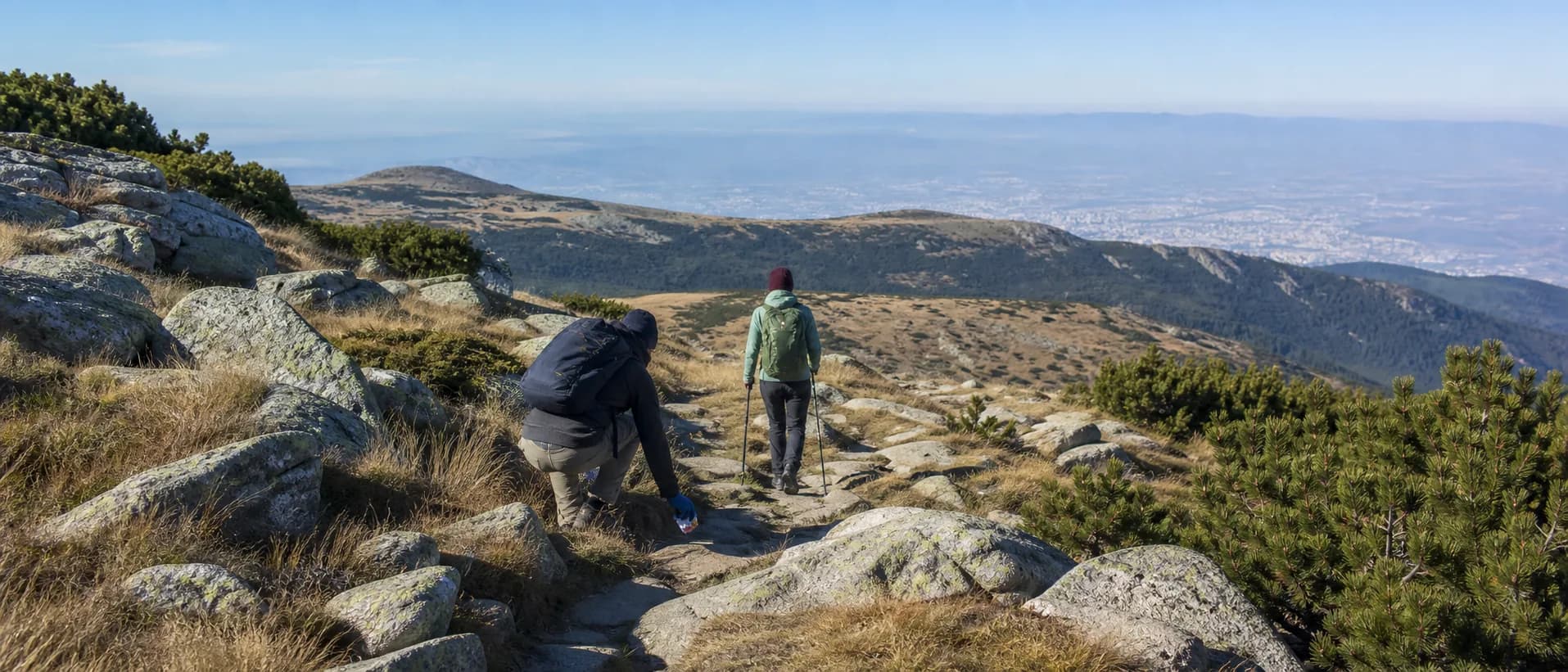
Rain changes a trail, not only the weather forecast. Water can expose roots, fill a drainage ditch, loosen a bank, hide a hole under mud or turn a small stream crossing into a genuine hazard. The most useful weekend decision is often not “Can I force my way through?” but “Can I stay on durable ground, turn around early and leave the damaged section to the land manager?”
This guide is for a walk on a marked or otherwise lawful route in Bulgaria in mid-August 2026. It does not declare a trail open or closed. A muddy photograph is not a closure notice, and the absence of an online warning is not proof that a bridge, slope or crossing is safe. Check the responsible park, municipality or land manager before travelling and again at the trailhead.
Read the whole weather story
Look at recent rain, not only the blue sky above the car park. Check NIMH warnings for the municipalities along the route, rainfall totals where available, thunderstorms, wind and the chance of more rain during your walking window. A sunny morning can follow a saturated night. In a high or wooded area, the trail may remain wet after the town dries.
The table is a prompt for judgement, not a remote clearance. Children, dogs, older walkers and people carrying heavy packs may reach the “turn back” decision sooner. A route that is technically passable for a fit person can still be the wrong plan for the group you brought.
Look for the places water concentrates
At the trailhead, scan the first section before committing. Note whether water is flowing along the tread, whether the outer edge has collapsed, and whether roots or stones are exposed. On a slope, check for fresh channels, loose soil, undercut switchbacks and mud that hides hard obstacles. At a crossing, look upstream for debris and downstream for a safe exit; never judge a crossing only by the water depth at your boots.
Do not stand below an unstable bank for a better photograph. Do not pull a branch from a stream, shift stones into a crossing or repair a drainage feature unless the responsible manager has instructed and equipped you to do so. A well-meant fix can send water onto another part of the trail or damage habitat.
When a route passes through a protected area, follow its marked-path and access rules. The national-park guidance from the Ministry of Environment is a useful baseline, but the current notice of the individual park or site takes priority. Stay out of water bodies where the regime prohibits entry, do not light fires and do not treat a dry-looking forest as a permission slip during fire season.
Protect the trail with your feet
Mud tempts people to step onto the grass, heather or forest floor. Resist that instinct when the established tread is safe enough to use. Slow down, shorten your stride, use poles if you already know how to use them and keep the group in a single durable line rather than spreading across the slope. Let faster walkers pass only where the ground can absorb it.
If the tread is not safely passable, the responsible action is to turn back. Do not widen a switchback, walk around a puddle through young plants or follow an unofficial line marked by footprints. Do not use a bicycle or vehicle to test a damaged section. Leave no tape, arrows or stones to create your own route.
Clean mud from footwear at a robust, non-sensitive place before it spreads to the next section, but do not wash soil into a stream. Pack a small rubbish bag and take your own packaging home. A wet trail is not a reason to abandon tissues, fruit peel or a drink bottle; organic waste is still introduced material and can attract animals.
Make a condition note others can use
A useful trail report is specific enough to be checked. Record the date and time, route name or nearest marked junction, surface, approximate length of the affected section, water movement, visible damage, whether you turned back and the direction of a safe retreat. Add one wide photograph from stable ground. Do not publish a precise location for vulnerable wildlife or encourage readers to approach a dangerous bank.
Use careful language: “fresh channel across the marked path, observed 12 August, turned back” is strong. “The trail is destroyed” is usually not. Do not convert one muddy patch into a permanent rating or state that a park has closed the route unless the land manager has said so.
Add the observation to Garbamons’ mapped trail and nature-place reports when it helps visitors make a better decision. Include the official page readers should recheck. A community note can show that conditions changed; it cannot replace a park notice, emergency warning or municipal instruction.
A realistic after-rain weekend plan
On Friday, choose a main route and a lower, shorter alternative. Check NIMH warnings, the land manager’s notices, daylight and transport. On Saturday morning, inspect the first accessible section before spending hours on the approach. Set a turnaround rule before anyone is tired: active erosion, unsafe crossing, lightning or a worsening group condition ends the main plan.
On Sunday, choose the alternative or a viewpoint reached on a durable public path. Use the time to write a dated observation, not to revisit a place that the group already judged unsafe. If you found ordinary litter on safe ground, carry out a small amount; for a larger accumulation, map the cleanup need with access, exclusions and a realistic bag estimate. Do not send volunteers onto an unstable slope or into flowing water.
The trail will recover more easily when visitors stop treating wet ground as an obstacle to defeat. Your best contribution may be a quiet retreat, an accurate report and one less new line cut across the hillside.
Sources & further reading
- Dangerous weather by municipality — National Institute of Meteorology and Hydrology
- Visiting Bulgaria’s national parks responsibly — Ministry of Environment and Water
- Vitosha Nature Park — Vitosha Nature Park Directorate
Access, prices and opening times change. Verify locally before you travel.
Tags
- trail erosion
- hiking safety
- after rain
- trail conditions
- Bulgaria
Elsewhere on the web
Links to reference material and organisations we don't control.
- ReferenceHikingWikipedia
- ReferenceTrailWikipedia
- OrganisationThe seven Leave No Trace principlesLeave No Trace
- VideoREI — skills and gear explainersYouTube