Gabrovo, Tryavna and Etar: crafts and Revival villages
Etar's water-powered workshops, Bozhentsi, Tryavna's carved ceilings, Dryanovo Monastery and Bacho Kiro Cave, Sevlievo and Hotalich, with hours and tickets.
Sources checked - 8 October 2026
In this article
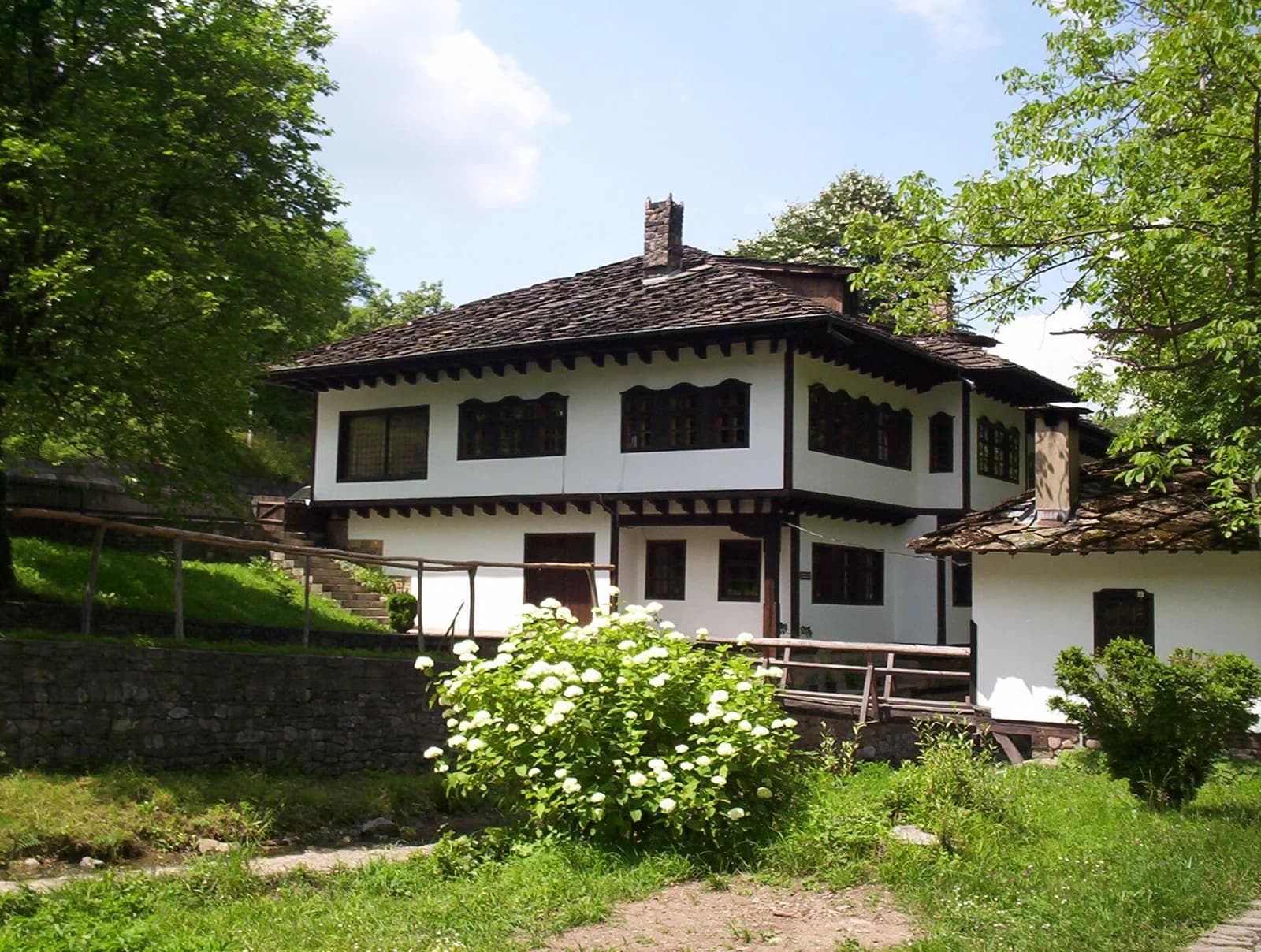
The wooded foothills of the Balkan range around Gabrovo hold one of Bulgaria's richest clusters of National Revival crafts and architecture, all within easy reach of each other. Etar is an open-air museum where water still turns the mills and lathes. Bozhentsi is a village of stone-roofed merchant houses, and Tryavna is the town of woodcarvers and icon painters. Near Dryanovo, a monastery that fought in the 1876 uprising stands a few minutes' walk from the cave that yielded some of Europe's oldest Homo sapiens remains, and Sevlievo, to the west, adds a pioneering 19th-century school and an excavated hilltop town.
What to see
Etar open-air museum
Etar opened on 7 September 1964 on the edge of Gabrovo, and its heart is a set of ten working water-powered installations fed by channels on two levels, which the museum counts among the richest collections of its kind in European open-air museums (water installations). Start by comparing two mills. The Karadzheyka grain mill of 1780 has a horizontal wheel that turns the millstone directly. The Dolapkinya has a large wheel whose wooden gears change the axis of rotation and raise the speed. Then look at what the water is made to do: fulling mills (valyavitsi) beat and felt home-woven wool, a tepavitsa pounds cloth and cord, and other installations twist braid, saw planks, turn wooden flasks and bowls, and sharpen tools. Staff can tell you which machines are being run that day.
Uphill from the channels, the craft street recreates the main street of a Revival-period town: houses, a café, a bakery, shops and 13 workshops among more than 25 buildings. They were rebuilt on original prototypes between 1967 and 1976, starting with a tanner's house, and the street presents 23 traditional crafts, from coppersmithing, pottery and woodcarving to goldsmithing, felt-making, bell-making and confectionery (craft street). It is a reconstructed townscape rather than an old street that grew here, but it lets you see the tools and materials of many crafts side by side.
The museum suggests two to three hours to see everything (visitor information). If you want to make something yourself, the Learn and Experience programme lets visitors over 12 spend about an hour on a craft of their choice, such as pottery, braid-making, goat-hair weaving, bell-making, wood-turning or icon painting, and take the result home. It costs €19 for adults and €11 for students including admission, and must be booked at least ten days ahead (programme).
Bozhentsi
About 15 km east of Gabrovo, Bozhentsi is a village of two-storey houses with stone-slab roofs, deep verandas, corner fireplaces and carved ceilings, declared an architectural and historical reserve in 1964. Local tradition names it after Bozhana, a noblewoman who fled Tarnovo after the Ottoman conquest; by the Revival its people traded in leather, wool, beeswax and honey (village history).
The museum houses show how that trade shaped daily life, so the guided circuit is worth doing rather than only strolling the cobbled lanes. It covers Baba Rayna House, one of the oldest buildings in the village, from the second half of the 18th century; the house of Doncho Popa, a wealthy wool and fur merchant of the early 19th century; and the Mengema, an early-19th-century workshop for purifying beeswax. The tour lasts about an hour, is given in Bulgarian and starts at the Museum-Information point. The Old School of 1870 hosts temporary exhibitions (reserve museums).
Tryavna
Tryavna gave its name to a school of woodcarving and to one of the oldest Revival icon-painting schools, and both are visible in its museums. The centre is Kapitan Dyado Nikola Square, with a clock tower from 1814 and the Old School, built between 1836 and 1839 as one of the first secular schools in Bulgaria (Tryavna). Inside are a reconstructed classroom from the monitorial system, paintings and sculpture by Dimitar Kazakov-Neron and his brother Nikola, and a collection of clocks that includes one whose hands run backwards (Old School).
Daskalov House holds the story everyone in Tryavna tells. Built for two of the sons of hadzhi Hristo Daskalov, it was dedicated on St George's Day 1808, when master carver Dimitar Oshanetsa and his journeyman Ivan Bochukovetsa made a wager and spent six months carving rival ceilings in separate rooms. The results, the master's May Sun and the journeyman's July Sun, are the reason to come; compare them before moving on to the museum of the Tryavna woodcarving school, with its sculpture and household iconostases (Daskalov House).
The surprise is the Museum of Asian and African Arts: more than 400 objects from Nepal, Tibet, China, India and several African countries, dating from the 2nd to the 20th century, mostly religious, including statues of Hindu deities, Buddhist ritual objects and African masks (museum page). They were donated by the sculptor and restorer Zlatko Paunov, whose mother came from the Tryavna area and who worked as a restorer at New York's Tibetan Museum after years in Italy and France (municipal biography).
Dryanovo Monastery and Bacho Kiro Cave
Dryanovo Monastery of St Archangel Michael lies in the valley of the Andaka, five kilometres from Dryanovo. Founded in the 12th century, it was burned and looted twice under Ottoman rule and rebuilt on its present site in 1845 (monastery history). In 1876 it became a stronghold of the April Uprising under Pop Hariton and Bacho Kiro. The museum in the monastery, three halls on two floors, shows the rebels' documents, weapons and belongings, Dryanovo's part in the Russo-Turkish War of 1877-1878, and coins, pottery and weapons of Thracians, Romans, Byzantines and medieval Bulgarians from the surrounding area (museum page).
Bacho Kiro Cave is 300 metres from the monastery. Dryanovo's hikers made it the first cave in Bulgaria fitted out for visitors, in 1937. Of its four-level labyrinth of about 3,600 metres, a 700-metre section is lit, with stalactites, stalagmites and columns. The short route takes 25-30 minutes and runs every half hour, alone or with a group; the long route of 60-70 minutes is guided (cave page). The cave also matters far beyond Bulgaria: in 2020 a Max Planck Institute team directly dated human bones found here, together with stone tools, bone tools and personal ornaments, to about 45,000 years ago, the oldest Upper Palaeolithic Homo sapiens known in Europe (Max Planck Institute). The excavation itself is not part of the tourist route.
In Dryanovo town, the History Museum on Shipka Street is devoted to Kolyu Ficheto, the self-taught master builder born here in 1800, whose works include the Byala bridge over the Yantra and the original Covered Bridge in Lovech (Kolyu Ficheto). Lafchieva House opposite shows town life around 1900, and Ikonomova House displays icons from the region (museum branches).
Sevlievo and Hotalich
Sevlievo's Hadzhistoyanovo School was completed in 1844 with money from the merchant Hadzhi Stoyan Nikolov, who invited the young Petko Rachev Slaveykov as its first teacher. It used the new monitorial method and taught Bulgarian and sacred history, arithmetic, singing and gymnastics (school history). Today it houses the town museum's archaeology and Revival exhibitions, including finds from Hotalich.
Hotalich, about 4 km north-west of town on Krushevski Bair, where the Rositsa leaves the plain through a gorge, was inhabited from the 5th-6th to the 14th century. Around 90 houses and workshops sit in four walled quarters below a citadel with more than 900 metres of walls, some still 3 metres high. Of its churches, look for the one built inside an older church, the earlier dated to the 5th-6th century and the later to the 12th-14th, and for the altar made from a Roman marble gravestone with its inscription erased. Pottery kilns full of vessels ready for firing and a hoard of about 3,000 copper coins of the 12th-13th centuries were among the finds (municipal description).
The Dandolovi Houses, built in 1870 for a father and his two sons, are three linked homes with separate shops and gates to the street and a shared courtyard behind, furnished with Sevlievo costumes and imported town furniture (municipal page). They open by appointment only.
How to plan your visit
One day from Gabrovo. Etar in the morning, Bozhentsi around lunchtime, and Tryavna's Old School and Daskalov House in the afternoon.
A second day. Dryanovo Monastery and the short route through Bacho Kiro in the morning, then Sevlievo's school museum and Hotalich in the afternoon while Hotalich keeps its April-October hours.
With Veliko Tarnovo. Dryanovo and Tryavna combine well with a base in Veliko Tarnovo; see the Veliko Tarnovo guide.
Weekday visits suit Sevlievo, whose school museum is open only on Saturday mornings at weekends, and Tryavna's Asian and African Arts Museum is closed on Mondays and Tuesdays. Etar's winter hours still leave plenty of room for the two to three hours it needs.
Practical information
Getting there
Gabrovo is 211 km from Sofia. By car, take the Hemus motorway and the I-4 to Sevlievo (I-4 route) and continue south to Gabrovo. Etar is served by Gabrovo city buses 1, 7 and 10 and has a car park for about 20 cars, which costs €1.54 a day except from December to February. Paths are cobbled and wet in places around the water installations, so wear comfortable shoes; dogs are allowed if kept under control (Etar access). A car makes it much easier to link Bozhentsi, Dryanovo Monastery and Hotalich in one trip.
Opening hours and tickets
Checked on 8 October 2026. Where no price is given, the operator does not publish a current one.
| Site | Hours now | Adult ticket |
|---|---|---|
| Etar | Daily 09:00-17:00 (09:00-19:00 from late April); buy tickets 30 minutes before closing | €7; students €3, family €16.50 |
| Bozhentsi museum circuit | Guided circuit of about 60 minutes from Museum-Information | €6; reduced €4, family €12 |
| Tryavna Old School and Daskalov House | Daily 09:00-17:00 until 31 March | €3 each; €7.50 for three museums, €15 for six |
| Asian and African Arts, Tryavna | Wednesday-Sunday 09:00-17:00 | €3 |
| Dryanovo Monastery museum | Daily 09:00-16:00 | Not published |
| Bacho Kiro Cave | Daily 09:00-18:00 until 31 October; 10:00-16:00 from 1 November | Not published |
| Kolyu Ficheto museum, Dryanovo | Daily 08:00-12:00 and 13:00-17:00 | Not published |
| Hadzhistoyanovo School, Sevlievo | Monday-Friday 08:30-12:00 and 13:00-17:00; Saturday 09:00-13:00 | €2 |
| Hotalich | Daily 09:30-18:00 until 31 October; guided group visits by request in winter | €3; family €5 |
| Dandolovi Houses, Sevlievo | By appointment | €2 |
Sources: Etar, Bozhentsi, Tryavna hours and tickets, Dryanovo museum, Bacho Kiro, Kolyu Ficheto museum, Sevlievo hours and prices.
Hours at the smaller sites change with the seasons, so for Bacho Kiro or the Sevlievo museums call ahead: the cave on +359 887 080993 and the Sevlievo museum on +359 675 32724.
Sources & further reading
- Water-powered installations - Ethnographic Open-Air Museum Etar
- Craft street - Ethnographic Open-Air Museum Etar
- For visits - Ethnographic Open-Air Museum Etar
- Opening hours and prices - Ethnographic Open-Air Museum Etar
- Learn and Experience - Ethnographic Open-Air Museum Etar
- Location, transport and visiting conditions - Ethnographic Open-Air Museum Etar
- Museum sites in Bozhentsi - Bozhentsi Architectural and Historical Reserve
- Bozhentsi - Wikipedia
- The Old School, Tryavna - Tryavna Museum
- Tryavna - Wikipedia
- Daskalov House Museum - Tryavna Museum
- Museum of Asian and African Arts, Tryavna - Tryavna Museum
- Birthday of honorary citizen Zlatko Paunov, 19 March 2024 - Municipality of Tryavna
- Opening hours of the Tryavna museums - Tryavna Museum
- Tickets for the Tryavna museums - Tryavna Museum
- Archaeology and National Revival Museum, Dryanovo Monastery - Municipality of Dryanovo
- Dryanovo Monastery - Wikipedia
- Bacho Kiro Cave - Municipality of Dryanovo
- The oldest Upper Palaeolithic Homo sapiens in Europe - Max Planck Institute for Evolutionary Anthropology
- Kolyu Ficheto History Museum, Dryanovo - Municipality of Dryanovo
- Kolyu Ficheto - Wikipedia
- Hadzhistoyanovo School - History Museum Sevlievo
- Opening hours - History Museum Sevlievo
- Ticket and service prices - History Museum Sevlievo
- Early Byzantine and medieval fortress Hotalich - Municipality of Sevlievo
- Dandolovi Houses - Municipality of Sevlievo
- I-4 road (Bulgaria) - Wikipedia
Tags
- Gabrovo
- Etar
- Tryavna
- Bozhentsi
- Dryanovo
- Bacho Kiro Cave
- Sevlievo
- Bulgarian Revival