Kazanlak and the Rose Valley: Thracian tombs and rose museums
See Kazanlak's UNESCO tomb copy, Seuthes III's tomb and other Thracian temples near Shipka, the Iskra treasury, the Rose Museum and the town's smaller museums.
Sources checked - 8 October 2026
In this article
Kazanlak lies in the Rose Valley, the broad basin under the Balkan range where Bulgaria grows the oil-bearing roses that made the town's name. The same valley is packed with Thracian burial mounds, among them a painted tomb on the UNESCO World Heritage List and the tomb of the Odrysian king Seuthes III. Few places in Bulgaria let you see ancient royal tombs in the morning and a rose-oil distillery in the afternoon.
What to see
The Kazanlak Tomb and its copy
On 19 April 1944, soldiers digging trenches on Tyulbeto hill hit a stone wall and found a painted chamber, which they first saw by the light of burning newspapers (Bulgarian National Radio). The tomb dates from the end of the 4th century BC, and in 1979 it became the first Bulgarian site on the UNESCO World Heritage List.
It is small: a passage, a rectangular antechamber and a round burial chamber under a beehive dome. Its fame comes from the paintings, done mainly in true fresco with four basic colours: black, red, yellow and white. Two friezes in the antechamber show warriors in combat. In the dome, the main frieze shows a funeral feast: at the centre sit the ruler and his wife, while servants bring gifts, women play music and grooms lead horses and a chariot. A smaller frieze shows a chariot race. The tomb was robbed in antiquity and only a few gold, silver and pottery finds remain, so the paintings are what you come for.
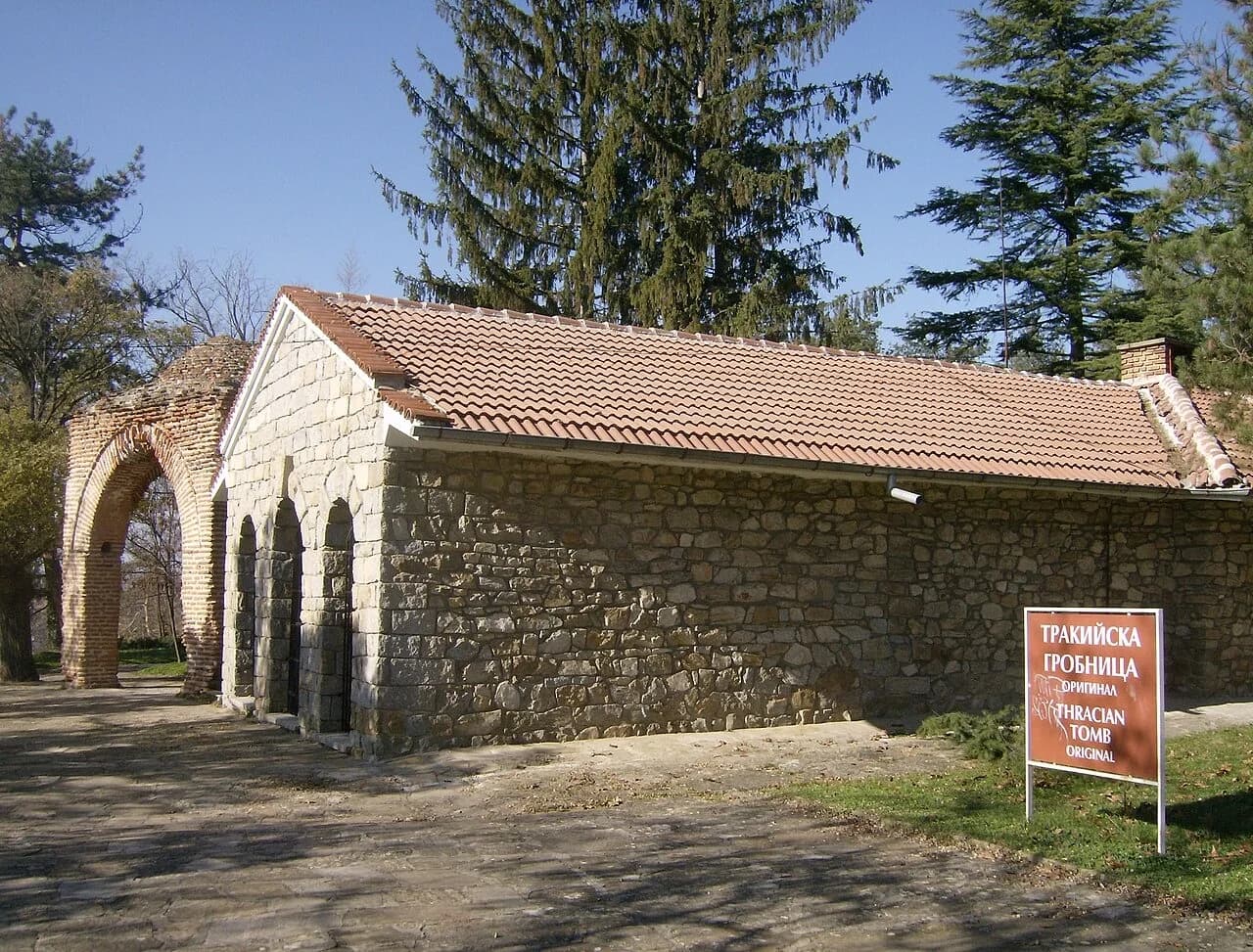
The original is sealed to protect the murals. Visitors see a full-size copy of the architecture and paintings next to it in Tyulbeto Park. It reproduces the architecture and paintings at full size, so you can stand in the round chamber and study the dome close up.
Thracian tombs around Shipka
The richest group of tombs lies around the village of Shipka, at the foot of the Balkan range, in what is often called the Valley of the Thracian Kings. Of the roughly 1,500 mounds in the Kazanlak area, only about 200 have been studied in depth (BNR). Five are open to visitors every day.
Tomb of Seuthes III (Golyama Kosmatka). About 1 km south of Shipka, this is the one to choose if you only see one. The mound was raised as a sacred hill in the first half of the 5th century BC and a temple was built inside it, with a facade and three rooms: a rectangular chamber, a round domed chamber and a final room cut from a single granite block weighing about 60 tonnes. At the start of the 3rd century BC it became a royal tomb: a nobleman was buried in the central chamber and a horse sacrificed in the first. The grave goods included a gold wreath, a gold cup, horse trappings, a bronze helmet and silver vessels inscribed with the name Seuthes. A bronze head of a statue was found buried 7 m south of the entrance. Its likeness to coin portraits of Seuthes III, founder of the town of Seuthopolis, led the excavator, Dr Georgi Kitov, to identify the tomb as his. It was discovered in autumn 2004, and you enter along a 13-metre passage.
Shushmanets. Two kilometres east of Shipka, this 4th-century BC temple tomb is an architectural surprise. An Ionic column stands in the vaulted antechamber, where four horses and two dogs were sacrificed, and a single Doric column rises in the centre of the round chamber to the keystone of the dome, with seven Doric half-columns around the wall. Traces of the original white plaster survive in the round room.
Ostrusha. Three kilometres southeast of Shipka, this mid-4th-century BC complex has six rooms over about 100 square metres. Its burial chamber is hollowed out of a granite block of more than 60 tonnes, and the ceiling is divided into dozens of painted panels with portraits, figures, animal fights and plant patterns.
Helvetia and the Griffins tomb, both about 0.5 km southeast of Shipka, are also open daily. Three further tombs, Golyama Arsenalka, Kran 2 and Svetitsata, can be seen by prior arrangement with the museum (price order).
Iskra Museum of History
Founded in 1901, Iskra is one of Bulgaria's oldest museums, with more than 70,000 objects in archaeology, Revival, modern history and ethnography. For anyone following the Thracian story, the treasury is essential: this is where the finds from the Seuthes III tomb are displayed, including the gold wreath, the helmet, the greaves and the full set of gold and silver horse trappings, together with a rare coin collection. The museum also holds what it describes as the largest collection of bone sickles in southeast Europe. Visit it after the tombs and the empty chambers suddenly fill with objects.
Rose Museum
The Rose Museum began in 1967 and moved in 2016 to a new building in Rosarium Park. It follows Bulgarian rose oil from field to trade: distillation stills, vessels for rose oil and rose water, a reconstructed laboratory of 1907 and a konkuma, a traditional rose-oil vessel, last used in 1947. The Revival collection adds the practical side: picking baskets and cutters, metal safes for the precious oil, a large bottle wrapped in willow, and the account books and archives of the firms of Ivan Manev and P. Iv. Orozov and Son. The shop sells rose oil, cosmetics and rose liqueur.
Kulata Ethnographic Complex
For the rose story told through daily life, Kulata has two houses. One is the 19th-century town house of the merchant Ivan Hadzhienov, built by master builders from Tryavna and known for its arched columned balconies; the other is a simple village house of around 1800. There is a primitive rose still, and the complex offers rose-distilling demonstrations, essential-oil tasting and rose jam and liqueur, along with a room on Kazanlak's 19th-century walnut-oil trade.
Chudomir Museum
Dimitar Chorbadzhiyski, who signed himself Chudomir, was both a humorous writer and a painter of the people around him. His house museum combines his former home with a gallery where a different selection of original drawings goes on show each year. The archive holds more than 15,000 manuscripts, letters, books, sketches and belongings of Chudomir and his wife, the painter Mara Chorbadzhiyska. You can also see his death mask and an augmented-reality guide that places him in his house and yard among his characters. It works best for visitors who read Bulgarian or come with someone who can explain the jokes.
Museum of Photography
Opened in 2015, the Museum of Photography holds more than 300 exhibits and about 900 photographs, arranged from metal and glass plate cameras through box cameras and 35 mm film to early digital models. The municipal listing picks out a Hasselblad, a miniature Czech spy camera, a 1910 stereo camera and Bulgarian-made Edelweiss and PhotoClip models. A gallery hall shows changing exhibitions. It is at 1 Chudomir Street.
Further west: Buhalov Han in Karlovo
Karlovo, further west in the Rose Valley and on the same railway line, has its own rose traditions. Buhalov Han, part of the Old Karlovo ethnographic complex, displays a carder, spinning wheel and loom beside finished rugs and costumes, and arranges craft demonstrations and workshops. Its tastings include rose syrup, jam, liqueur and Turkish delight, rose and lavender teas, and coffee brewed in hot sand. The complex is at 31 Vasil Levski Street and opens 09:15-18:00 from April to October and 08:45-17:30 in winter, with a lunch break from 11:45 to 12:30 (Old Karlovo). See our Karlovo, Kalofer and Sopot guide for the town itself.
When to go
The roses bloom in late May and early June, and Kazanlak celebrates with the Rose Festival, first held in 1903. In 2026 it ran from 15 May to 7 June, with rose-picking rituals in the surrounding villages at weekends, distilling demonstrations, the crowning of the Rose Queen and a parade on the final day. Book accommodation early for those weeks. Outside the festival the museums and tombs are quieter, and the Iskra sites stay open every day of the year.
Suggested plans
Half a day in town. Start at Iskra and its treasury, then visit the tomb copy in Tyulbeto Park and finish at the Rose Museum.
One day. Drive out to Shipka in the morning for the Seuthes III tomb, Shushmanets and Ostrusha, then return to Kazanlak to see the Seuthes finds at Iskra and the tomb copy in the afternoon.
Two days. Add the Rose Museum, Kulata and either Chudomir or the Photography Museum, or spend the second day in Karlovo.
How to get there
Direct trains from Sofia to Kazanlak take just over three hours; others change at Karlovo. The town museums are in Kazanlak itself, but the tombs around Shipka need a car or taxi.
Opening hours and prices
Checked on 8 October 2026 against the museum's hours page and the admission order in force from 5 January 2026. Call the museum on +359 431 63741 if you plan to arrive late in the day.
| Sight | Hours | Adult ticket |
|---|---|---|
| Iskra Museum, permanent exhibition and treasury | Daily 09:00-17:30 | €4 |
| Rose Museum | Daily 09:00-17:30 | €3 |
| Kazanlak Tomb copy | Daily 09:00-17:00 | €3 |
| Seuthes III, Shushmanets, Ostrusha, Helvetia, Griffins tombs | Daily 09:00-17:00 | €3 each |
| Golyama Arsenalka, Kran 2, Svetitsata tombs | By prior request | €1.50 each |
| Kulata Ethnographic Complex | Daily 09:00-17:30 in season | €3 |
| Museum of Photography | Mon-Sat 09:00-17:30 Oct-Apr, 09:00-18:00 May-Sep | €1 |
| Chudomir Museum | Mon-Fri 09:00-17:30 | Pay on site |
Iskra sells combined tickets: €7.50 for any three of its sites, €8.50 for three including the treasury, €9 for four including the treasury, and €20 for all its sites over three days. Children under seven enter Iskra's sites free, and Iskra's sites and the Photography Museum are free for individual visitors on the last Monday of each month. Guided talks at the tombs cost €2 in Bulgarian and €5 in a foreign language.
Sources & further reading
- Thracian Tomb of Kazanlak - UNESCO World Heritage Centre
- The Kazanlak Thracian tomb was discovered 80 years ago - Bulgarian National Radio
- Kazanlak Tomb - Museum of History Iskra - Kazanlak
- Goliama Kosmatka Mound - Tomb of Seuthes III - Museum of History Iskra - Kazanlak
- Tomb of Seuthes III in Golyama Kosmatka mound - Kazanlak municipal tourism portal
- Temple in Shushmanets mound - Museum of History Iskra - Kazanlak
- Temple in mound Ostrusha - Museum of History Iskra - Kazanlak
- Sight map and site locations - Museum of History Iskra - Kazanlak
- Opening hours - Museum of History Iskra
- Admission order effective 5 January 2026 - Museum of History Iskra
- For Museum - Museum of History Iskra
- Rose Museum - Kazanlak municipal tourism portal
- Revival collection, Museum of Roses - Museum of History Iskra - Kazanlak
- Ethnographic complex Kulata - Museum of History Iskra - Kazanlak
- Chudomir Literary and Art Museum - Kazanlak municipal tourism portal
- Museum of Photography and Contemporary Visual Arts - Museum of Photography and Contemporary Visual Arts
- Museum of Photography - visitor listing - Kazanlak municipal tourism portal
- Rose Festival - Kazanlak municipal tourism portal
- Train timetable Sofia - Kazanlak - Bulgarian State Railways
- Buhalov Han - Old Karlovo Ethnographic Complex
- Tastings - Old Karlovo Ethnographic Complex
- Old Karlovo Ethnographic Complex - Old Karlovo Ethnographic Complex
Tags
- Kazanlak
- Rose Valley
- Valley of the Thracian Kings
- Kazanlak Tomb
- Thracian heritage
- Rose Museum
- UNESCO