Stara Zagora and Haskovo: Roman, Thracian and Neolithic sites
Stara Zagora's Neolithic house and Roman forum, Kabile near Yambol, the Thracian tombs at Alexandrovo and Mezek, and the museums of Haskovo.
Sources checked - 8 October 2026
In this article
The Upper Thracian Plain around Stara Zagora and Haskovo holds some of the oldest and most varied history in Bulgaria. In a single trip you can stand inside an 8,000-year-old farmhouse, walk a Roman street under a modern museum, cross the open ruins of a Thracian city and step down a 20-metre corridor into a stone tomb. The towns are close to two motorways, so the sites combine easily into one to three days.
Stara Zagora
The Neolithic Dwellings Museum
This is the stop that makes Stara Zagora unusual. Found during rescue excavations in 1969, the museum shelters a house built at the beginning of the sixth millennium BC, about 8,000 years ago, and burned with its contents in place (Neolithic Dwellings). It measured 10 by 5.8 metres and stood about 7 metres high, made of wooden stakes and woven rods plastered with clay and straw, with two rooms below and one above for three families. Ovens still stand against the north walls, with stone hand mills and large clay granaries beside them and around 60 pots in each room. Three clay columns with branched, horn-like tops are read as cult installations, and fragments of an oven and hand mills that fell from the upper floor in the fire lie among the ground-floor remains. Downstairs, the "Prehistoric Art in Stara Zagora" exhibition adds pottery, human and animal figurines, ornaments and tools from the region.
The Regional History Museum and the Roman street
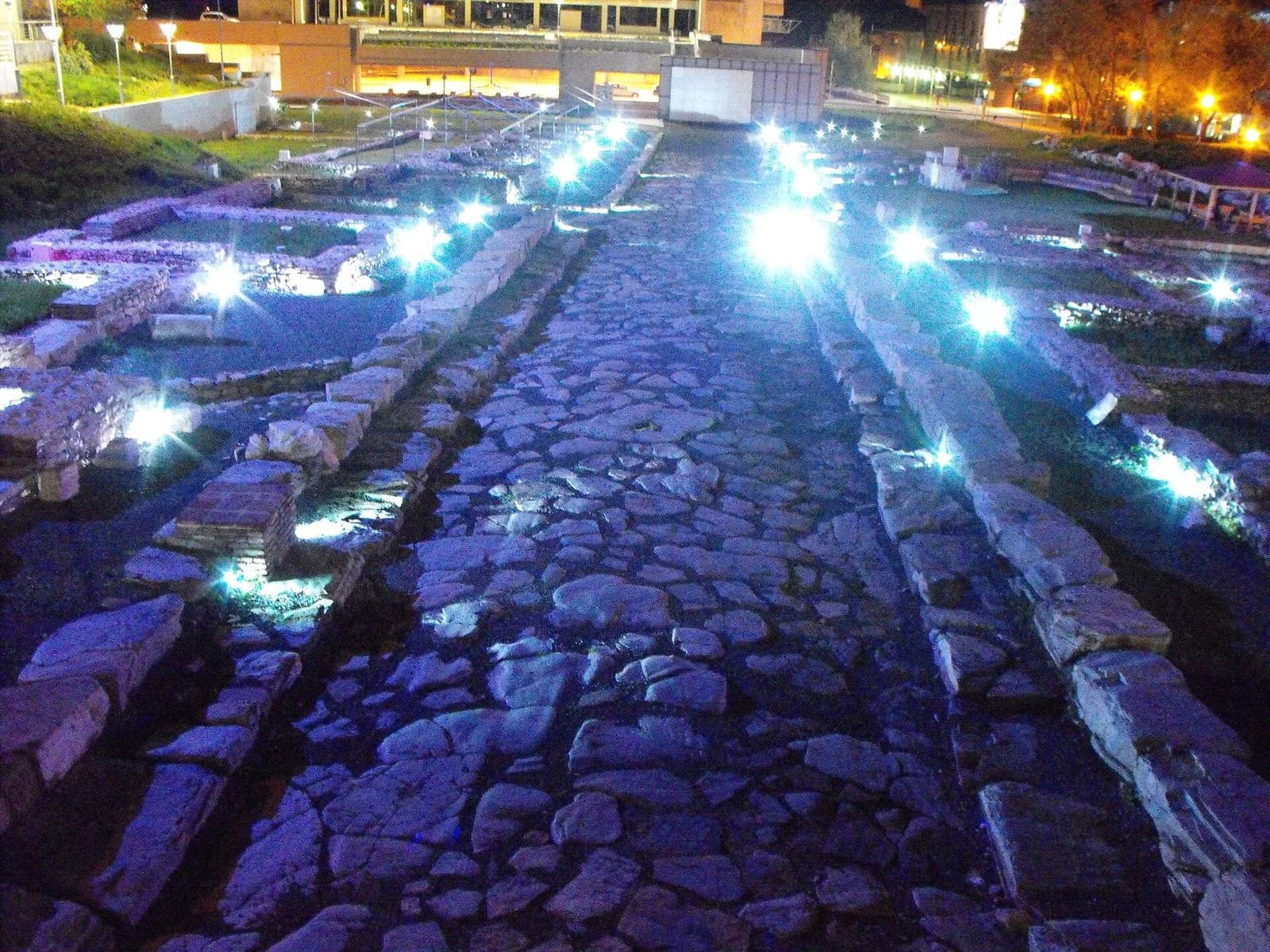
The hourglass-shaped Regional History Museum opened on 3 March 2009 directly over a stretch of the cardo maximus, a main street of Roman Augusta Traiana, and openings between its floors let you look down on the paving from the galleries (Ministry of Tourism). Its collection of about 100,000 objects runs from the sixth millennium BC to the rebuilding of the town after the war of 1877-1878. Look for a bone idol and a marble figurine of the fifth millennium BC, Sarmatian weapons, gold jewellery, glass vessels with figured decoration, marble sculpture of Orpheus, Thracian Horseman reliefs and the stone lioness and cub, the city's heraldic symbol.
The Augusta Traiana forum
In the city centre, the open-air forum complex covers about seven decares. Trajan founded Augusta Traiana around 106-107 AD and it flourished in the second and third centuries. You can see the Western Gate and part of the decumanus maximus, a stone-paved square with the pedestal of a statue, baths, sections of the fortress wall and a curved auditorium that seated more than 1,300 people (forum complex). Entry is free, and the auditorium is still used for concerts and performances. Guided talks can be booked through the museum on +359 42 919 214.
The Museum of Religions
The 15th-century Eski Mosque on Pazarska Street stands on top of a remarkable stack of sacred sites: an Early Iron Age cult pit of the eighth to sixth century BC, a sanctuary of the Thracian Horseman from the second and third centuries AD, and a medieval Christian cemetery church of the tenth to thirteenth century. All are displayed inside the mosque, which was restored in 2011 and whose wall paintings are protected in their own right (Museum of Religions). Allow half an hour to see one spot reused for worship across nearly three thousand years.
The Geo Milev House
The museum opened in 1953 in the childhood home of Georgi Kasabov, who wrote as Geo Milev. Three rooms are restored as they looked in the early 20th century, an exhibition hall was added in the 1970s, and the archive holds his manuscripts, letters, drawings and much of his multilingual library. In the yard grows the oak he planted himself, now a protected natural landmark (Municipality of Stara Zagora).
Chirpan: Yavorov's birthplace
West of Stara Zagora, the poet Peyo Yavorov's family home in Chirpan has been open since 31 October 1954. The kitchen, guest room and "Peyo's room" keep the family's belongings, and an exhibition hall added in 1973 follows his life from a Chirpan childhood and schooling in Plovdiv to work as a telegraph operator, the Misal literary circle in Sofia, the Macedonian revolutionary movement and his relationships with Mina Todorova and Lora Karavelova (museum history). The complex at 26 Kracholovi Street also includes the Nikola Manev Art Gallery and an open-air stage (Municipality of Chirpan).
Yambol and the ancient city of Kabile
Kabile, 8 km north-west of Yambol, was one of the largest cities of ancient Thrace from the fourth century BC (Tundzha Municipality). Because no modern village was built on top, the reserve spreads over more than 600 decares of open ground, under excavation since 1972 (Kabile reserve). On Zaychi Vrah, the hill above the site, is a rock sanctuary of Cybele and Artemis. Below it lie Hellenistic walls and gates of the fourth to second century BC, a Roman military camp of the second to fourth century with barracks and public buildings, a bath with underfloor heating and two early Christian basilicas with colourful floor mosaics. Start in the on-site museum, with more than 900 square metres of displays, to get the sequence straight before you walk. Wear good shoes and bring water in summer: it is an exposed site.
In Yambol itself, the Regional History Museum at 2 Byalo More Street covers what came before. Its prehistory collection includes a horn sickle, a bearded male figurine, a clay model of a temple and a stone sceptre in the shape of an animal, as well as finds from a fully excavated house at the village of Drama that yielded more than 240 vessels, tools, figurines and amulets (prehistory department). It opens on weekdays only, so on a weekend go straight to Kabile.
Haskovo and the Alexandrovo tomb
Haskovo's Regional History Museum on Freedom Square is the place for archaeology and the region's longer story, with separate collections for archaeology, ethnography and modern history (about the museum). For domestic life, its branch at Paskaleva House is better: a two-storey Revival house of the mid-19th century whose kitchen, dining room, salon, women's room and dressing room show a prosperous family moving from rural to urban ways, with Viennese furniture, a Russian samovar, an iron bed, local rugs and a round kyoshk (Urban Life exhibition).
The highlight of the area, though, is the painted tomb near the village of Alexandrovo. It was found in December 2000 in the Roshavata Chuka mound and dates from the fourth century BC (tomb overview). Visitors see the paintings in the museum centre beside the mound, opened in 2009, which has a full-size replica of the architecture and murals, with a break in the low corridor to make access easier (the replica). In the round chamber, two of six painted bands carry figures: riders and men on foot fighting and hunting, and a funeral feast. Look closely at the tunics, spears, swords and harness, which tell researchers a great deal about Thracian arms and horsemanship (the murals). The name of the man buried here is unknown. The centre also shows 98 gold appliqués from the Sakar hills that it presents as among the oldest worked gold in the world (BTA directory).
Dimitrovgrad and the Kasnakovo sanctuary
Dimitrovgrad is a 20th-century city, formed in 1947 by joining the villages of Rakovski, Mariyno and Chernokonevo. Its History Museum on Sv. Kliment Ohridski Street tells that story well. The Brigade Movement room shows the tools, maps, photographs, flags and awards of the youth brigades whose labour built the new city (brigade exhibition), and the city room adds household objects from the old villages, the book that proposed the city's name, a brick from the fertiliser plant and a miner's carbide lamp (city exhibition).
Two branches stand on D. Blagoev Boulevard. Penyo Penev's former apartment at number 9 keeps more than 1,300 items, among them manuscripts, letters and recordings of the poet reading his work, and the Petko Churculiev Gallery at number 7 holds 35 paintings by Churculiev, a collection of theatre posters and Nedko Solakov's conceptual "Card Index" of 1988 (sites; art collection).
Outside the city, the Sanctuary of the Nymphs and Aphrodite lies 500 metres north-east of the village of Kasnakovo. An inscription above the central spring records that Titus Flavius and his wife Claudia Montana built and dedicated it to the Nymphs and Aphrodite on their Roman estate in the second to fourth century. The site has parking, a small information centre and picnic areas, and people still gather here on Ascension Day (sanctuary).
Harmanli and Mezek
In Harmanli, the History Museum occupies the old post office, built around 1884 to a design by Pietro Montani, chief architect of Eastern Rumelia. Its exhibitions cover the railway station and the town's growth "from palanka to town", and the stone Humpback Bridge of 1585, restored in 2021, stands nearby (museum history; exhibitions). It is a short stop on the way south-east.
Near the border town of Svilengrad, the tomb at Mezek is the opposite of Alexandrovo: no paintings, but you walk inside the real thing. Villagers found it in 1931 under a mound 14 to 15 metres high and 90 metres across. A corridor more than 20 metres long leads through two rectangular chambers into a round room under a beehive dome, the whole about 31 metres long and built of cut blocks joined with iron cramps. Its gold, bronze and glass finds are in museums in Haskovo, Sofia and Istanbul. The tomb is open all year with a paid entry (Ministry of Tourism). For another painted tomb with a replica, compare Kazanlak in our Rose Valley guide.
Suggested plans
One day in Stara Zagora. Neolithic Dwellings at opening time, the Regional History Museum before lunch, then the forum and the Museum of Religions. Add the Geo Milev House late in the afternoon.
Two days. Stara Zagora on day one. On day two drive to Haskovo for the Alexandrovo centre in the morning, then Dimitrovgrad's museum and Kasnakovo in the afternoon. Or, from Stara Zagora, go east to Kabile and Yambol instead.
Three days. Add the south-east loop: Harmanli and Mezek, with the Haskovo museum on the way. Chirpan fits on any day travelling between Plovdiv and Stara Zagora.
When to go. Spring and autumn are the most comfortable seasons for the open sites at Kabile and the forum. In winter several museums close on Sundays and Mondays and Kabile shuts at 15:30, so plan weekday visits.
Practical details
Getting there. Stara Zagora is about 230 km from Sofia, close to the Trakia motorway, and Yambol lies further east along it. Haskovo, Dimitrovgrad and Harmanli sit beside the Maritsa motorway towards Turkey. All the main towns have rail and coach links, but Kabile, Alexandrovo, Kasnakovo and Mezek are much easier by car. Without a car, see our public transport guide.
Hours and adult prices below were checked on 8 October 2026.
| Site | Opening hours | Adult ticket |
|---|---|---|
| Regional History Museum, Stara Zagora | Tue-Sun 10:00-18:00, tickets to 17:30 (contacts) | €3.50 (fees) |
| Neolithic Dwellings, Stara Zagora | 10:00-12:30 and 13:00-18:00; Tue-Sat Oct-Mar, Tue-Sun Apr-Sep | €3.50 |
| Museum of Religions, Stara Zagora | 10:00-18:00; Tue-Sat Oct-Mar, Tue-Sun Apr-Sep | €2 |
| Augusta Traiana forum | Open-air | Free |
| Geo Milev House | Oct-May Mon-Sat 09:00-17:30; Jun-Sep daily 09:30-18:00 (contacts) | On site |
| Yavorov House, Chirpan | Mon-Fri 08:00-17:00, Sat-Sun 09:00-16:00 | On site |
| Kabile reserve | Daily; Nov-Mar 09:00-15:30, Apr-Oct 08:00-18:30 (visitor information) | €3 |
| Regional History Museum, Yambol | Mon-Fri 08:00-12:00 and 13:00-17:00; weekends on request (visitor information) | €3 |
| Regional History Museum, Haskovo | Nov-Mar Tue-Fri 09:00-17:00, Sat 10:00-16:00; Apr-Oct Tue-Fri 09:00-17:30, Sat 09:00-17:00 (visit) | €3.50; branches such as Paskaleva House €2 |
| Alexandrovo museum centre | Daily 08:00-18:00 since 1 August 2026 (schedule) | €4 |
| History Museum, Dimitrovgrad | Mon-Fri 09:30-18:00, weekends 09:00-12:30 and 13:00-17:30 until 1 Nov; from 2 Nov Mon-Fri 09:30-17:00, Sat 10:00-16:00; closed the last Friday of each month (sites) | On site |
| Penyo Penev House and Churculiev Gallery | Tue-Fri 10:00-12:30 and 14:00-18:00, Sat 10:00-12:30 and 13:00-18:00 | On site |
| Kasnakovo sanctuary | Tue-Sat 09:00-17:00 | On site |
| History Museum, Harmanli | Mon-Fri 08:00-17:00, lunch 12:00-13:00 (municipality) | On site |
| Mezek tomb | Year-round | Paid entry |
Smaller museums here keep weekday hours and close for lunch, so ring ahead if you plan a weekend or a single site anchors the day.
Sources & further reading
- Neolithic Dwellings Museum - Regional History Museum Stara Zagora
- Stara Zagora Regional History Museum - Ministry of Tourism of Bulgaria
- Museum contacts and exhibition hours - Regional History Museum Stara Zagora
- Museum services and admission fees - Regional History Museum Stara Zagora
- Antique forum complex of Augusta Traiana - Stara Zagora municipal tourism portal
- Architectural complex Museum of Religions - Regional History Museum Stara Zagora
- Geo Milev House Museum - Municipality of Stara Zagora
- Geo Milev House Museum - contacts - Geo Milev House Museum
- History of the Yavorov House Museum - Peyo Yavorov House Museum, Chirpan
- Museum complex P. K. Yavorov House Museum and Nikola Manev Art Gallery - Municipality of Chirpan
- National Archaeological Reserve Kabile - Tundzha Municipality
- Kabile Archaeological Reserve - Regional History Museum Yambol
- Kabile visitor information - Regional History Museum Yambol
- Prehistory department - Regional History Museum Yambol
- Yambol museum visitor information - Regional History Museum Yambol
- About the museum - Haskovo Regional History Museum
- Urban life from the post-Liberation period - Haskovo Regional History Museum
- Visit - Haskovo Regional History Museum
- Alexandrovo tomb overview - Alexandrovo Museum Centre
- The replica - Alexandrovo Museum Centre
- The murals - Alexandrovo Museum Centre
- Museum Centre for Thracian Art, Alexandrovo - Bulgarian News Agency museum directory
- From 1 August 2026 the Thracian Art museum centre moves to a seven-day schedule - Haskovo Tourist Information Centre
- Historical Museum Dimitrovgrad - sites and hours - Historical Museum Dimitrovgrad
- Brigade Movement exhibition - Historical Museum Dimitrovgrad
- Dimitrovgrad exhibition - Historical Museum Dimitrovgrad
- Art department and collections - Historical Museum Dimitrovgrad
- Sanctuary of the Nymphs and Aphrodite - Historical Museum Dimitrovgrad
- Harmanli Museum - building history - Harmanli Historical Museum
- Harmanli Museum - modern history exhibitions - Harmanli Historical Museum
- Historical Museum Harmanli - Harmanli Municipality
- Mezek Thracian Tomb - Ministry of Tourism of Bulgaria
Tags
- Stara Zagora
- Augusta Traiana
- Haskovo
- Yambol
- Kabile
- Thracian tombs
- Dimitrovgrad
- Upper Thracian Plain